Christmas Small Space Decor Ideas on a Budget: 18 Big-Festive Looks for Tiny Homes
Living in a small apartment or a tiny home does not mean skipping Christmas. It means decorating smarter — trading the seven-foot tree for a wall of lights, the overflowing mantel for one well-styled shelf, and the houseful of decor for a few high-impact pieces that earn their footprint.
Honestly? Small spaces are easier to make cozy than big ones. Every light shows up more, every branch reads bolder, and nothing gets lost in a corner you never sit in. One strand of warm fairy lights does more in a 400-square-foot apartment than three strands do in a suburban great room.
This guide has 18 renter-friendly, small-space Christmas decor ideas, all on a budget. Most cost under $15, and the whole room can come together for under $50. Nothing requires nails, holes, or landlord approval.
Quick-Start: Pick Your Budget Tier
$0 — Rearrange and forage. You already own more Christmas than you think: last year’s ornaments, a fairy-light strand, pinecones from a walk, a red throw, a candle. Paper snowflakes cost nothing and fill a window in ten minutes.
$10–$20 — The light layer. One warm-white fairy-light strand ($5–$8) and one small bag of pinecones or faux berry stems ($4–$8). Lights alone make a small space feel like Christmas — this tier is the single best value in this guide.
$25–$40 — The tree + shelf. A slim pencil tree or tabletop tree ($12–$20) plus a mini garland for the shelf or doorway ($8–$12). You now have a real tree footprint without giving up floor space.
$45–$55 — The full small room. Add battery LED candles ($8–$12), velvet pillow covers for the couch ($6–$10), and a wreath for the front door (~$12–$18). Tree, lights, textiles, door — the complete apartment formula.
The Tree Question: Space-Saving Tree Alternatives
In a small space, the tree is the biggest decision and the biggest footprint. Full-size trees eat 9–12 square feet. Every idea below gives you the tree moment at a fraction of that.
1. Hang a flat wall tree — $3–$10
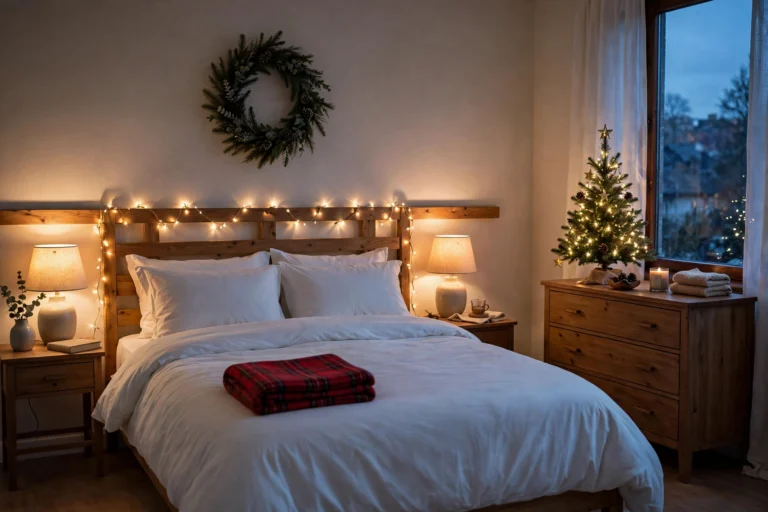
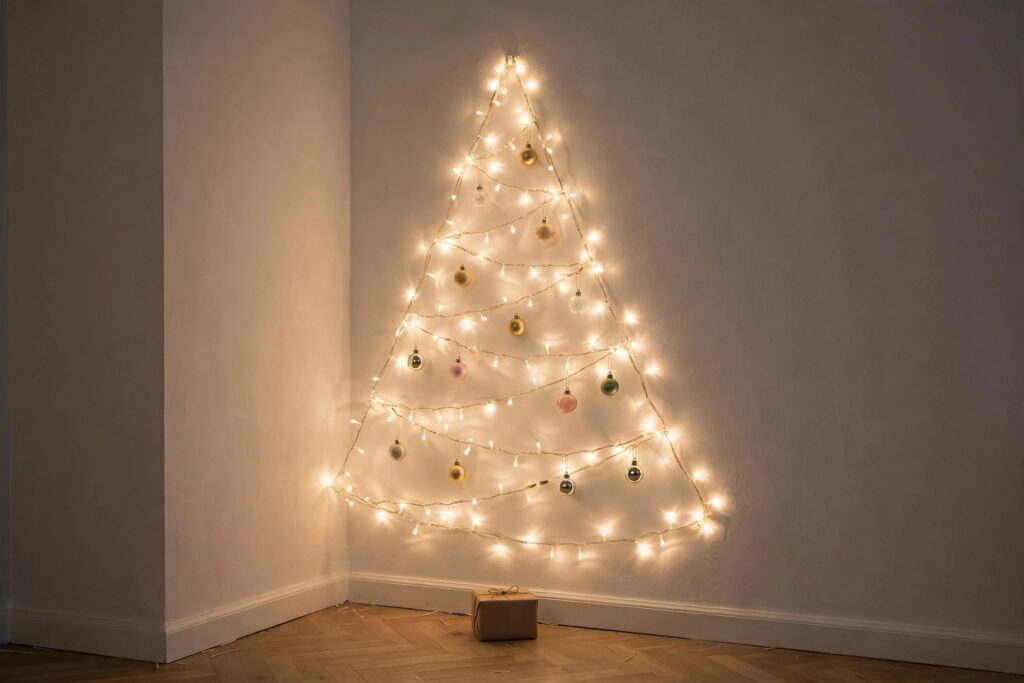
The ultimate small-space tree: a tree shape made of warm fairy lights taped or hooked to the wall in a triangle, with a few lightweight ornaments hanging from the strand. Takes zero floor space, comes down with zero damage (use removable hooks), and looks genuinely magical at night.
Quick tip: Map the triangle with painter’s tape first, then lay the light strand over it. Keep ornaments under an inch and featherweight — shatterproof plastic only.
Do this: Warm-white lights on a light-colored wall; the glow is the whole look.
Skip this: Multicolor lights for a wall tree — in a small room the color reflections multiply and it reads as chaos.
2. Tuck a slim pencil tree in a corner — $15–$35
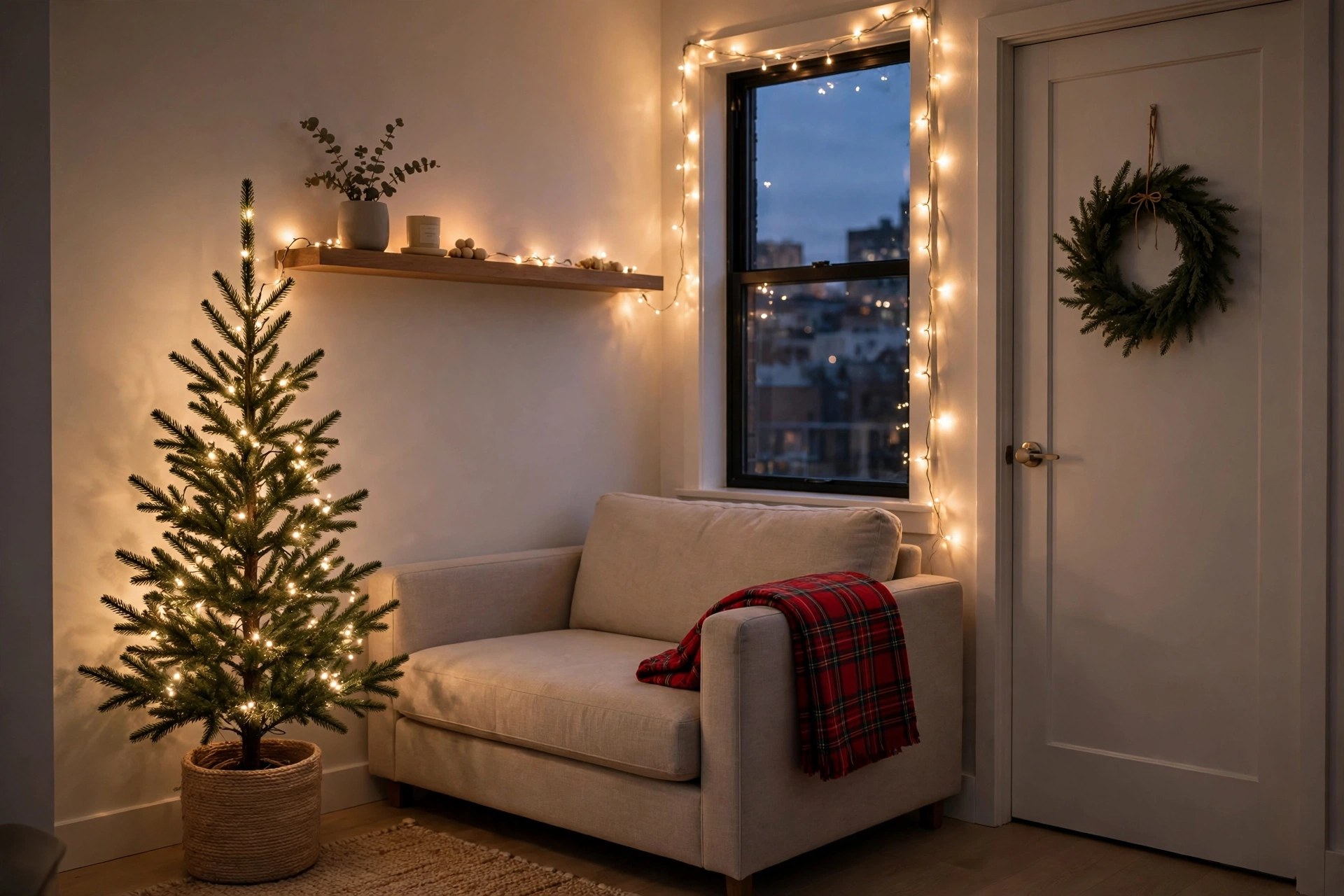
Pencil trees are 18–24 inches wide instead of 48 — they fit in corners, beside the door, even next to the TV stand. A 4-foot pre-lit pencil tree ($20–$35) or an unlit one plus your own strand ($15–$25) gives you a real, full-height tree in two square feet.
Do this: Push it into the deepest corner and let the room breathe around it; keep ornaments small and restrained.
Skip this: A wide 6-foot pencil tree in a studio — it stops being a pencil tree and starts being a hallway blocker.
3. Cluster three mini tabletop trees on a shelf — $8–$20
Three 12–18 inch mini trees grouped on a bookshelf, credenza, or dresser read as one intentional display and cost a fraction of a floor tree. Plain green mini trees run $3–$8 each; add a tiny strand of lights woven through the group ($5).
Do this: Vary the heights (books underneath one) and keep all three the same finish — all green, or all frosted.
4. Turn a step ladder into a tree — $0–$12
A wooden step ladder you already own becomes a tree: drape garland or a light strand around the rails, hang ornaments from the rungs, and put a small star or bow on top. It stores flat in January and costs nothing if you own the ladder.
Quick tip: Lean it in a corner and treat each rung as a shelf — tiny framed ornaments and pinecones on the steps, lights spiraling up the sides.
Do this: Match the ladder to your decor — natural wood for rustic rooms, painted white for modern ones.
Skip this: A rickety ladder. It holds ornaments for six weeks; make sure it stands solidly first.
5. Style a branch in a tall vase — $0–$8
One good bare branch in a floor vase, wrapped in fairy lights and hung with five or six ornaments. It is the most minimalist Christmas tree possible, it takes one square foot, and a branch from a walk is free. Spray-paint it white or gold (~$5) for a Scandinavian feel.
Do this: Choose a branch with strong side limbs — the silhouette is the decoration.
Skip this: Overloading it. Six ornaments on a branch; ten on a pencil tree. Restraint is the aesthetic.
Go Vertical: Decorate Up, Not Out
Floor space is sacred in a small home. Walls, shelves, doors, and windows are free real estate — and vertical decor draws the eye upward, making the room feel taller.
6. Swag a garland over one doorway — $8–$15
One evergreen garland across a single doorway arch transforms the whole room’s sightline. Faux cedar or pine garlands (~$8–$15 for 6 feet) hang from removable hooks with zero damage. Fluff it hard — thin garland is the difference between “decorated” and “sad vine.”
Quick tip: Two cheap garlands twisted together look fuller than one expensive one and usually cost less.
Do this: Pick your most-seen doorway — the one you walk through ten times a day.
Skip this: Garlanding every doorway in a studio. One strong moment beats three thin ones.
7. Hang a mini garland along a floating shelf — $5–$10
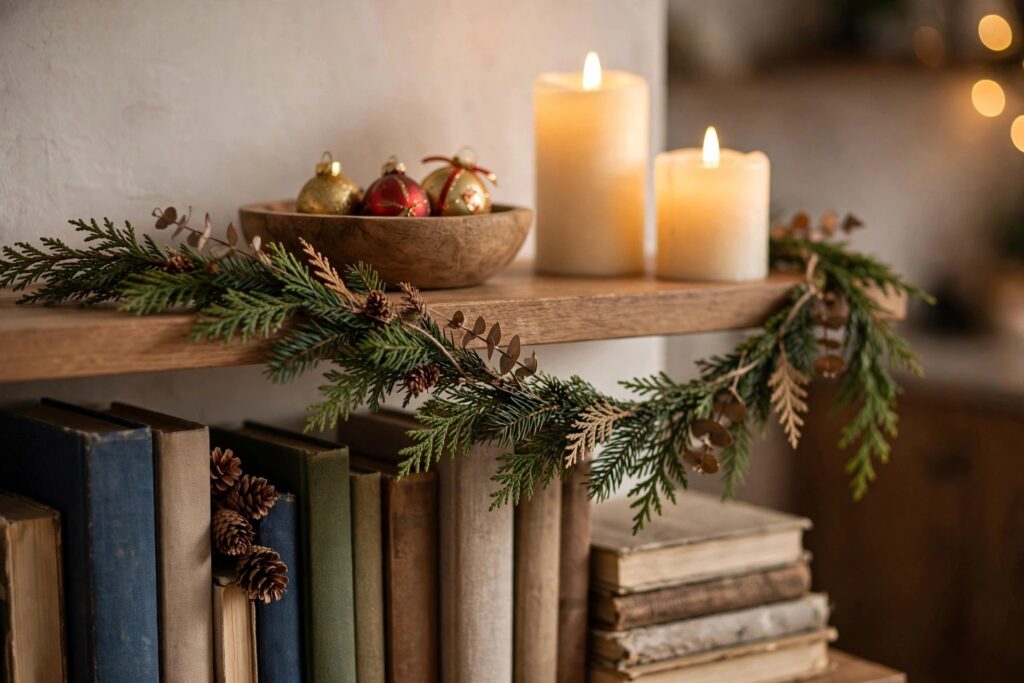
The small-space answer to the mantel garland: a 3-foot mini garland draped along the front edge of a bookshelf or floating shelf, with a few ornaments nestled in it. It frames the shelf you already have and turns everyday storage into a display.
Do this: Let the garland dip slightly between two removable hooks for that professional swag curve.
Skip this: A garland so thick it hides the shelf’s contents. Thin is fine here — it is jewelry, not furniture.
8. Put mini wreaths on cabinet doors — $8–$16
A tiny 8–10 inch wreath on each kitchen cabinet door is one of the most-photographed small-space Christmas tricks, and it works: repetitive, rhythmic, zero floor space. Plain mini wreaths ($2–$4 each) plus ribbon to hang them from removable hooks ($4 for the ribbon).
Quick tip: Hang them all at the exact same height with the same ribbon length. The uniformity is what makes it look designed.
Do this: Two to four cabinets — the ones you see from the living area.
Skip this: Wreaths on cabinets you open constantly. They will annoy you by December 3rd.
9. Frame a window with string lights — $5–$10
Outlining one window with warm string lights gives you the cozy glow of a decorated room from one strand. Use removable clips around the window frame, and let the lights be visible from the street too — instant curb appeal for renters.
Do this: Warm white, steady glow, one window — the biggest window in the room.
Skip this: Twinkle-only strands as the sole lights in a small room; they are lovely for ten minutes and distracting for a month.
10. Add removable window decals — $4–$8
Snowflake and star decals on the window or sliding glass door add daytime Christmas interest where lights only work at night. Static-cling versions peel off in January with no residue — truly renter-safe. A sheet of 20–40 decals runs ~$4–$8.
Quick tip: Place them asymmetrically — a cluster in one upper corner looks artful; a grid looks like a classroom.
Do this: White or frosted decals on dark window frames for contrast.
Skip this: Decals on windows you need to see through clearly. Keep one pane clear.
Surface Styling: Small Vignettes, Big Impact
In a tiny home, every surface is visible all the time. Three well-styled square feet beat thirty random ones.
11. Build one tray vignette for the coffee table — $8–$18
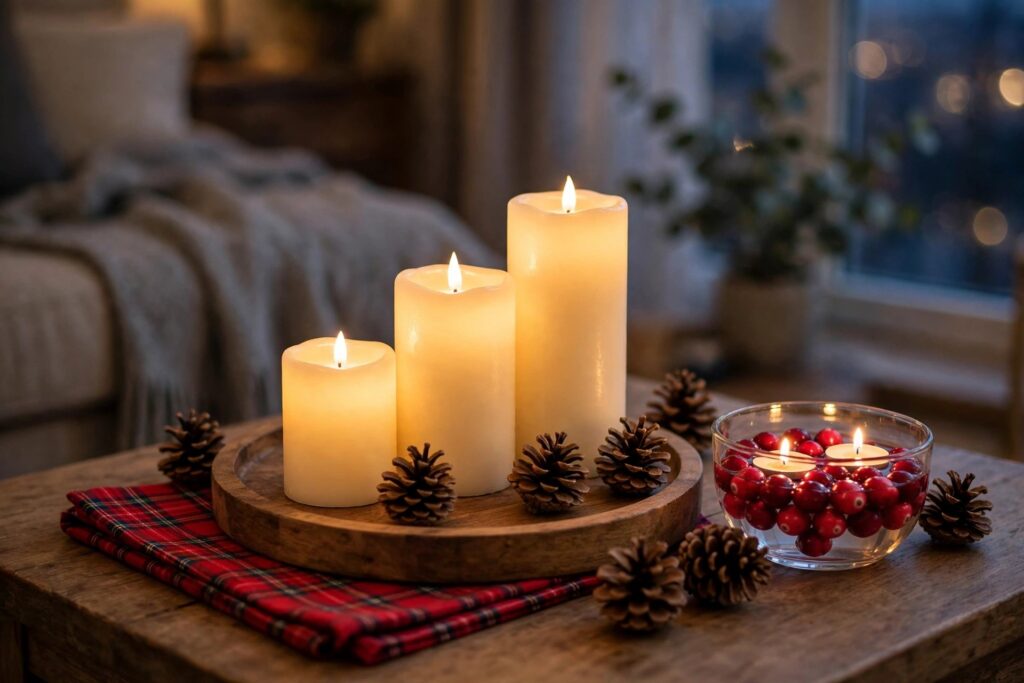
A single tray on the coffee table holds your whole Christmas: three LED pillar candles in ascending heights (~$8–$12 for a set), a few pinecones, and a small bowl of cranberries or ornaments. It is contained, it moves in one lift when you need the table, and it photographs beautifully.
Do this: Keep everything inside the tray’s edges — containment is what makes a small vignette read as intentional.
Skip this: Real candles on a small coffee table in a small room. LED flames have come far, and the fire math is not in your favor here.
12. Style the bookshelf like a mantel — $5–$12
No fireplace? Your tallest bookshelf is your mantel. Clear the top shelf, lay a small garland or eucalyptus stems along it, add two battery candles and a few ornaments between the books. The vertical rhythm of books + greenery + glow reads as a designed display.
Quick tip: Group your Christmas items in odd numbers — three ornaments, five pinecones — and leave breathing room between groups.
Do this: Work with the shelf’s existing color story; do not fight your book spines.
Skip this: Moving your whole library for a month. Style around the books, not instead of them.
13. Float cranberries and tea lights in a glass bowl — $3–$6
The cheapest centerpiece on this list: a clear glass bowl you own, water, a handful of fresh cranberries ($3), and two or three floating tea lights ($2). It takes five minutes, lasts a week before the cranberries need swapping, and glows like something far more expensive.
Do this: Use it on the dining table or entry console — anywhere guests see it first.
Skip this: Leaving the same water for two weeks. Change it weekly; cloudy water ruins the effect.
14. Coil a garland into a tabletop wreath — $6–$10
No wall space for a wreath? Coil a cheap faux garland into a flat circle on the dining table, set a candle cluster or a small ornament in the center, and you have a centerpiece with zero hanging required. One 6-foot garland (~$6–$10) makes a generous table wreath.
Do this: Tuck pinecones and a few ornaments into the coil so it reads as full from above.
Skip this: Making it wider than half your table — you still need room for dinner.
Textiles and Scent: The Cozy Layer
Decor fills the eyes; textiles and scent fill the feeling. In a small space these do disproportionate work because there is nowhere for the coziness to dissipate.
15. Swap in velvet pillow covers — $6–$14
Two velvet or flannel pillow covers (~$3–$7 each) over your existing couch pillows instantly seasonal-ize the seating area. Deep red, forest green, or cream — envelope-style covers that store flat in January.
Do this: One patterned cover plus one solid. In a small room, two pillows is the whole look.
Skip this: Buying whole new pillows. Covers only — your storage closet will thank you.
16. Drape one plaid throw over the couch arm — $8–$18
A single plaid throw folded over the armrest or back of the couch is the fastest Christmas signal in interior design. Discount stores stock them from October (~$8–$15); thrift stores often have them for $4–$8.
Quick tip: Fold in thirds lengthwise for a neat band — the styled look, not the tossed look.
Do this: Red, green, or black-and-white buffalo check against neutral upholstery.
Skip this: A throw plus a matching blanket plus a matching runner. One plaid moment per room.
17. Simmer a Christmas-scented pot — $2–$5
Orange slices, cinnamon sticks, cloves, and a sprig of pine simmered in water on the stove makes a 400-square-foot apartment smell like a Christmas cabin in twenty minutes. The ingredients cost ~$2–$5 and the pot can be refreshed for days.
18. Hang stockings on a bookshelf, not a mantel — $5–$15
Stockings need a ledge, not a fireplace. Hang them from a bookshelf edge, a floating shelf, or a tension rod inside a window frame with removable hooks. Small knit stockings (~$3–$5 each) look better in a small room than full-size ones anyway — scale matters.
Do this: Hang them at slightly varied heights for a natural, collected look.
Skip this: Heavy stocking holders on a shelf edge. They are designed for mantels and will pull a light shelf forward.
The One Rule of Small-Space Christmas
If an idea needs floor space, it loses to the idea that needs wall space. If it needs storage in January, it loses to the one that stores flat. And if you are choosing between five small things and one good thing — lights, a slim tree, a tray vignette — pick the one good thing. Small rooms forgive a lot, but they never forgive clutter.
Start tonight with the lights: one warm-white strand on your biggest window takes ten minutes and about $6. Tomorrow, the wall tree or the shelf garland. By the weekend your tiny home will feel like the coziest place on the block — and your January self, facing zero storage bins, will be grateful.
Frequently Asked Questions
How can I decorate a small apartment for Christmas on a budget?
Focus on high-impact, low-footprint ideas: one warm-white light strand ($6), a wall tree or slim pencil tree ($15–$25), a tray vignette for the table ($10), and one textile swap like a plaid throw ($10). Under $50 total covers the whole room, and nothing needs floor space or landlord permission.
What is the best Christmas tree for a small apartment?
A 4-foot slim pencil tree for corners ($20–$35 pre-lit) is the closest to a real tree experience. For zero floor space, a flat wall tree made of fairy lights ($3–$10) or three mini tabletop trees grouped on a shelf (~$8–$20) both look intentional and festive.
How do I hang Christmas decorations in a rental without damage?
Removable adhesive hooks, removable clips, tension rods inside window frames, painter’s tape for light strands, and static-cling window decals. Everything on this list is designed to come down in January with no holes, no residue, and your full deposit intact.
How do I make a small living room feel Christmassy without clutter?
Decorate vertically (walls, shelves, windows, doors) instead of horizontally, stick to one cohesive color palette of two to three colors, and contain tabletop decor to a single tray. One well-styled vignette beats five scattered decorations in a small room.
When should I start decorating a small apartment for Christmas?
The day after Thanksgiving is the traditional start, but small spaces take so little time that the weekend after works fine. Buy lights and mini trees in early November before the best budget stock sells out — discount stores restock less often as December approaches.