Budget Lighting Ideas: 17 Ways to Light Your Home Beautifully for Under $50
Budget Lighting Ideas: 17 Ways to Light Your Home Beautifully for Under $50
Lighting is the fastest way to make a home look expensive on a budget. You can paint the walls, rearrange the furniture, and buy all the throw pillows you want — but one harsh overhead light will undo all of it in a second. Flip that around: warm, layered light makes even bargain furniture look intentional.
The good news is that lighting is one of the cheapest rooms-in-your-home upgrades there is. Most of the ideas in this guide cost under $25, several cost nothing, and none require an electrician. We are talking bulb swaps, lamp placement tricks, DIY shades, and renter-friendly fixtures that leave no holes.
This guide has 17 budget lighting ideas for every room, with honest USD cost bands, quick tips, and do/skip guidance so you spend on what actually shows up.
Quick-Start: Pick Your Budget Tier
$0 — The free layer. Swap every cool-white bulb you own to warm (more below), turn off the big overhead light, and rearrange lamps you already have into corners and beside seating. Free, and it changes the room tonight.
$10–$25 — The warm-up. One warm LED bulb 4-pack ($8–$12) plus one battery puck-light 3-pack ($10–$15). Under-cabinet glow, closet light, and warm tone everywhere — the single best value in this guide.
$25–$50 — The fixture swap. A thrifted lamp base ($8–$15) with a new drum shade ($12–$18), or a plug-in pendant kit with a woven shade (~$25–$40). You now have a real “designed” light moment.
$50–$75 — The layered room. Add an arched or tripod floor lamp from a discount store (~$35–$55) to the tiers above. Overhead lights stay off permanently — the room is fully lamp-lit.
The Warmth Layer: Bulbs and Placement
Before buying a single fixture, fix the light you already have. Bulb temperature and lamp placement do more than any new purchase.
1. Swap every bulb to 2700K warm white — $8–$14
The cheapest transformation in home decor: replace cool-white (4000K–5000K) bulbs with warm-white 2700K LEDs. Cool light makes a room feel like an office; warm light makes wood look richer, skin look better, and everything feel expensive. A 4-pack of dimmable 2700K LED bulbs runs ~$8–$14 and covers most of a living room.
Quick tip: Buy “dimmable” even if you have no dimmer — they work in regular sockets and give you options later.
Do this: 2700K in living areas and bedrooms, where you relax.
Skip this: Warm bulbs over a desk or kitchen task zone — 3000K is better where you actually need to see detail.
2. Kill the overhead and go lamp-only in the evening — $0
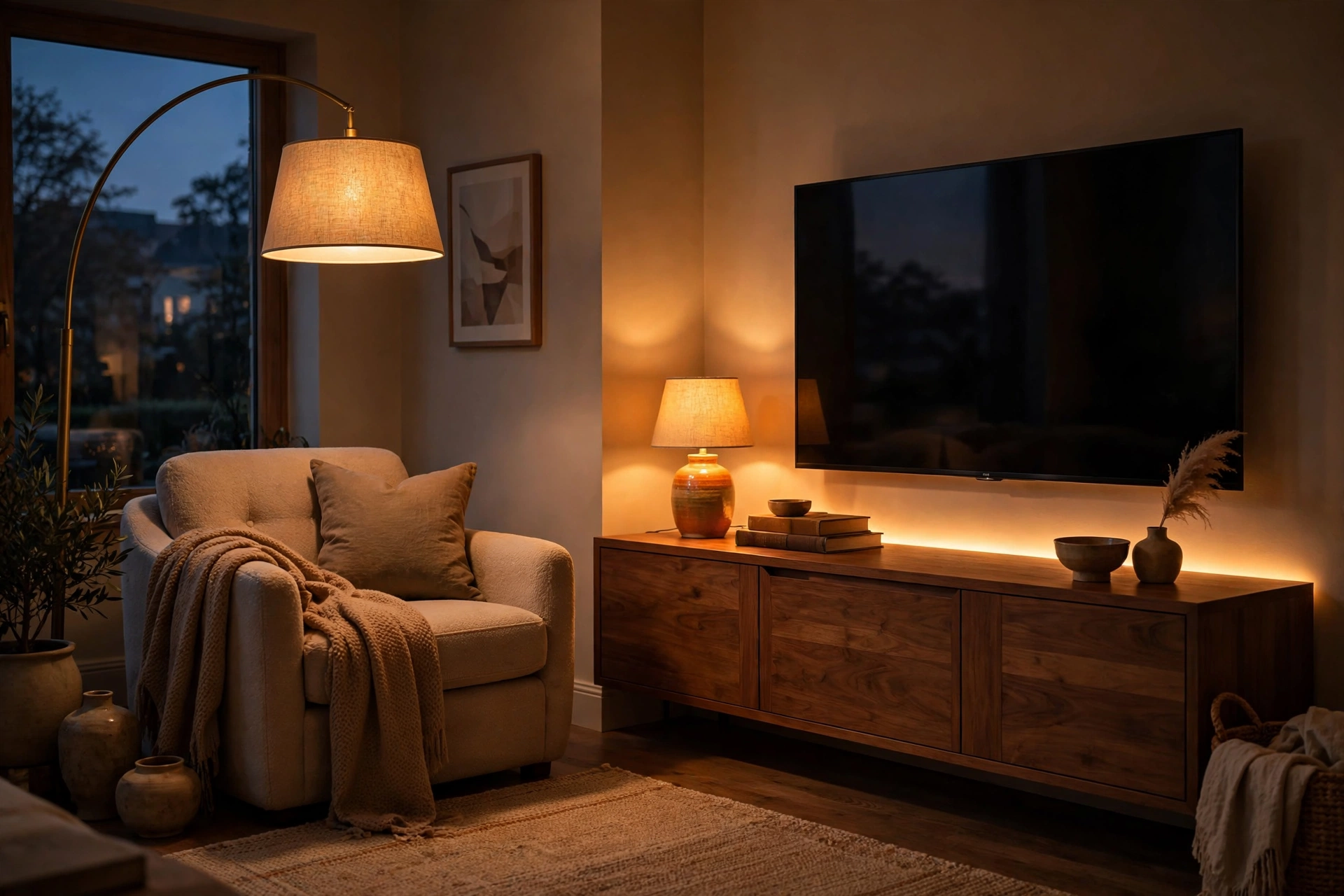
The “big light” — that single ceiling fixture blasting down from the middle of the room — is the enemy of coziness. Try one week of evenings with the overhead off and two or three lamps on instead. Corners glow, shadows get soft, and the room suddenly has depth. It costs nothing and most people never go back.
Do this: Put lamps at different heights — a floor lamp, a table lamp, one low accent — for layered light.
Skip this: One lone lamp in a big room. The rule is three light sources per room, minimum.
3. Put lamps in the corners, not against the walls — $0
A lamp pushed flat against a wall throws half its light into the drywall. Pull it 12–18 inches into the corner and it washes two walls with glow, making the room feel bigger. This works with floor lamps, table lamps on side tables, even a candle cluster. Zero dollars, noticeably brighter-feeling room.
Quick tip: Corners are where rooms go dark first — lighting them is the fastest way to make a space feel finished.
4. Add a dimmer plug to any lamp — $10–$15
No rewiring needed: a plug-in lamp dimmer (~$10–$15) sits between the lamp cord and the outlet and gives you a slide or remote dimmer on any standard lamp. Dimmed lamps at 60% look like candlelight — this is the hotel-lobby trick, and it works on the cheapest lamp you own.
Do this: Dim every lamp in the living room and bedroom; full brightness is for cleaning, not relaxing.
Skip this: Non-dimmable bulbs with a dimmer — they flicker or buzz. Check the bulb box for “dimmable.”
5. Bounce light with a mirror behind a lamp — $0–$15
A mirror hung or leaned behind a table lamp doubles the perceived light — the lamp glows, the mirror reflects it, and the corner reads twice as bright. Thrift stores are full of mirrors for ~$5–$15, and leaning one on a console behind a lamp needs no hanging hardware at all.
Quick tip: This is also the best cheap trick for a dark hallway — mirror + small lamp = hallway that no longer feels like a tunnel.
DIY Fixtures and Shade Swaps
Shades and fixtures are where budget lighting starts looking designer. The base can be thrifted; the shade is what people see.
6. Turn a basket into a pendant shade — $20–$35
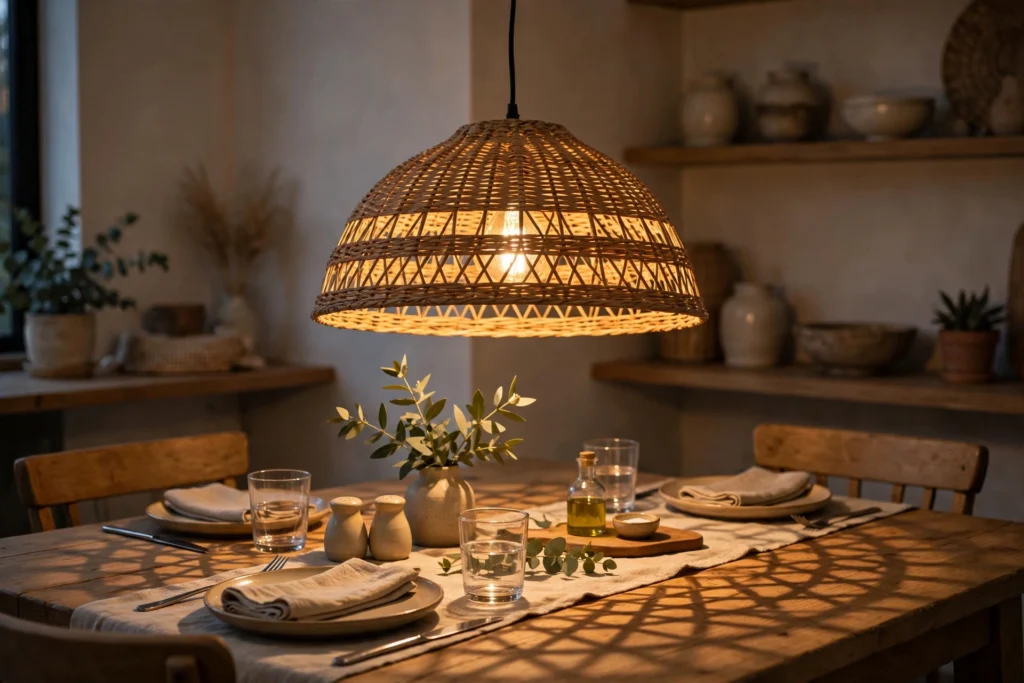
A woven basket with the bottom cut out, hung from a plug-in pendant cord kit (~$15–$20 for the kit, ~$5–$15 for the basket), makes a pendant light that looks straight out of a boutique hotel. Rattan, seagrass, and wire baskets all work — the woven texture throws gorgeous patterned shadows.
Quick tip: Use an LED bulb (they run cool) — never an old incandescent in a basket shade.
Do this: Hang it low over a dining table or reading chair — 28–34 inches above the table surface.
Skip this: A basket with a tight weave and a bright bulb — too little light escapes. Open weaves glow best.
7. Give a thrifted lamp a new shade — $18–$30
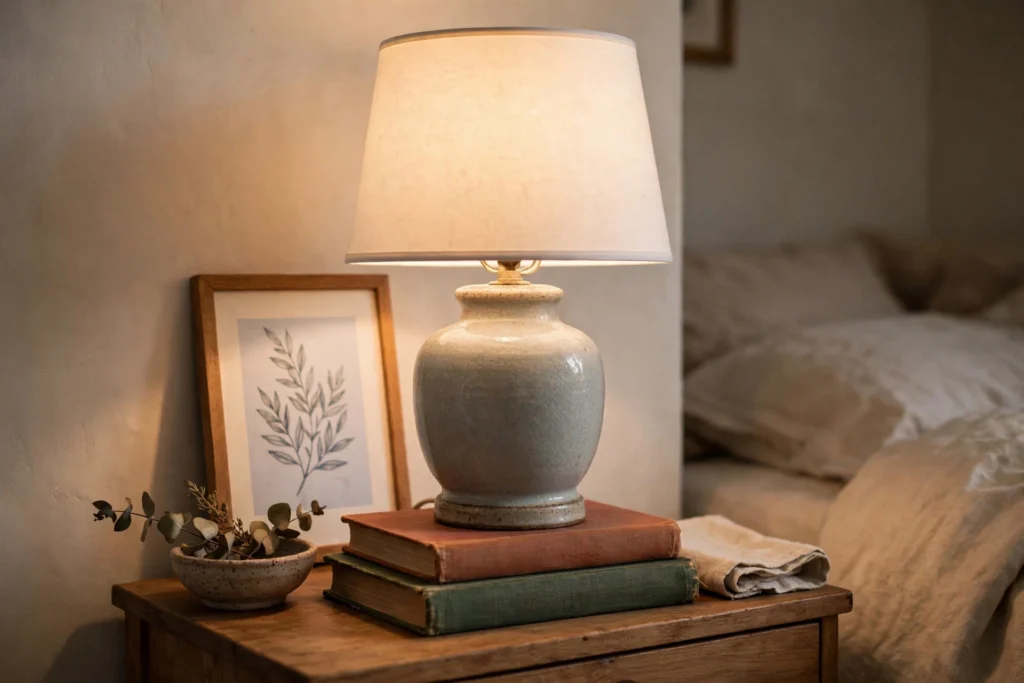
Thrift stores sell solid lamp bases for $5–$15 (ceramic, brass, and wood ones hide among the ugly ones). Skip the dusty old shade and buy a new white or linen drum shade ($12–$18). New shade + old base = a lamp that looks $80, for under $30. Spray-paint the base if the finish is dated — matte black or brass-gold spray paint (~$6) works miracles.
Do this: Match the shade size to the base — the shade’s bottom diameter should be within 2 inches of the base’s widest point.
Skip this: A shade smaller than the base. It looks like a hat that doesn’t fit.
8. Wrap a plain shade in fabric or ribbon — $5–$12
A boring white drum shade becomes custom with a glue gun and fabric: wrap it in linen, burlap, or even a patterned tea towel ($5–$12 in fabric). Ribbon trim around the top and bottom edges ($3) hides the raw edges and looks tailored. Fifteen minutes, no sewing.
Quick tip: Fabric spray adhesive gives a smoother finish than a glue gun for the big wrap; save the glue gun for the trim.
9. Make a paper lantern cluster — $12–$20
Three to five round paper lanterns ($2–$4 each) hung at staggered heights from one ceiling point reads as a real chandelier — this is a classic stylist trick for dining rooms and bedrooms. Use a multi-socket pendant adapter ($8) on one cord kit so all five run from a single plug or ceiling canopy.
Do this: Vary the sizes (8″, 10″, 12″) and hang them 6–10 inches apart in height.
Skip this: Colored lanterns in a neutral room — white or natural rice-paper keeps it timeless.
10. Spray-paint dated fixtures instead of replacing them — $6–$12
That shiny brass 90s chandelier or the chrome bathroom bar light? A can of matte black or brushed-nickel spray paint (~$6–$12) and an afternoon turns it current. Remove the fixture (or mask carefully in place), clean with degreaser, prime, and do light coats. This is a $10 alternative to a $150 replacement.
Quick tip: Painter’s tape over the sockets and a drop cloth underneath — overspray is the only real risk here.
Renter-Friendly Lighting: No Wiring, No Holes
Renters can have great lighting too. Everything in this section comes down cleanly and needs no electrician.
11. Stick battery puck lights under cabinets — $10–$18
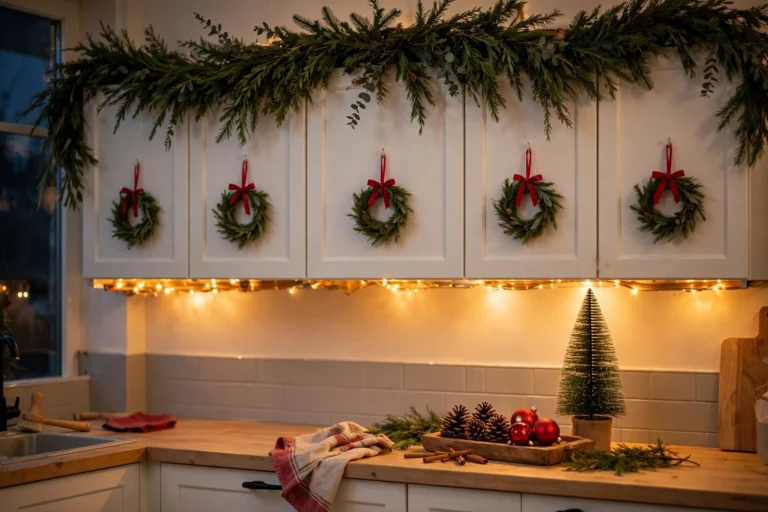
A 3-pack of battery puck lights (~$10–$18) with adhesive backing goes under kitchen cabinets, inside closets, and under bookshelves in minutes. The under-cabinet glow makes a kitchen look renovated at night — it is the highest-impact $15 in this entire guide. Look for tap-on or remote-control versions so you are not fumbling for switches.
Do this: Warm white (3000K) pucks in the kitchen — cool-white ones make food look unappetizing.
Skip this: Pucks as your only kitchen light — they are accent glow, not task lighting.
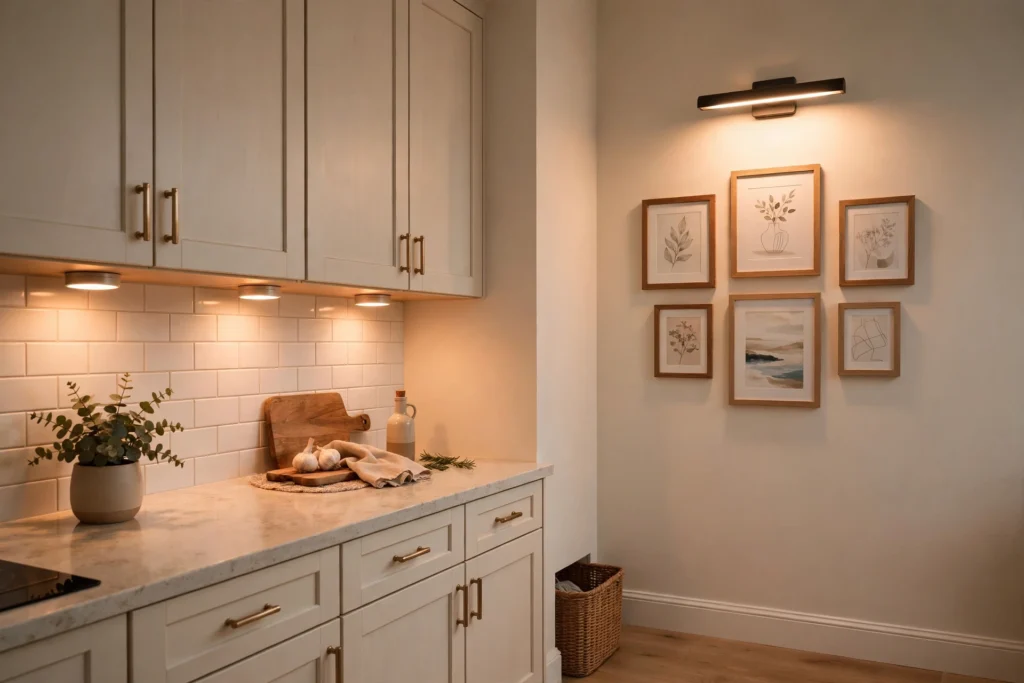
12. Hang plug-in sconces beside the bed — $25–$45
Wall sconces without wiring: plug-in sconces (~$25–$45 each) mount with two small screws or heavy-duty adhesive strips and run a slim cord down to the outlet (hide it with a cord cover, ~$8 for a pack). Flanking the bed with sconces frees the nightstands and looks like a hotel — a classic designer move for under $50 a side.
Quick tip: Cord covers painted the wall color disappear almost completely.
13. Swag a pendant from a hook — no ceiling wiring — $25–$40
No ceiling outlet? Hang a plug-in pendant cord from a ceiling hook ($3) and swag it across to the wall, down to an outlet — the draped cord is part of the look. A cord kit ($15–$20) plus a shade (~$10–$20) gives you a real pendant over a reading chair or dining table with zero electrical work.
Do this: Let the cord drape in a gentle curve — the swag is a style feature, not something to hide.
Skip this: Swagging across a walkway where heads meet cord. Keep it over furniture.
14. Light the closet and pantry for $12 — $10–$15
Motion-sensor LED bars (~$10–$15 for a 2-pack) stick inside closets, pantries, and under stairs with magnets or adhesive, and turn on when you open the door. It feels absurdly luxurious for twelve dollars — every closet becomes a boutique, and you stop losing things in the dark back corner.
Fix the Dark Room
Some rooms are just dark — north-facing, small windows, bad orientation. These ideas manufacture brightness without construction.
15. Layer three light types in a dark room — $20–$40
Dark rooms need all three layers: ambient (a floor lamp washing the ceiling, ~$25–$35), task (a table lamp by the reading spot), and accent (puck lights or a candle cluster on a shelf, ~$10). One overhead fixture can never fix a dark room; three small sources at different heights can. Bounce the floor lamp’s light off a white ceiling for maximum spread.
Quick tip: White or light lampshades throw more light into the room than dark ones — save the black shades for rooms that are already bright.
Do this: Aim at least one light upward — ceiling-bounced light fills a room more evenly than anything aimed down.
Skip this: A single bright bulb in the ceiling fixture. It creates harsh shadows and makes the darkness around it feel darker.
16. Use daylight bulbs strategically — $8–$12
Here is the exception to the warm-bulb rule: in a genuinely dark room used during the day — a home office, a craft corner — a 4000K–5000K daylight LED (~$8–$12 for a 4-pack) in one lamp mimics actual daylight and fights the cave feeling. Keep warm bulbs everywhere else; use daylight only where you work.
Do this: One daylight lamp at the desk, warm everywhere else in the room.
Skip this: Daylight bulbs in the bedroom or living room — they kill coziness fast.
17. Add LED strip glow behind furniture — $12–$20
A $12–$20 adhesive LED strip behind the TV console, under a floating shelf, or along the back of a headboard creates a halo of light that makes the wall — and the room — feel deeper. Warm white (2700K–3000K) only. Most strips are USB-powered or plug-in, cut to length, and peel-and-stick: fully renter-safe.
Quick tip: Behind the headboard is the sleeper hit — it makes the whole bedroom glow like a boutique hotel for fifteen dollars.
Do this: Hide the strip itself — you want to see the glow, never the dots.
Skip this: Color-changing RGB mode for everyday use. Fun for a party, tiring as a lifestyle.
Frequently Asked Questions
How many lamps does a living room actually need?
Three, minimum: a floor lamp for ambient light, a table lamp near seating for task light, and one accent — a small lamp, candle cluster, or LED strip — for depth. One overhead fixture plus zero lamps is why most living rooms feel flat.
What is the cheapest way to make a room look expensive with lighting?
Warm 2700K bulbs ($10 for a 4-pack) and turning off the overhead light. Under $15 total, and it outperforms any single fixture purchase. After that, a plug-in dimmer ($12) on your main lamp.
Are plug-in and battery lights actually bright enough?
For accent and mood lighting, yes. Battery pucks and LED strips are not task lighting — they will not light your desk for detailed work. Use them for glow (under cabinets, behind furniture, inside closets) and keep a real lamp where you read or work.
Can renters install sconces and pendants?
Yes — plug-in versions need no wiring. Sconces mount with adhesive strips or tiny screws (spackle fixes those for ~$4 at move-out), and swag pendants hang from a removable ceiling hook. Everything in the renter section of this guide leaves with you.
Do LED bulbs really save money?
A 9-watt LED gives the light of an old 60-watt bulb and lasts ~15,000 hours versus ~1,000. At average US electricity rates, swapping ten bulbs saves roughly $60–$80 a year — the bulbs pay for themselves in a few months.
All prices are typical US retail as of late 2026 — thrift stores, discount retailers, and sales will beat them. Start with the free layer tonight: warm bulbs in, overhead off, lamps in the corners.