19 Small Space Storage Ideas on a Budget That Actually Hide Clutter
Small rooms do not need more furniture. They need better decisions. The average one-bedroom apartment hides roughly 30% of its usable storage in places nobody thinks to look — the six inches under the bed, the backs of doors, the 12 inches of dead air above every doorway. The problem is not that you own too much stuff (though a declutter never hurts). The problem is that the stuff has nowhere to live.
The ideas in this guide go beyond “buy more bins”: under-bed storage, over-door organizers, vertical hacks, and renter-friendly fixes for the kitchen, bathroom, and closet. Every idea carries an honest USD cost band, and most come in under $40.
Quick-Start: Pick Your Budget Tier
$0–$15 — The free layer. Declutter one shelf, vacuum-pack off-season clothes in the bags you already own, move a bookshelf from a big room to a small one, and rearrange by frequency of use. Free, and you will feel the difference tonight.
$15–$40 — The workhorse tier. Under-bed bins, over-door organizers, tension rods, shelf risers, a picture ledge. This is the sweet spot — maximum square footage of storage per dollar.
$40–$100 — The furniture tier. Bed risers, a rolling cart, a narrow bookcase, a storage ottoman. One or two of these per room changes what the room can hold.
$100–$250 — The one-splurge tier. A tall narrow wardrobe, a storage bench, a loft-style shelf unit over a doorway. Still cheaper than moving to a bigger place.
Bedroom: Steal the Space You Are Already Sleeping On
1. Under-bed rolling bins — the single best dollar-per-cubic-foot buy in a small home — $20–$40
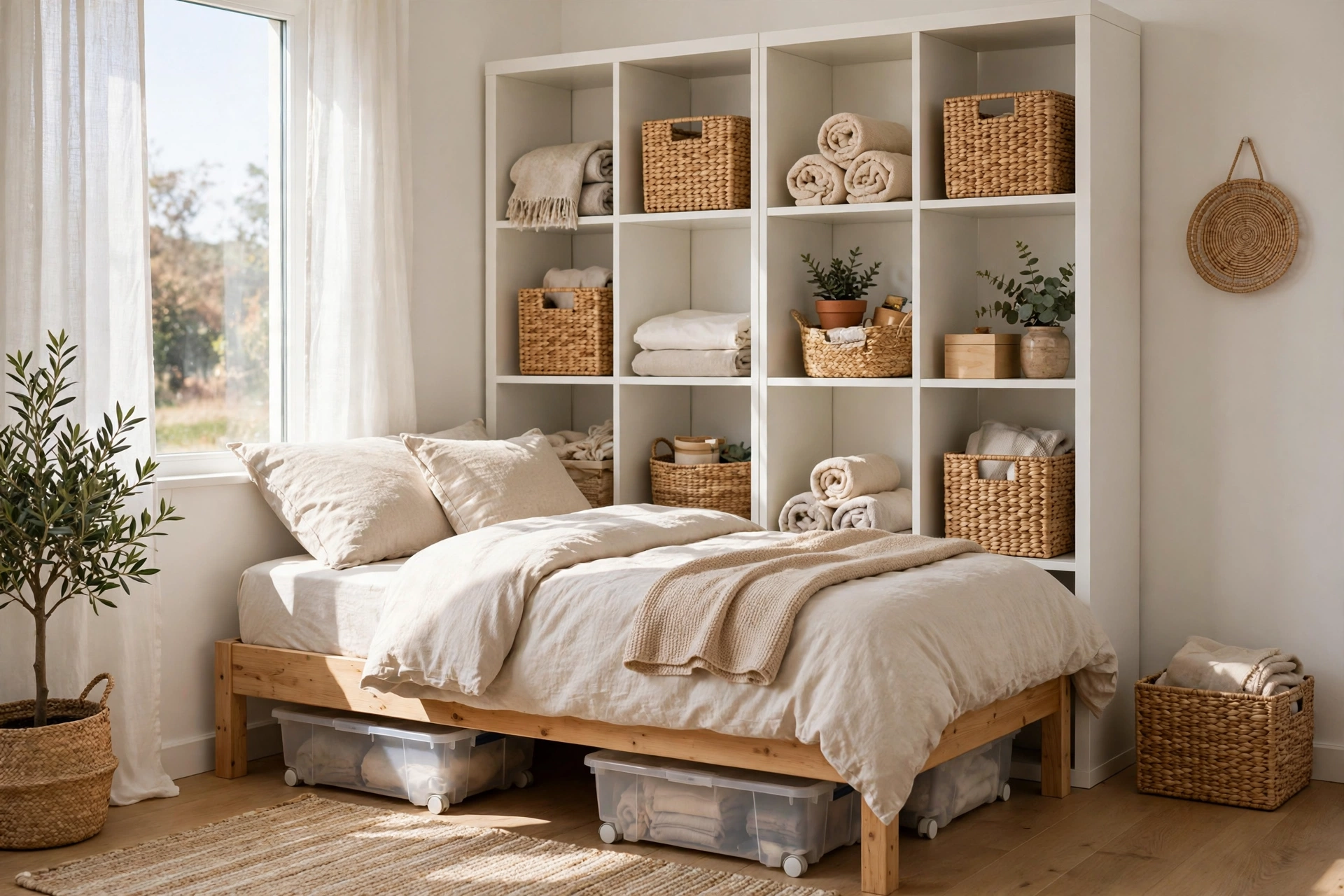
The space under a standard bed is roughly 60 x 80 inches of completely unused floor area. Flat rolling bins turn it into a dresser you never see. Buy the long, low ones (about 6 inches tall) so they actually slide under, and prefer sets with lids — dust is real under a bed.
Quick tip: Vacuum storage bags inside the bins double capacity again — bulky bedding compresses about 70%, so one bin can hold what used to fill two.
Do this: Measure the clearance under your bed before buying — platform beds can be too low for standard bins.
Skip this: Open baskets under the bed. They collect dust and read as clutter from across the room.
2. Bed risers — 6 extra inches of vertical clearance for $10–$25
If your bed sits too low for bins, risers lift the whole frame 5–8 inches in ten minutes, unlocking roughly 13 cubic feet of hidden storage.
Quick tip: Some risers ($25–$40) have built-in outlets and USB ports — they solve the “no outlet near the bed” problem in older apartments at the same time.
Do this: Check your frame’s weight rating — risers plus a mattress plus you is heavier than you think.
Skip this: Stacking two sets of risers. That is a wobble accident, not a solution.
3. An over-the-door shoe and accessory organizer — $10–$20
Over-door hanging organizers with clear pockets hold far more than shoes: scarves, belts, toiletries, cleaning supplies, craft materials, chargers. The hook-over design needs zero hardware, which is why renters love it.
Quick tip: Hang one inside a closet door for accessories and one inside the bathroom door for toiletries — the bathroom one replaces a shower caddy that keeps sliding off.
Do this: Put the organizer where you get dressed, not where it looks tidy.
Skip this: Overloading it past the hook’s weight rating — doors that do not close properly are a daily annoyance.
4. A wall-mounted picture ledge above the bed — $8–$15
Deep shelves invite piles; shallow ledges force editing. A 45-inch picture ledge (about $8–$15) above the bed holds paperbacks, a small clock, a framed photo, and a remote tray — replacing a nightstand in a bedroom that cannot fit one. Paint it your wall color and it reads as architecture instead of storage.
Quick tip: Mount it at sitting-reach height, roughly 48–52 inches from the floor, so you can grab a book without fully sitting up.
Do this: Keep it edited — ledge, not landfill. Four to six objects max.
Skip this: Mounting it directly over pillows without checking for studs or using proper anchors.
5. A tall narrow dresser instead of a wide one — $80–$150
Floor space is the scarce resource, not wall space. A 24-inch-wide, 5-drawer tall dresser holds nearly the same as a 48-inch-wide unit while freeing two feet of floor.
Quick tip: Check secondhand listings first — tall solid-wood dressers are the easiest used-furniture win, often $40–$80, because nobody wants to move them.
Do this: Anchor anything taller than 30 inches to the wall. Safety beats aesthetics.
Skip this: Buying a wide dresser “because it was on sale.” The floor it eats costs you more than it saves.
Entryway and Hallway: Give the Drop Zone a Real Home
6. A slim shoe-storage bench — $60–$120
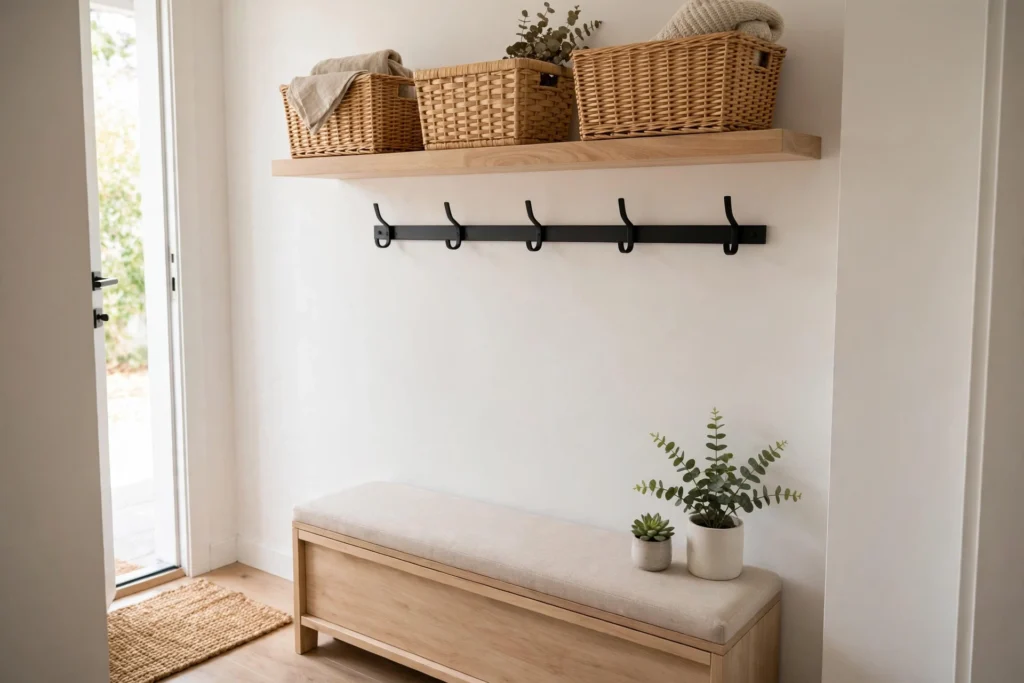
The entryway is the first 4 feet guests see and the first thing that clutters. A slim bench (about 30 inches wide, 12 inches deep) with a lidded top stores 6–8 pairs of shoes, gives you a seat to tie them, and holds keys and mail on top. Deep enough for shoes, narrow enough for a hallway.
Quick tip: Put a boot tray underneath for wet-weather shoes — $10–$15, and it saves the bench (and your deposit) from salt stains.
Do this: Keep the top surface to a small tray for keys and one decorative item — the bench is storage, not a junk shelf.
Skip this: The 18-inch-deep “storage bench” that narrows a 36-inch hallway to a pinch point.
7. A wall hook rail plus one floating shelf — $15–$30
A 30-inch rail with 5 hooks ($10–$18) handles coats, bags, and the tote you always forget. One floating shelf above it ($8–$12) holds a basket for sunglasses, sunscreen, and the mail. Together they replace a full hall tree for under $30 and take zero floor space.
Quick tip: Mount the rail at about 60 inches — high enough that bags do not drag the floor, low enough that shorter people can actually reach it.
Do this: One hook per person per season. When a hook is permanently buried, something above it needs to leave.
Skip this: Hooks on hollow-core doors — they strip out within months. Studs or proper wall anchors only.
8. An over-door rack for cleaning and utility supplies — $12–$20
Cleaning supplies live in a jumble under the sink in most small homes. Move them to an over-door wire rack on a utility closet or pantry door: sprays, sponges, cloths, and batteries all visible, all reachable, and the under-sink space goes back to what it should hold.
Quick tip: This works double-duty in a small bathroom — hang it inside the door for towels, toiletries, and hair tools.
Do this: Keep the heaviest bottles low on the rack so the door hangs straight.
Skip this: Wire racks on doors you slam. The rattle never stops and the hooks wear out.
Kitchen: Every Dead Zone Is a Cabinet
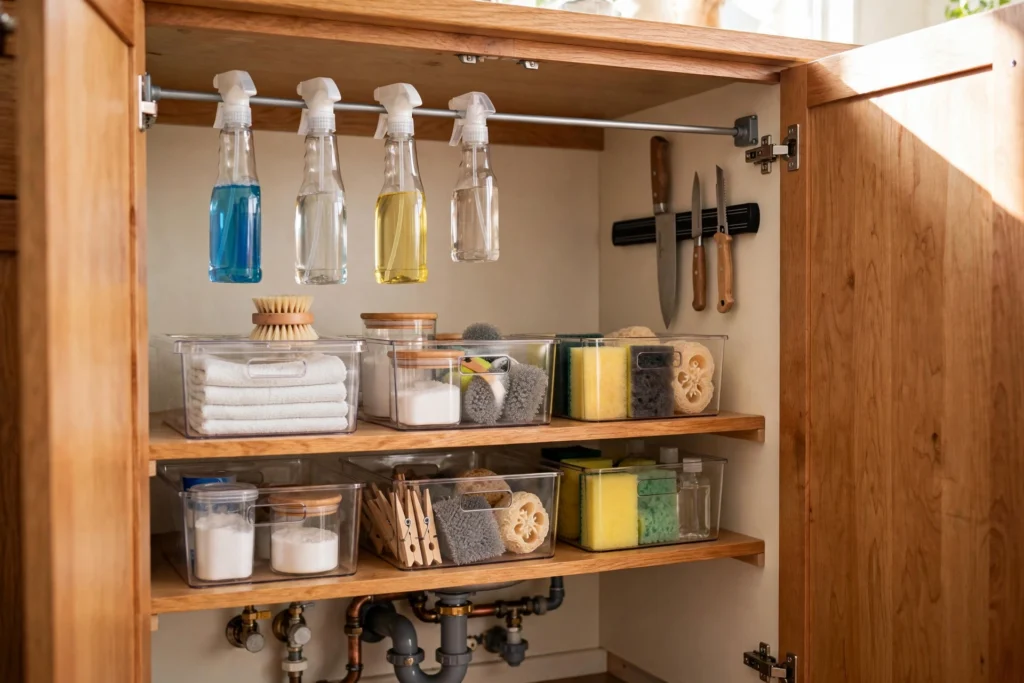
9. Under-sink tension rod — $8–$12, the cheapest kitchen upgrade that exists
A tension rod mounted across the under-sink cabinet, hung with spray bottles by their trigger handles, frees the entire cabinet floor for bins. No drilling, no tools, ten minutes. It is the highest return per dollar in this entire list.
Quick tip: Add a second rod lower down for dish towels and a small caddy — suddenly one cabinet holds three categories instead of one pile.
Do this: Measure the cabinet width and buy a rod rated slightly above it so it stays put.
Skip this: Hanging anything heavy enough to bend the rod — spray bottles, not full gallon jugs.
10. Magnetic knife strip and wall-mounted utensil bar — $15–$25
A magnetic knife strip ($15–$20) clears an entire knife block off the counter. Add a $5–$10 stainless rail with S-hooks for spatulas, ladles, and measuring cups, and a small kitchen gains back roughly two square feet of counter — the most valuable real estate in the room.
Quick tip: Some strips come with adhesive backing rated for tile, so even renters with a “no drilling” clause can use them. Check the rating against your wall texture — adhesive fails on textured surfaces.
Do this: Mount the strip at a height where the longest knife clears the counter below.
Skip this: Magnetic strips near the stove in tiny kitchens — heat and steam loosen adhesives and warp the mount.
11. Shelf risers and clear stackable bins in the pantry — $20–$35 total
Pantry shelves waste vertical space — cans are 4 inches tall on 12-inch shelves. Shelf risers ($10–$15 for a set) double the usable surface on each shelf. Clear stackable bins ($10–$20 for a set of 4) corral snacks and packets so nothing disappears behind anything.
Quick tip: Airtight containers for flour, rice, and cereal earn their cost twice — they replace bulky packaging AND keep pests out. Buy them after you have used the space for a month and know what actually needs decanting.
Do this: One category per bin, labeled. “Snacks,” “baking,” “backstock” — boring labels beat an exciting mess.
Skip this: Decanting everything on day one. It is a $100 commitment and half of it will not fit your actual habits.
12. A slim rolling cart for the dead gap — $40–$70
Almost every small kitchen has a 6–8-inch dead gap between the fridge and the counter, or between the counter and the wall. A slim rolling cart fills it exactly — spices, oils, canned goods, or cleaning supplies, pulled out only when needed. Freestanding, so renters can take it when they leave.
Quick tip: Measure the gap twice. These carts come in 5, 6, 7, and 8-inch widths, and a cart half an inch too wide is a decoration for the hallway.
Do this: Stock it by task — a coffee cart, a baking cart, a cleaning cart. One purpose per cart.
Skip this: Using it as overflow for things with no category. A cart of “miscellaneous” is just a junk drawer on wheels.
Living Room: Storage That Does Not Look Like Storage
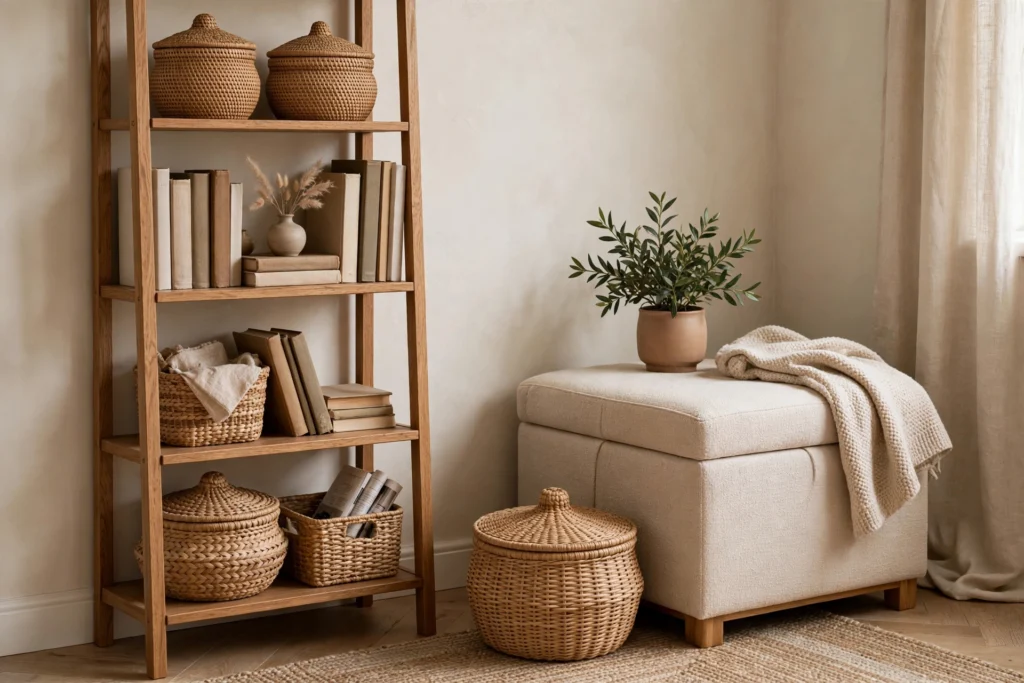
13. A storage ottoman — $40–$80
Blankets, board games, the charging cable graveyard — the ottoman swallows it all, gives you a footrest, and serves as emergency seating. Choose one with a reversible top so it doubles as a tray table.
Do this: Keep one category inside (blankets OR games, not both). Mixed interiors become the same junk drawer as the cart above.
Skip this: The giant square ottoman that blocks the only walking path. Measure your traffic lane first.
14. Tall narrow bookshelves flanking a doorway or window — $50–$90 each
Bookcases are usually bought wide and placed against the only long wall. Flip it: buy tall and narrow (about 24 inches wide) and flank a doorway or window where nothing else fits. Two of them hold more than one wide unit and make the room feel taller.
Quick tip: Fill the lower shelves with lidded baskets instead of books — baskets at floor level read as intentional; book spines at floor level read as overflow.
Do this: Keep the 60/30/10 rule in mind — baskets and closed boxes on at least half the shelves.
Skip this: Filling every shelf edge to edge. Leave some open stretches or the whole wall looks like a warehouse.
15. Baskets and bins in a single material — $20–$50 for a set
Five mismatched plastic bins read as clutter. Five matching seagrass or fabric bins read as design. Decant the visual chaos into one material — woven baskets for the living room, clear bins for the closet, matching fabric cubes for cube shelving — and the storage itself becomes the decor.
Quick tip: Buy one size that fits your shelves exactly, then buy more of it. Mixed sizes in one shelving unit are what make it look accidental.
Do this: One material per room. Living room = woven, bedroom = fabric cubes, pantry = clear plastic.
Skip this: Decorative baskets with no lid for anything you will not dust weekly. Open weave collects dust fast.
Closet and Bathroom: The Small Rooms That Carry the Load
16. A second closet rod — $15–$25, doubles hanging space in an hour
Most closets waste the bottom 3 feet. A second tension or screw-mounted rod at half height doubles hanging capacity — shirts and folded pants below, longer items on the original rod. Add a hanging shelf organizer ($12–$18) on one side for folded items and the closet suddenly works like a dresser too.
Quick tip: This is the move for shared closets: each person gets a rod. Arguments about closet space drop to zero.
Do this: Leave one section of the original rod full-length for dresses and coats.
Skip this: Double-rodding a closet you have not decluttered first. More rods for more stuff you do not wear is not organization.
17. Adhesive hooks and a wall-mounted dispenser in the bathroom — $10–$20
Tiny bathrooms cannot fit furniture, so the walls have to work. High-quality adhesive hooks ($8–$12 for a set) hold towels, robes, and the hair dryer. A wall-mounted three-chamber shower dispenser ($12–$18) replaces four bottles crowding the tub edge.
Quick tip: Prep the wall properly — clean with rubbing alcohol, press firmly, and wait 24 hours before hanging anything. Most adhesive-hook failures are prep failures, not product failures.
Do this: One hook per item, no doubling up. Two robes on one hook is how hooks end up on the floor.
Skip this: Cheap no-name adhesive strips for anything over a few ounces. They fail, and they take paint with them.
18. Vacuum storage bags for seasonal rotation — $12–$20 for a set of 8
Winter coats, heavy blankets, and off-season clothes eat closet space nine months a year. Vacuum bags compress them about 70% flat, and the flat slabs slide under beds, onto high closet shelves, or behind the sofa. Hand-pump versions need no vacuum cleaner.
Quick tip: Do the rotation twice a year — when the heat comes on, and when the AC does. Each rotation is a built-in declutter moment: if you forgot you owned it, you probably do not need it back.
Do this: Label every bag. “Winter sweaters — 2026” beats opening six bags in October.
Skip this: Storing anything with feathers or down compressed long-term without airing it out first — it needs a day to loft back.
19. The 60/30/10 audit — free, and the idea that makes the other 18 work — $0
Walk each room with this ratio: 60% of your storage closed (doors, lids, drawers), 30% open display (shelves you keep edited), 10% flexible (carts, trays, the “today” basket). When a room feels cluttered, it is almost always the ratio that is off — too much open storage, not enough closed. Fix the ratio before buying anything.
Quick tip: Photograph each room from the doorway. The camera is honest in a way your eyes are not — clutter you have stopped seeing will jump out in a photo.
FAQ
How much does it cost to organize a small apartment on a budget?
A single room typically runs $40–$100 if you stick to the workhorse tier — under-bed bins, over-door organizers, tension rods, shelf risers. A whole small apartment, done room by room over a few weekends, lands around $150–$300 total. Start with the room that bothers you most; the kitchen or bedroom usually gives the biggest relief per dollar.
What is the best storage for renters who cannot drill?
Over-door organizers, tension rods, rolling carts, freestanding shelves, adhesive hooks, and vacuum bags all need zero holes. The only rule: respect weight ratings, and prep walls properly for adhesive products (clean with rubbing alcohol, wait 24 hours). If your lease allows small holes, a single picture ledge or hook rail is worth the spackle at move-out.
What is the cheapest way to add storage to a small bedroom?
Under-bed rolling bins plus bed risers — about $30–$65 total for roughly 13 cubic feet of hidden storage, equivalent to a small dresser. It beats a dedicated storage bed ($300–$800) by an order of magnitude. If you already own a bed, bins and risers are the move.
How do I make a small room look bigger while adding storage?
Go vertical, keep the floor visible, and keep most storage closed. Tall narrow units make ceilings feel higher; under-bed bins and wall-mounted storage keep sightlines to the floor, which is what makes a room feel spacious. Match your storage materials (one basket type per room) so the storage reads as design.
Where should I start if my whole small home feels cluttered?
Declutter first, then audit. Walk each room and sort by frequency of use — daily items at hand height, weekly items on shelves, seasonal items up high or under the bed. The 60/30/10 ratio from idea #19 tells you what to buy: if your open shelves are overflowing, you need closed bins, not another shelf.
Nesting Ideas is reader-supported. When you buy through links on our site, we may earn a commission — it never changes what you pay, and it keeps the ideas coming.