17 Kitchen Sink Ideas for a Cleaner More Modern Kitchen
our kitchen sink gets used more than almost any other surface in the house. Dishes, produce, handwashing, coffee mugs, it never stops. Most people grab the cheapest option that fits the cabinet opening, then spend the next decade wishing they’d chosen differently. The sink sets the tone for the whole room. Get the material, shape, and faucet right, and everything around it looks more deliberate. Get it wrong, and even expensive countertops and cabinets look a little off.
These kitchen sink ideas cover every style, budget, and layout, from sleek double-bowl stainless in an open-plan kitchen to warmly aged copper over butcher block. Whether you’re doing a full renovation or simply swapping a worn basin, each idea here comes with sizing details, material specifics, and honest caveats. Because a gorgeous sink that’s miserable to use is not an upgrade. By the end you’ll know which basin depth fits the way you cook, which material matches the care you’ll actually give it, and which faucet ties the zone together instead of fighting it.
Quick Answer: Best Kitchen Sink Ideas by Style
The best kitchen sink ideas pair the way you cook with the way you want your kitchen to look. For most modern kitchens, a single-bowl undermount in stainless, composite granite, or fireclay gives you the most flexibility for the money. Match the faucet finish to at least one other metal already in the room, and the sink zone will look deliberate even on the messiest cooking day.
1. White Apron-Front Sink with Brass Bridge Faucet
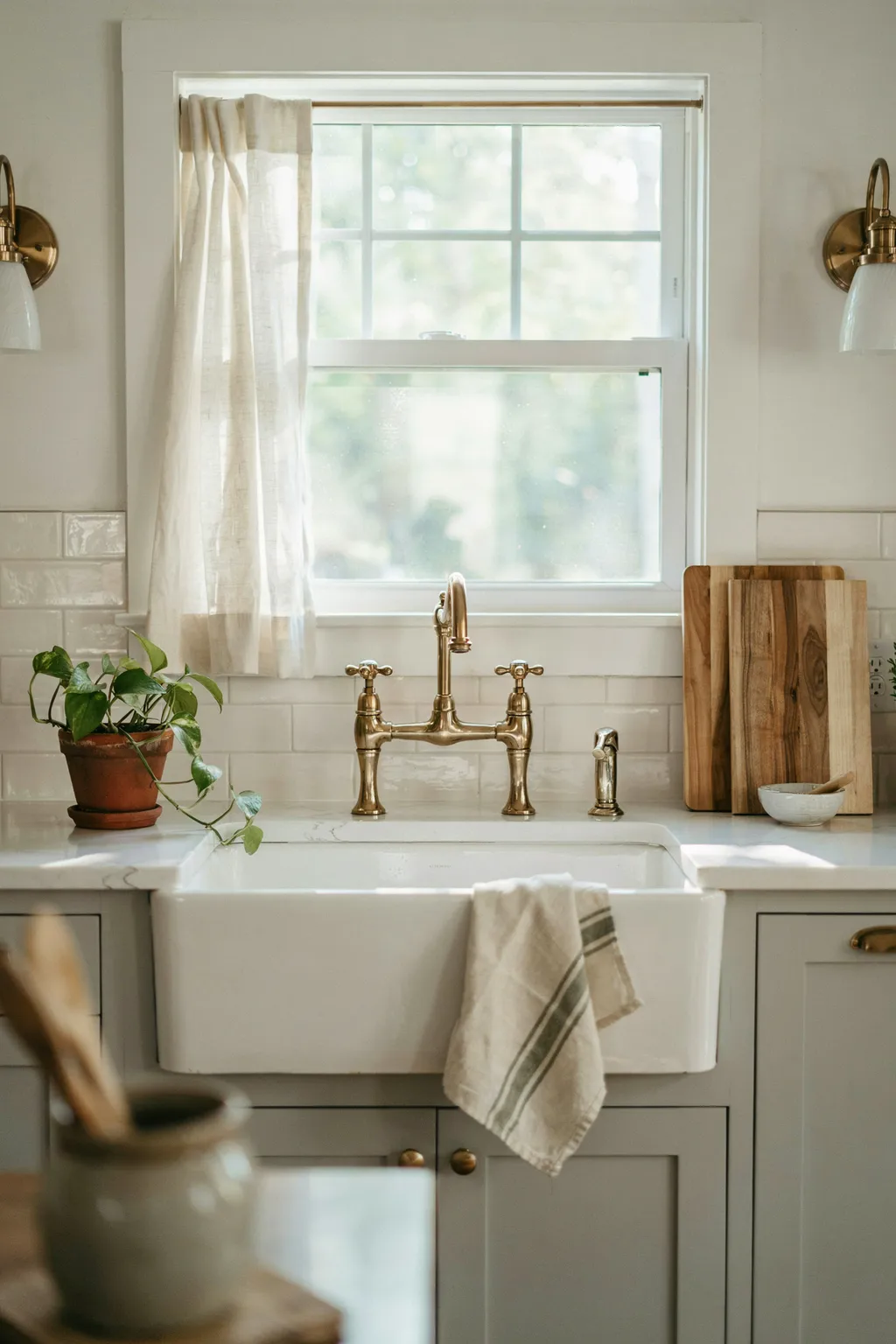
Few kitchen sink ideas have aged as gracefully as a white fireclay apron-front sink under a polished brass bridge faucet. The exposed front panel adds depth and visual weight to the base cabinet line, so the sink zone feels purposeful rather than purely functional. Against grey shaker cabinets and warm wood accents, it lands right at the intersection of classic and current. A bridge faucet, the two-column design joined by a horizontal connector bar, keeps hot and cold controls close and intuitive, and quality versions in unlacquered or living brass run $400 to $900. The finish patinas naturally to a richer, darker tone over months of use.
For the sink itself, fireclay is the gold standard. Fired above 1,800°F, it resists chipping and staining far better than cast iron porcelain at a similar price. Wall-mounted brass sconces flanking the window above add warmth without crowding the counter. This combination won’t suit a kitchen with high-gloss finishes or ultra-minimal hardware, where the warm metal reads too formal. In a transitional or farmhouse kitchen with mixed textures, though, it is nearly impossible to get wrong.
2. Double-Bowl Stainless Steel Undermount Sink
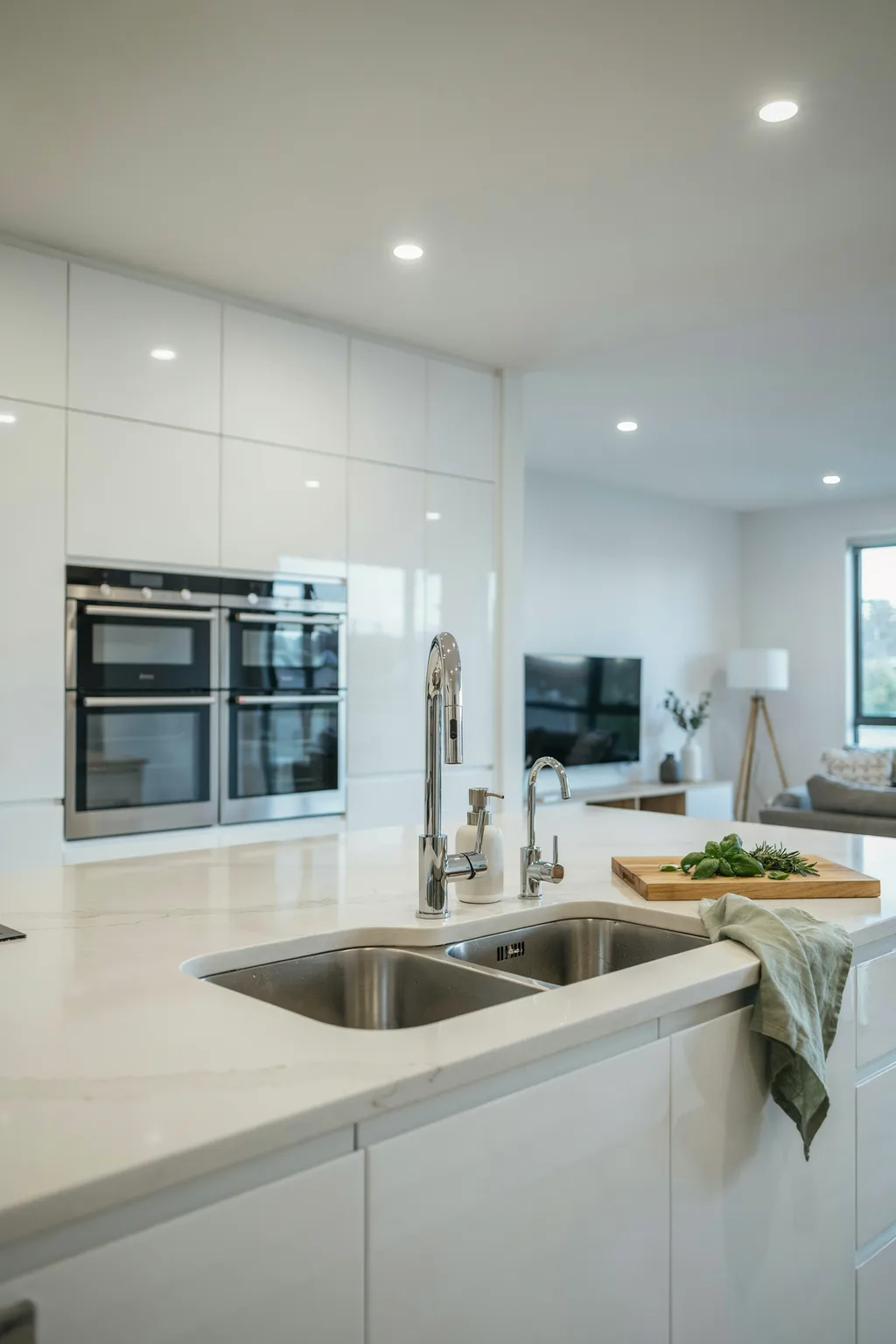
Double-bowl stainless steel undermount sinks are built for households that cook seriously. Two basins let you soak a cutting board on one side while rinsing vegetables on the other, or keep prep water completely separate from dirty dishes. The undermount installation sits flush beneath the stone countertop, so wiping crumbs straight into the basin takes one motion, with no rim lip to catch debris. Stainless in 16-gauge (lower gauge means thicker steel) shrugs off dents from heavy pots and suits contemporary and Scandinavian kitchens equally well.
A tall chrome pull-down faucet over a white quartz island earns its keep here, since the pull-down head reaches both basins and fills stock pots without repositioning. Add a smaller second faucet beside it, a filtered water tap or a dedicated spray, and a busy kitchen quickly learns to rely on that separation. Undermount installation needs a solid surface countertop and won’t work over laminate. It also won’t suit a compact kitchen, because double-bowl sinks typically run 32 to 36 inches wide, so a small layout loses more prep space than it gains in multitasking.
3. White Composite Undermount Sink on Marble Quartz
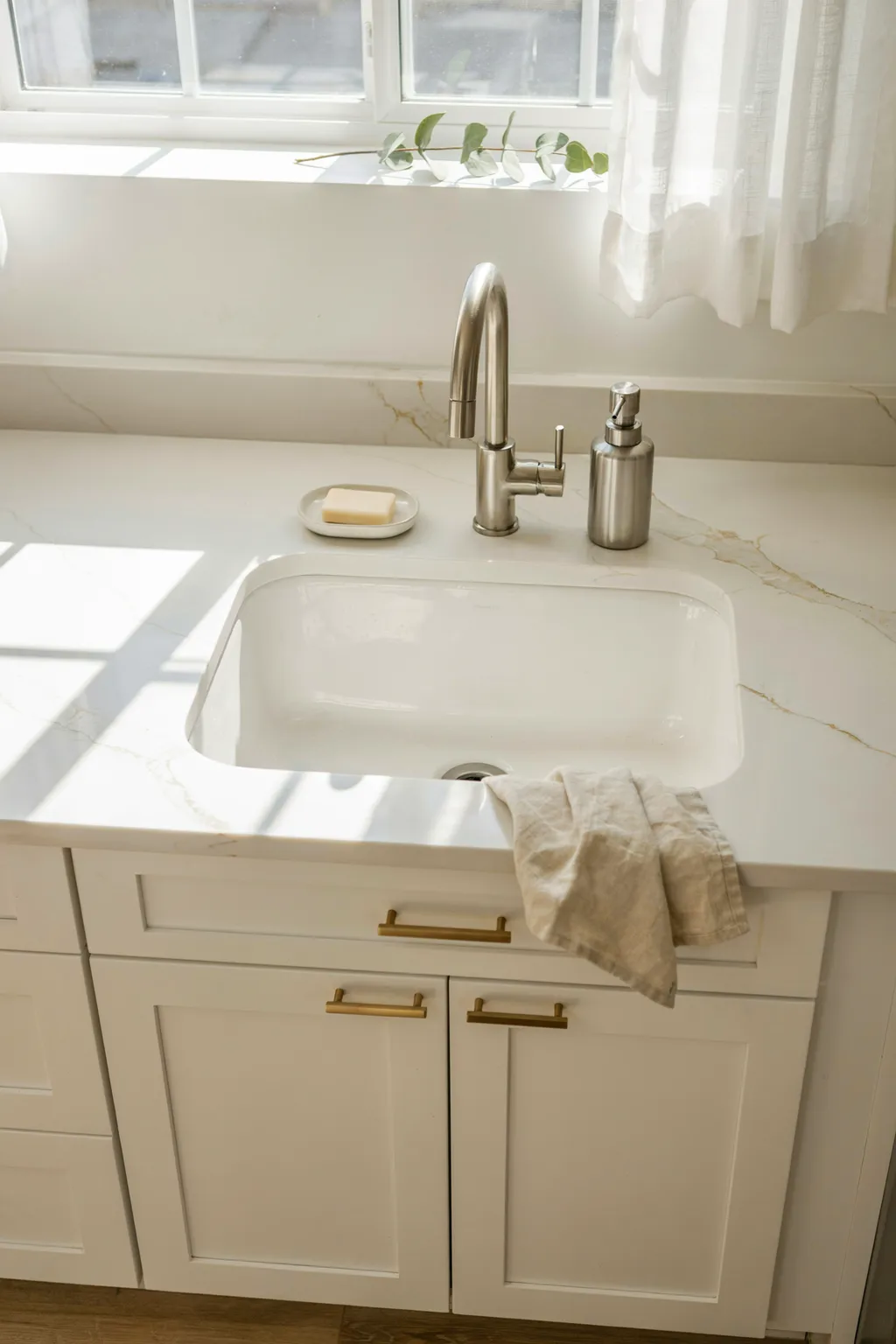
One of the cleanest-looking kitchen sink ideas is also one of the most practical: a white composite granite or quartz sink that nearly disappears into a light countertop. When sink and stone share a palette, the whole counter zone reads as a single continuous surface. Composite sinks are roughly 80% granite or quartz particles bound in acrylic resin, which gives them strong heat resistance (up to 530°F) and a matte finish that doesn’t broadcast water spots the way stainless does.
A brushed nickel pull-down faucet keeps the scheme cool and light without competing with the stone. Composite also absorbs sound far better than stainless, so running the dishwasher or washing up late at night stays noticeably quieter. The honest caveat: red wine, coffee, and beet juice left sitting for hours can stain a white basin. A daily rinse plus an occasional wipe with a diluted bleach solution keeps the surface looking new. For a kitchen that prizes calm and continuity, this is one of the most underrated options on the list.
4. Copper Drop-In Sink with Butcher Block Countertop

Copper is the most characterful material in any list of kitchen sink ideas, and it looks best over a butcher block countertop. The warm amber of end-grain or edge-grain wood against the reddish-brown depth of a hammered copper basin creates a palette no synthetic material can fake. The sink develops a living patina over time, darker in low-traffic areas and brighter where it gets daily contact, so it looks genuinely aged rather than artificially distressed. An oil-rubbed bronze or antique copper bridge faucet keeps the period look consistent without matching too precisely.
Copper is also naturally antimicrobial. The Copper Development Association has documented that copper surfaces kill 99.9% of bacteria within two hours of contact, which makes it an unexpectedly hygienic choice for a basin you use all day. Budget $400 to $900 for a quality 14-gauge hammered copper drop-in; thinner 18-gauge copper dents too easily for heavy use. The honest drawback is acid: lemon juice, tomato sauce, and vinegar speed up the patina and can leave light etch marks if they sit for hours. Wipe the basin after each use and treat it with food-grade mineral oil every couple of months.
5. Stainless Sink with Built-In Drainer and Open Wood Shelves
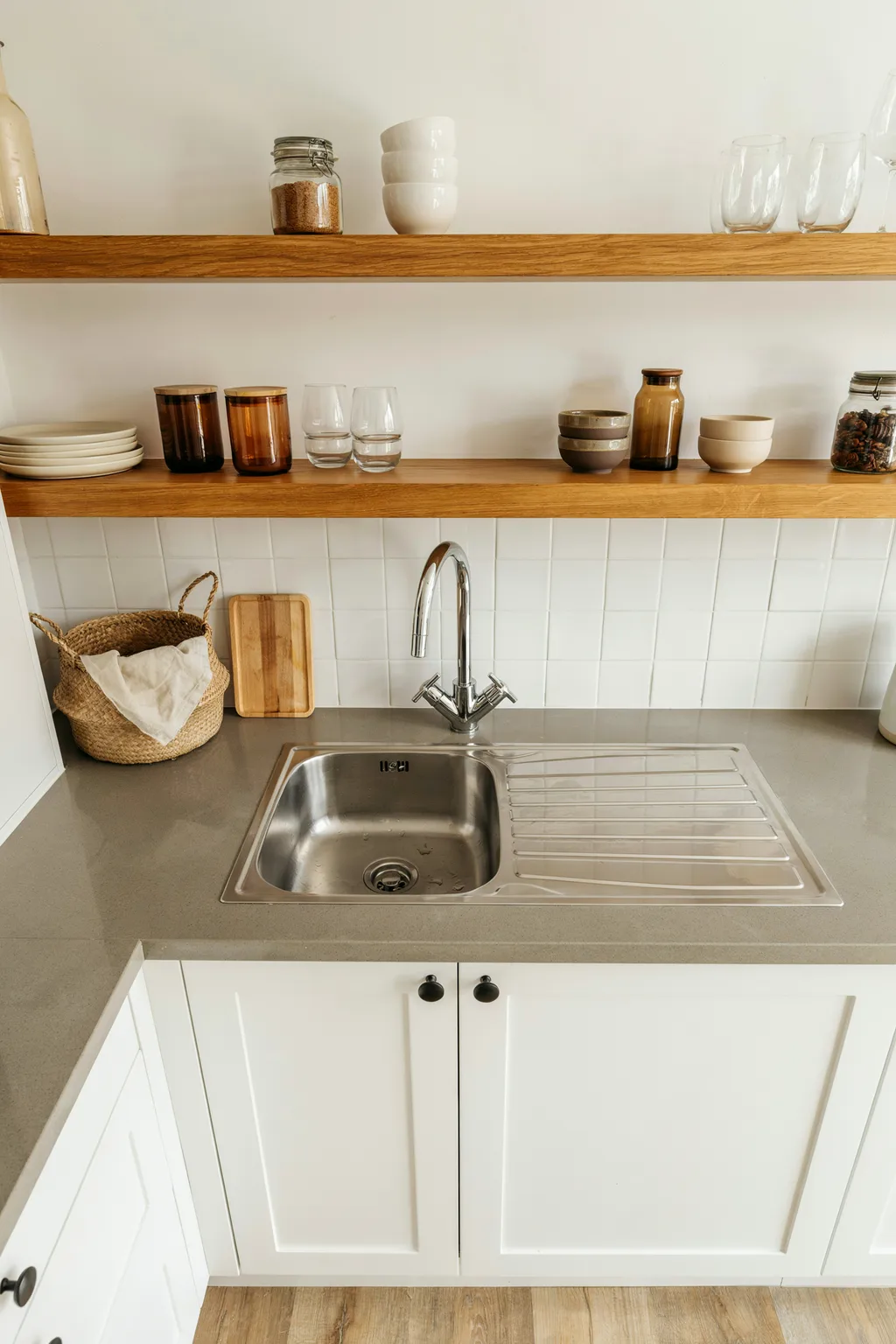
Built-in drainer sinks are one of the most underrated kitchen sink ideas for small kitchens. The ridged drying platform is part of the sink unit and drains back into the basin on its own, so there are no soggy dish mats, no water pooling on the counter, and no separate rack eating space. This format is standard in European and Japanese kitchens and makes immediate sense in any compact layout where every inch of counter matters.
Open wood shelves above the sink add storage without visual weight. A stack of plates, a couple of ceramic mugs, and a woven rattan basket, styled simply, keep the area from feeling clinical. Stainless, white square tile, and light wood together create a Japandi-leaning look that feels calm rather than cold. Sink-plus-drainer units typically run 30 to 33 inches wide and cost $150 to $400, making this one of the more budget-friendly ideas here. One thing to know upfront: integrated drainer sinks are almost always top-mount, which means a visible rim at the countertop joint. It cleans up fine with regular wiping, but if you want the seamless look of an undermount, this format isn’t it.
6. Hammered Copper Undermount Sink with Rustic Bridge Faucet
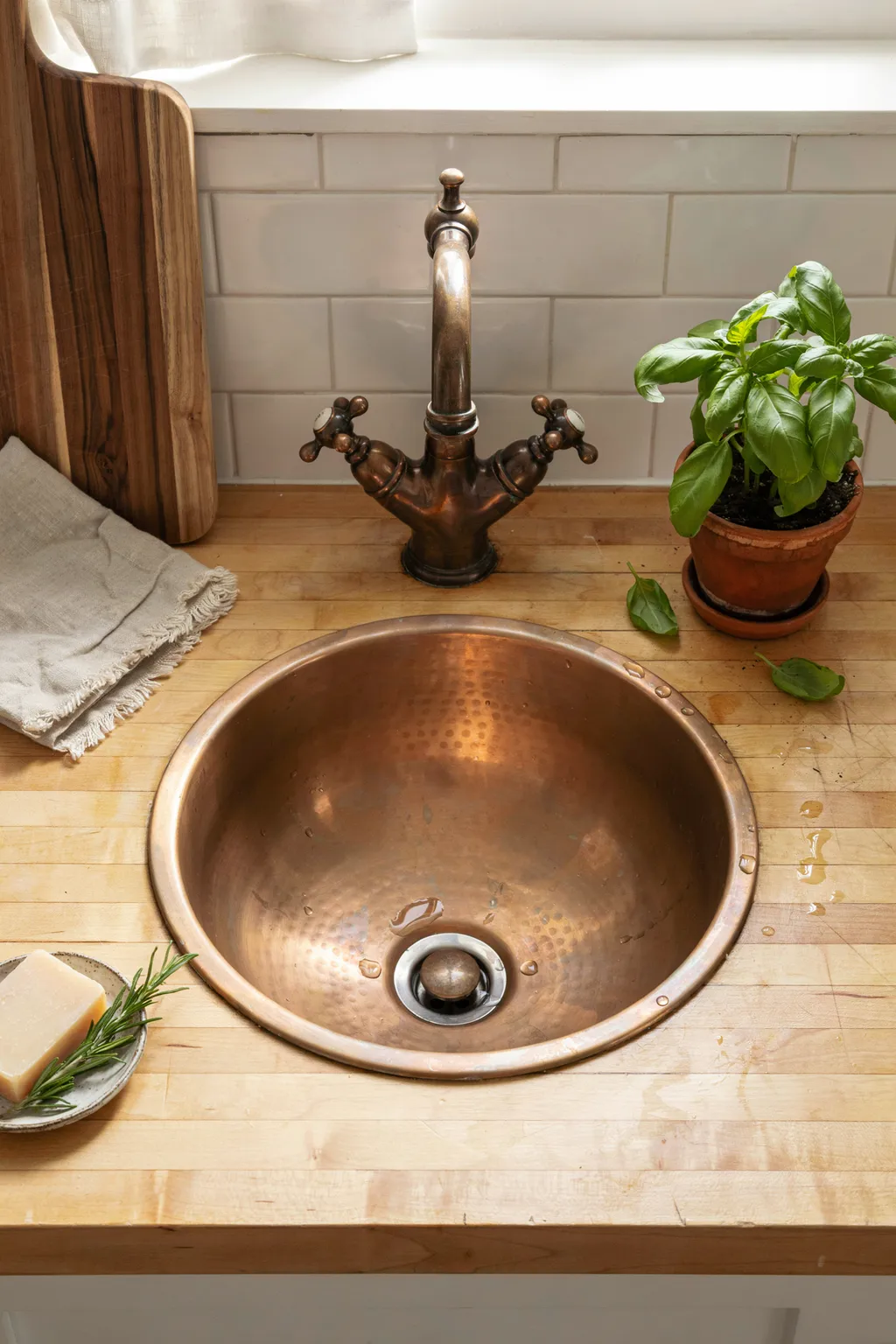
Choosing a copper sink in the undermount style, rather than drop-in, adds a refinement most people don’t expect from a material tied to rustic kitchens. The rim hides entirely below the countertop edge, so the surface reads clean while the hammered texture brings movement and depth to the basin. Set against pale butcher block or light maple, the warm metal catches light differently at every angle, creating quiet interest in an otherwise still composition. An oil-rubbed bronze pillar faucet with lever handles at the rear reinforces the handcrafted feel without looking theatrical.
Copper undermount sinks run $350 to $800 for solid-copper options, and you should avoid anything below 14-gauge, which dents under normal use. Most come in lacquered and unlacquered versions. Lacquered copper holds a consistent bright finish and needs nothing beyond soap and water. Unlacquered copper develops a natural patina and wants periodic mineral oil conditioning to keep the surface even. Neither is better. It comes down to whether you prefer consistency or character.
7. Matte Black Granite Composite Sink with Black Faucet
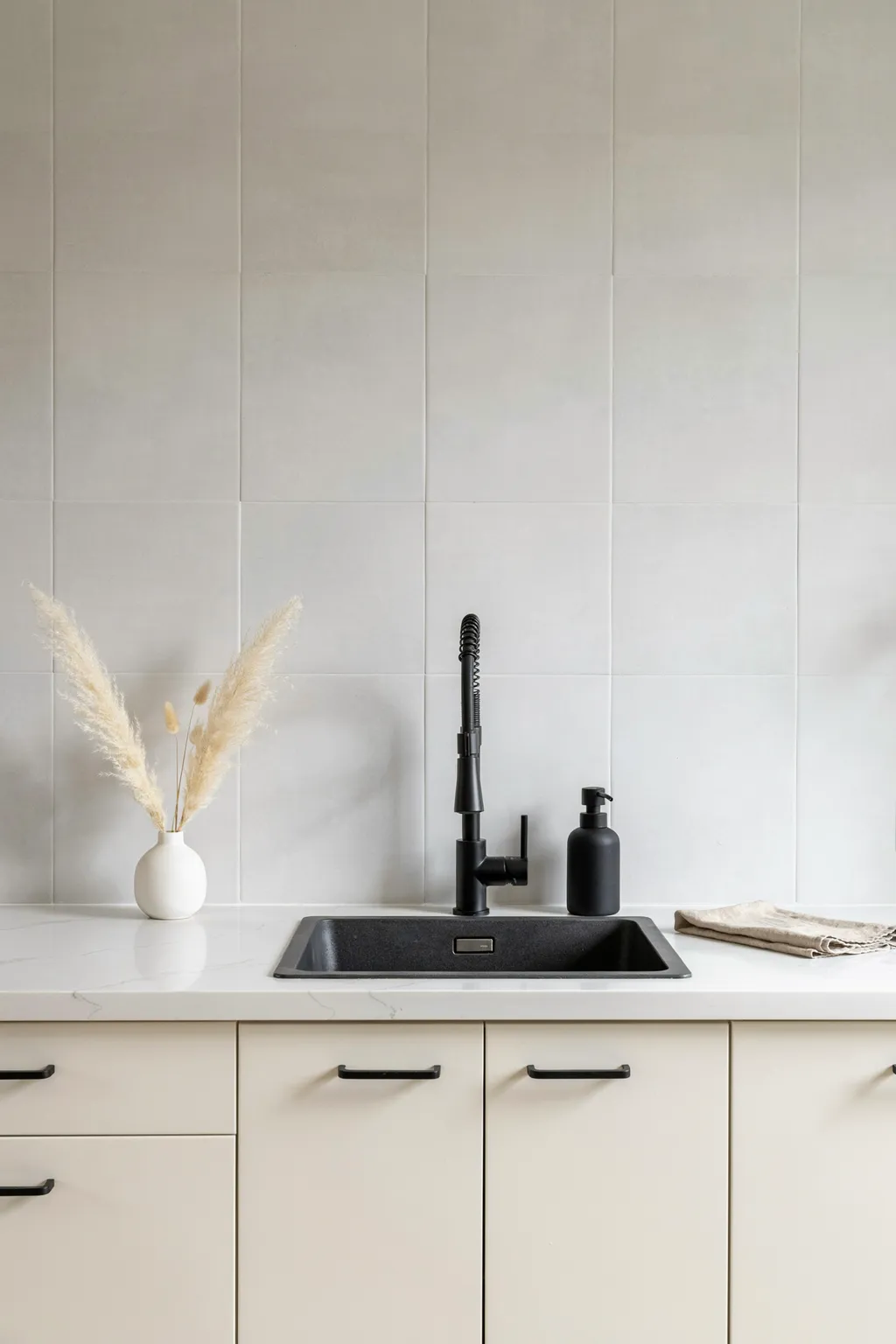
A matte black granite composite sink paired with a matching matte black coil-spring pull-down faucet is one of the bolder kitchen sink ideas here, and one of the most cohesive. When sink and faucet share the same flat, non-reflective finish, the installation reads as a single intentional element instead of a pile of parts. Against white marble-look quartz, the contrast turns graphic and arresting, a composition that looks deliberate in photos and holds attention in person.
Granite composite in matte black resists scratches, takes heat up to 530°F, and handles impact far better than porcelain or ceramic at the same price. It also hides scuffs and daily wear better than a polished finish would. A one-basin 30-inch composite sink in this finish runs $300 to $700 from major manufacturers. One caveat trips people up: light calcium and lime deposits from hard water show clearly on matte black. A weekly wipe with a 50/50 white vinegar and water solution clears buildup before it dulls the finish for good.
8. Farmhouse Sink Beneath a Window with an Herb Garden Sill
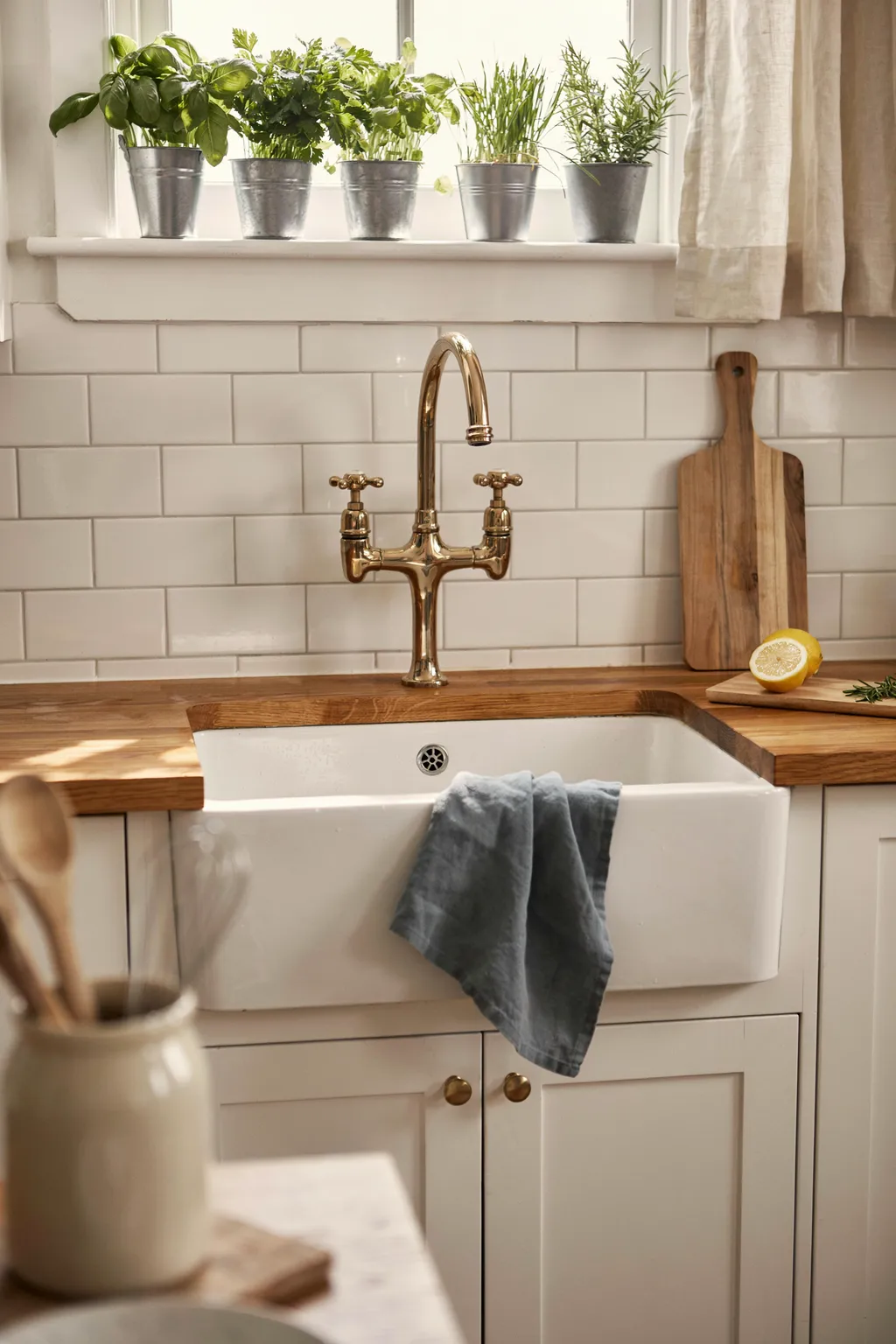
Setting a farmhouse apron sink directly under a wide window and filling the sill with herbs is one of the kitchen sink ideas that earns its place through daily use, not first impressions. Natural light while you wash up, fresh herbs within reach while you cook, a view of the outdoors from the spot you stand at most: the practical and the pretty genuinely overlap here. A single-bowl fireclay basin in white is the right call below a window because it bounces the incoming light back and keeps the zone feeling open.
A brass bridge faucet scaled to the wide apron front looks right in a way a single-handle faucet rarely does. White subway tile behind keeps the palette clean so the herbs and the wood countertop, not the tile, carry the warmth. Single-bowl apron sinks start at $350 for basic fireclay; budget at least $500 for a 30-inch model with a proper reveal and consistent glaze depth. One real limit: windowsill herbs need at least 6 hours of direct sun a day. South or west-facing windows are ideal. A north-facing window or a shaded yard leaves the herbs struggling, and a patchy, yellowing garden defeats the whole look.
9. Gold Undermount Sink with Dark Countertop and LED Strips
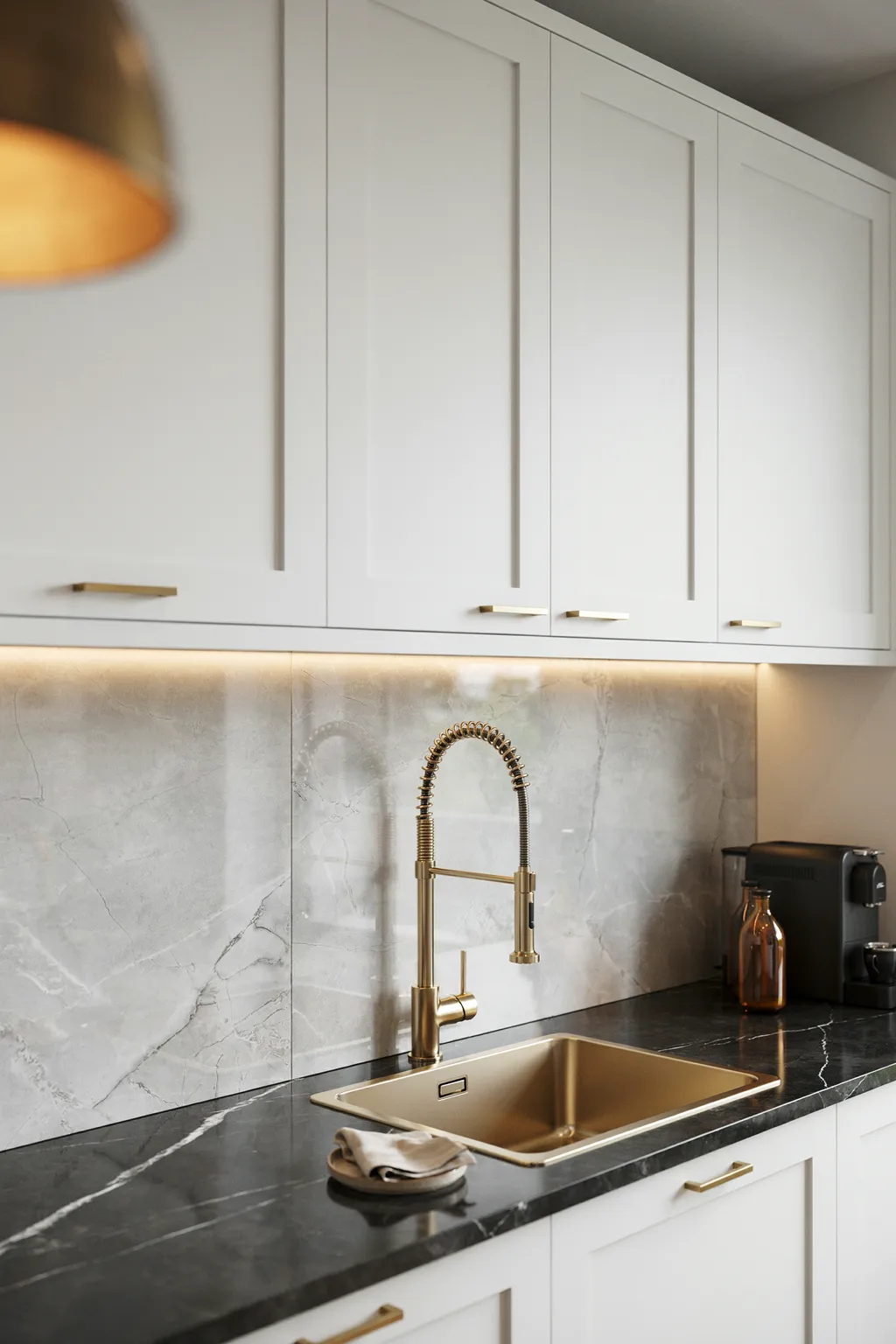
A champagne or brushed gold undermount sink set into dark granite or soapstone is one of the most dramatic kitchen sink ideas on this list. The deep black stone makes the warm gold basin read with a richness no lighter countertop can match. Under-cabinet LED strips amplify the effect: they wash the backsplash in warm amber light and catch the gold from the side, while keeping the rest of the room from feeling heavy or dark.
Look for PVD-coated sinks (Physical Vapor Deposition) rather than plated gold. PVD bonds vaporized metal in a vacuum chamber, so the finish won’t flake, peel, or dull the way electroplated gold does. Quality PVD gold sinks run $500 to $1,500, and a matching champagne gold coil-spring pull-down faucet keeps the fixture language consistent above the basin. The strips themselves ($30 to $80 for a standard run) are one of the better value upgrades you can add here: better task lighting, less eye strain, and gold accents that glow at every hour. The trade-off is upkeep, since dark countertops show every splash and fingerprint and get wiped down more often than a light surface.
10. Double Stainless Undermount with Penny Tile Backsplash
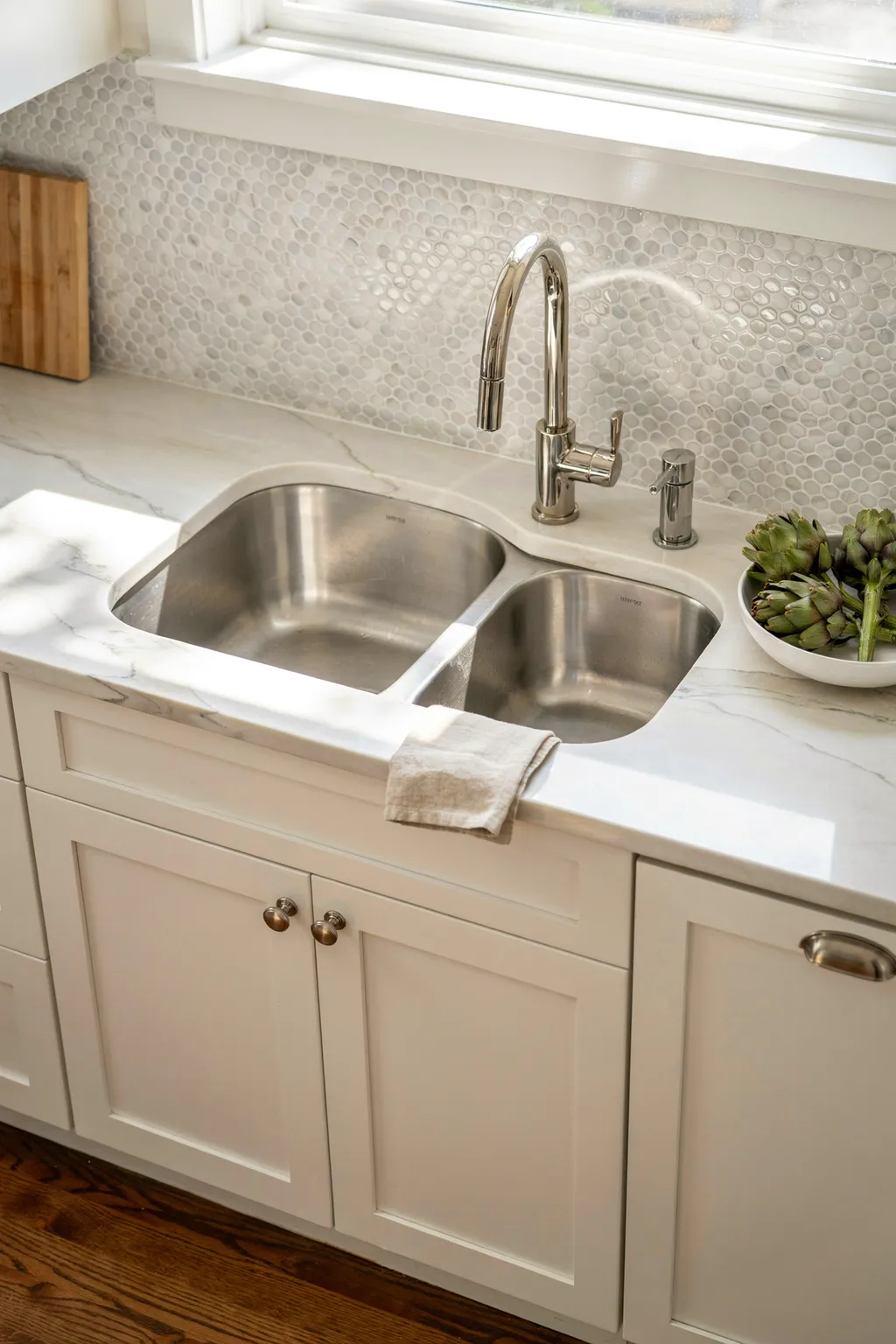
A 60/40 double-bowl stainless steel undermount sink with a white penny-round tile backsplash is one of those kitchen sink ideas that rewards you more the longer you live with it. The uneven bowls are practical: the larger basin swallows big pots, sheet pans, and wide cutting boards, while the smaller one handles produce rinsing and prep. That split makes the sink more useful on a busy cooking day than a perfectly equal 50/50 layout would.
Penny tiles, usually 3/4-inch circles, work beautifully in a high-moisture backsplash zone because their rounded edges grout cleanly and the tight mosaic glows in natural light. A chrome gooseneck pull-down faucet is the right partner: polished chrome echoes the stainless without matching too perfectly, and a small second spray gives you a dedicated source for filling pots or rinsing produce without tying up the main tap. White quartz and cream shaker cabinets keep the surrounding palette neutral so the penny tiles stay the statement. This setup works best with at least 36 inches of counter on either side; narrower runs make the 60/40 bowl feel cramped.
11. Black Composite Sink with Drainer and Wall Utensil Rail
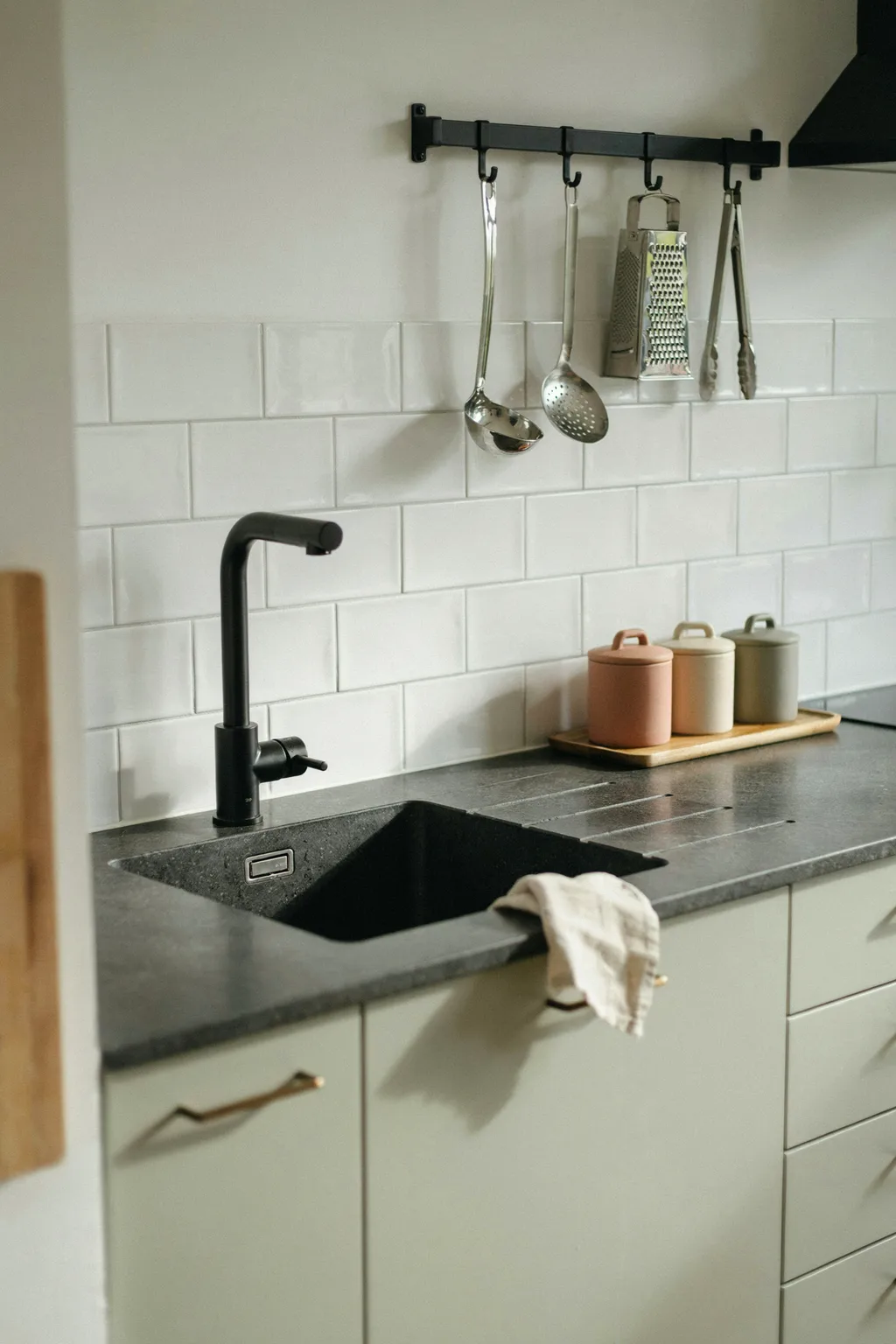
Organization-first kitchen sink ideas don’t have to look industrial. A dark charcoal granite composite sink with an integrated ribbed drainer wing, paired with a black wall-mount utensil rail above white subway tile, keeps everything you reach for constantly (ladle, tongs, soap, paper towels) within arm’s reach without using an inch of counter. The dark matte composite reads high-contrast against the white tile, giving the zone a defined, purposeful feel.
A matte black squared gooseneck faucet with cross-handle levers ties the fixture to the basin without the color match being too literal. A few storage canisters on a narrow wooden tray beside the sink add warmth to an otherwise cool, monochrome palette and keep dry goods close during prep. Composite granite drainer-wing sinks run $250 to $550 and come in 30- and 33-inch widths. One check before ordering: integrated drainer sinks are top-mount, so the rim sits on the countertop surface rather than under it. Confirm your countertop supports top-mount and that the rim-to-surface joint will seal cleanly first.
12. Double Fireclay Farmhouse Sink with Sage Green Cabinets
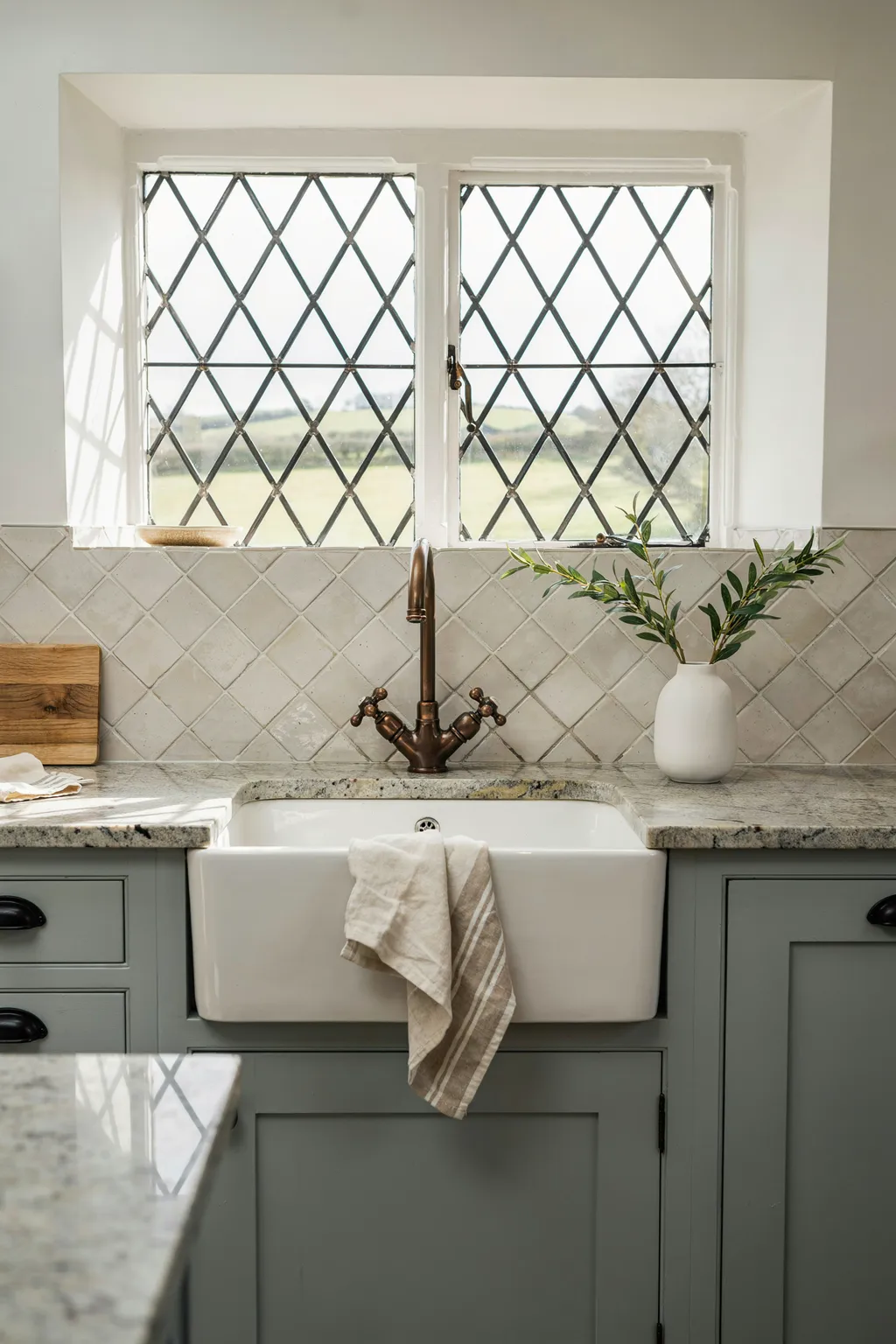
A double-bowl fireclay farmhouse sink with sage green shaker cabinets is one of the most complete kitchen sink ideas for a cottage or English country kitchen, working as a single design decision rather than a stack of separate choices. The double apron runs 36 inches wide (against 30 inches for a standard single farmhouse), so it anchors a longer run of cabinetry with real presence. Sage green is warm enough to feel cozy and muted enough to stay sophisticated, the kind of color that holds up over years.
An oil-rubbed bronze bridge faucet over speckled granite grounds the look without competing for attention. A diamond-lattice tile backsplash framing the window adds architectural depth that subway tile can’t, reading like a design decision instead of a default. Double-bowl fireclay farmhouse sinks start at $900 and climb past $2,200 for large or specialty sizes. Budget for professional installation, because these sinks weigh 100 to 130 lbs, and the reveal alignment (the precise gap between the apron face and the cabinet frame below) takes patience and experience to get right.
13. Drop-In Double Stainless with an Over-Sink Drying Rack
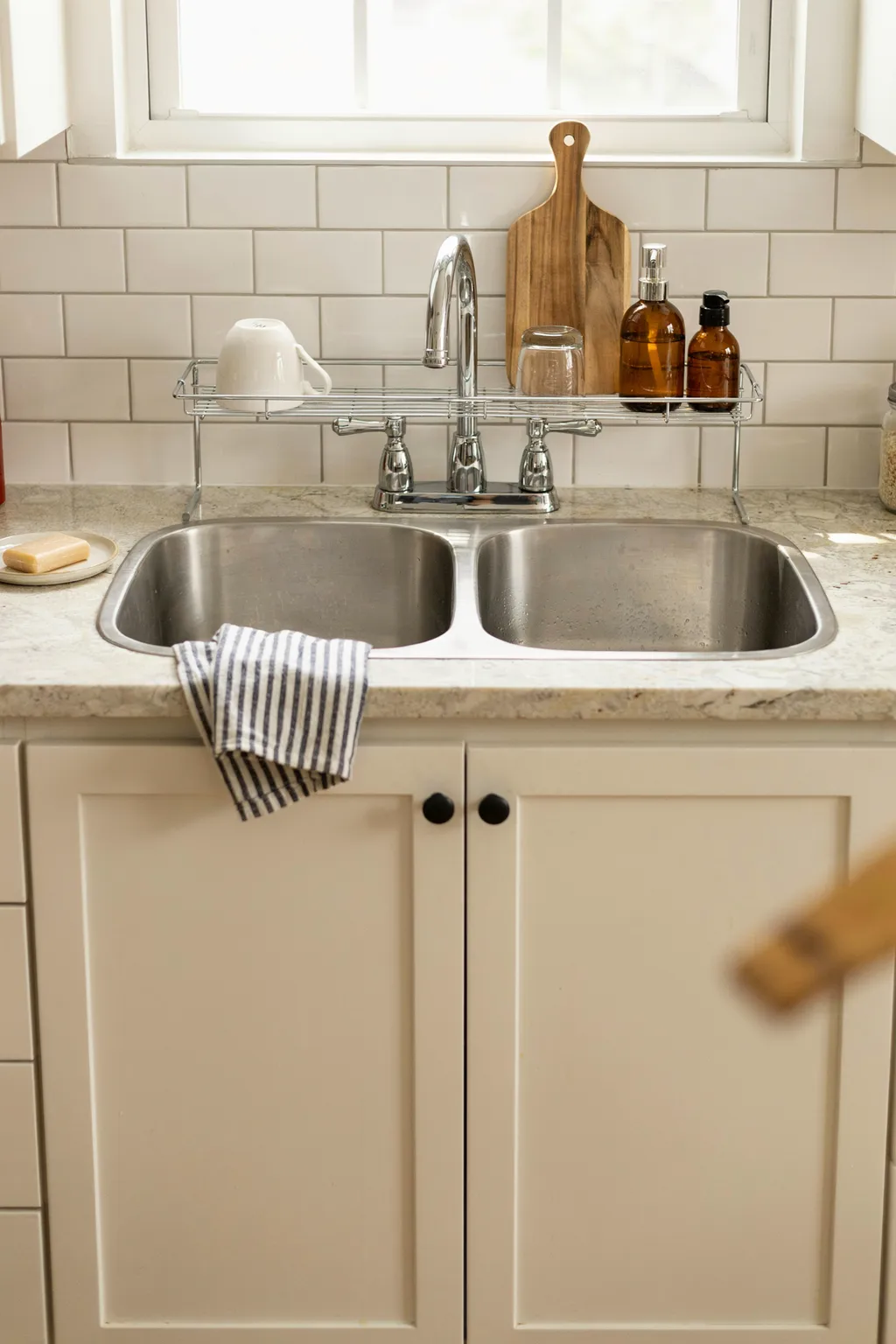
An over-sink dish drying rack, a wire or stainless shelf that spans both basins and lets dishes drain straight back into the sink, is one of those kitchen sink ideas that quietly fixes a problem you’ve worked around for years. The dishes dry above the basin, the water drips down the drain, and your counter stays completely clear. This format is standard in European kitchens and makes particular sense in homes where hand-washing is the norm rather than the exception.
A chrome bridge faucet with two handles sets the controls at the rear of a double-bowl drop-in, so you can adjust temperature intuitively with your hands in either basin. Light granite countertops in cream or beige warm up the stainless instead of letting it read clinical, and a couple of amber glass soap dispensers plus a few objects on the sill add the personal detail stainless can’t. Standard double drop-in sinks with equal bowls run 28 to 33 inches wide and cost $120 to $350, one of the most budget-accessible options here. The one upkeep task: the rim-to-countertop seam collects soap residue over time, so a fresh bead of silicone caulk every year or two keeps discoloration from setting in.
14. Matte Black Apron Sink with Butcher Block and Coil Faucet
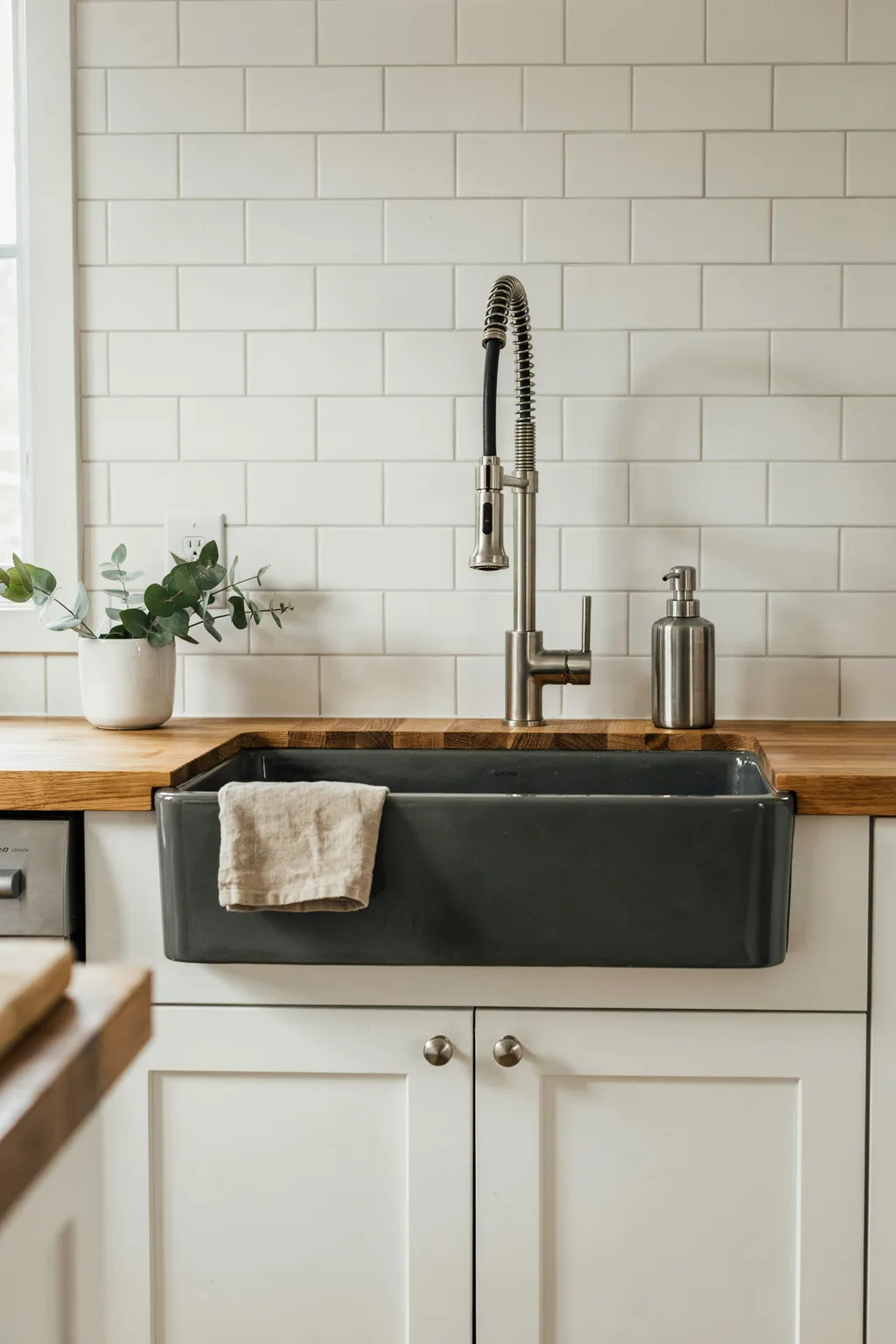
A matte black fireclay apron sink over a butcher block countertop brings two natural, tactile materials into a contrast that works precisely because neither one reads as synthetic. The deep charcoal basin against warm wood is striking without feeling cold. A coil-spring, commercial-style faucet in brushed nickel keeps the hardware functional and adds an industrial edge the black apron can carry without tipping the room into restaurant territory. White subway tile behind and white shaker cabinets below give the basin room to stand out, though this only works well in a kitchen with good natural light.
The single-basin apron format in a 30-inch width gives you 9 to 10 inches of interior depth, which earns its keep soaking large pots, washing oversized sheet pans, and batching produce. Matte black fireclay starts at $450 for a single-bowl 30-inch apron, and you should budget $650 to $1,200 for models with tighter tolerances and a more consistent glaze. One caveat worth knowing before installation: matte black fireclay can chip at the rim if heavy cast iron is dropped from height. A stainless sink grid on the basin floor protects the surface during everyday use and costs $30 to $60 as an add-on.
15. Stainless Undermount with Mixed Matte Black and Chrome Fixtures
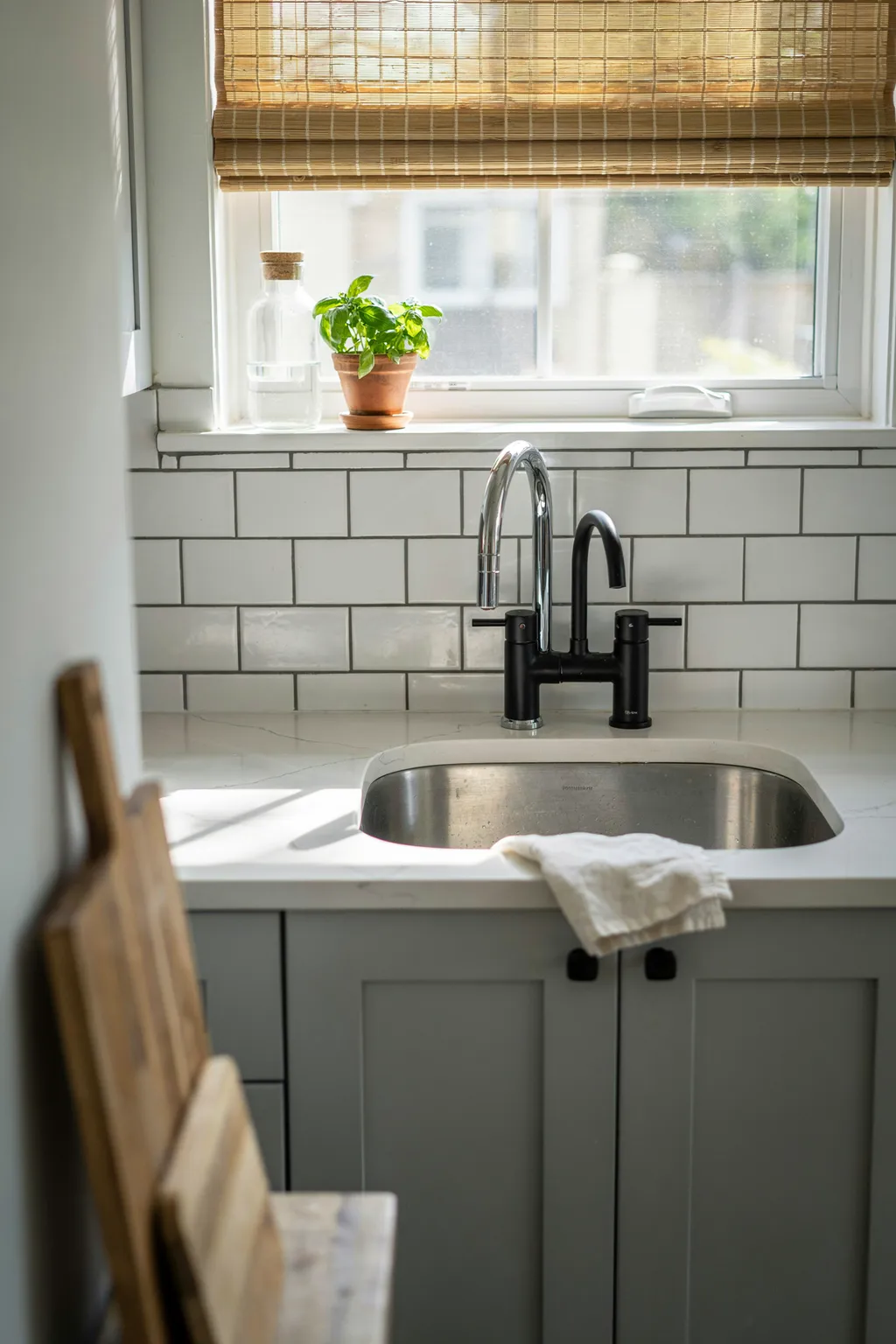
Mixing a polished chrome pull-down faucet with matte black accents (a secondary bridge-style tap for filtered water, black cabinet hardware, a black pot filler) is one of those kitchen sink ideas that looks like a considered design move but works as a daily convenience. Two faucets over a single undermount stainless basin means one is always free while the other is in use, a mundane detail that matters enormously on a busy cooking evening.
The woven bamboo shade above the sink softens the stainless and matte black with warmth and texture, without adding a single piece of wood furniture to the surface. White quartz and grey shaker cabinets keep the rest of the palette neutral so the two metals don’t fight; the rule is to hold yourself to two finishes and let one clearly lead (chrome here, with black as the accent). Stainless gauge matters more than most people realize: at 18-gauge the sink flexes slightly under heavy loads, while at 16-gauge it holds firm. For a family kitchen in daily heavy use, the 16-gauge upgrade is worth the $50 to $100 difference over a decade.
16. White Double-Bowl Drop-In Fireclay Sink on White Quartz
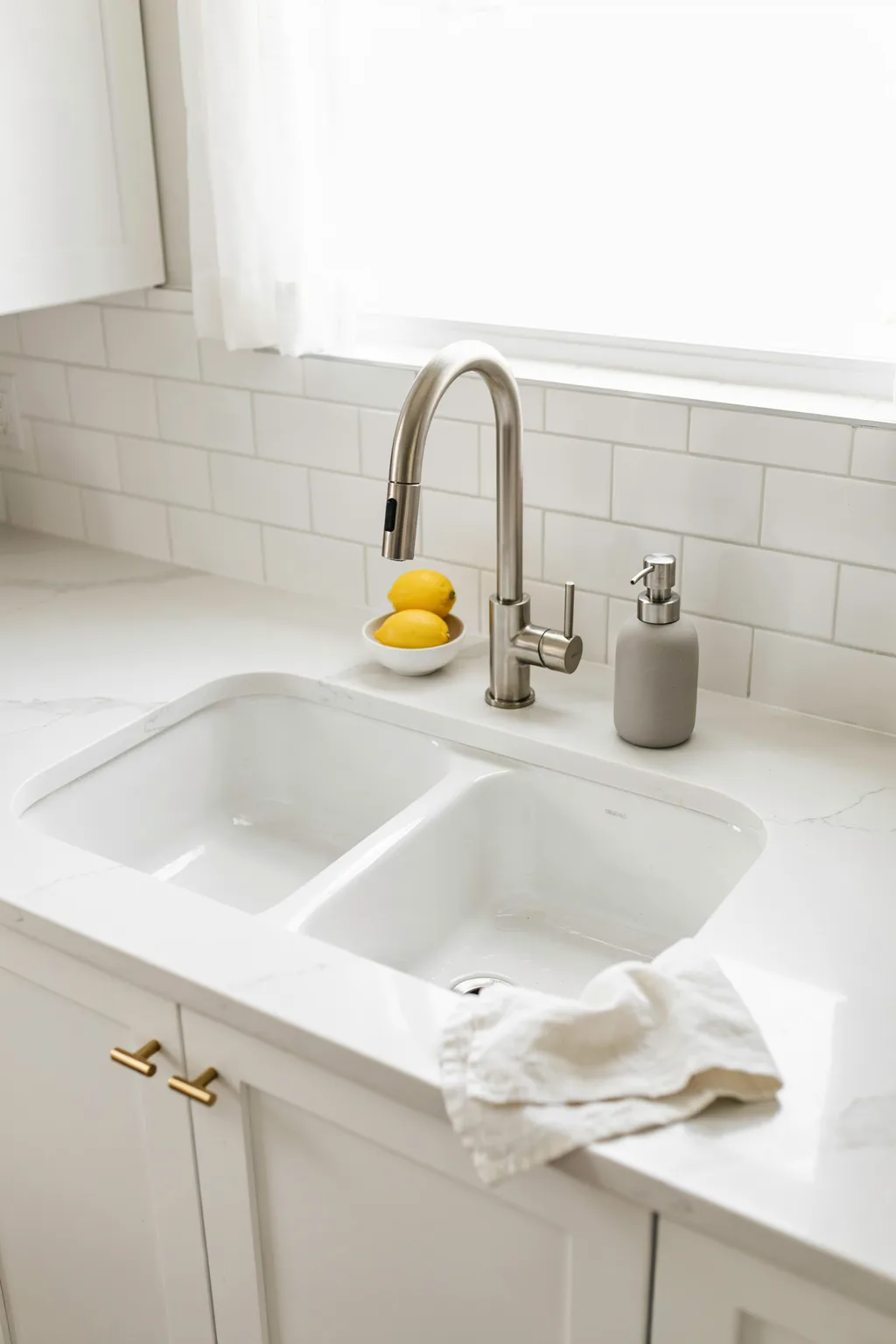
One of the most quietly beautiful kitchen sink ideas is also one of the most practical: a white double-bowl drop-in fireclay sink on a white quartz countertop. Fireclay’s smooth, slightly glassy surface reflects light in a way ceramic and composite can’t match, giving the whole sink area a subtle luminosity. Because the sink and countertop share a white palette, the eye never fixates on the basin, and the entire workspace reads as a single calm surface.
A brushed nickel pull-down faucet and a grey ceramic soap dispenser keep the hardware from reading cold against all that white. Calacatta or Statuario quartz with subtle veining adds just enough movement to keep the surface from feeling blank. Drop-in installation lets you replace this sink later without disturbing the countertop, a real advantage in a rental or a home you plan to sell within a few years. One structural note: drop-in fireclay double-bowl sinks weigh 70 to 100 lbs, so the base cabinet must be fully assembled and wall-anchored before the sink goes in. A cabinet that isn’t secured properly will shift under the weight and throw off the reveal within months.
17. Matte Black Undermount Sink with Statement Pendant Lights
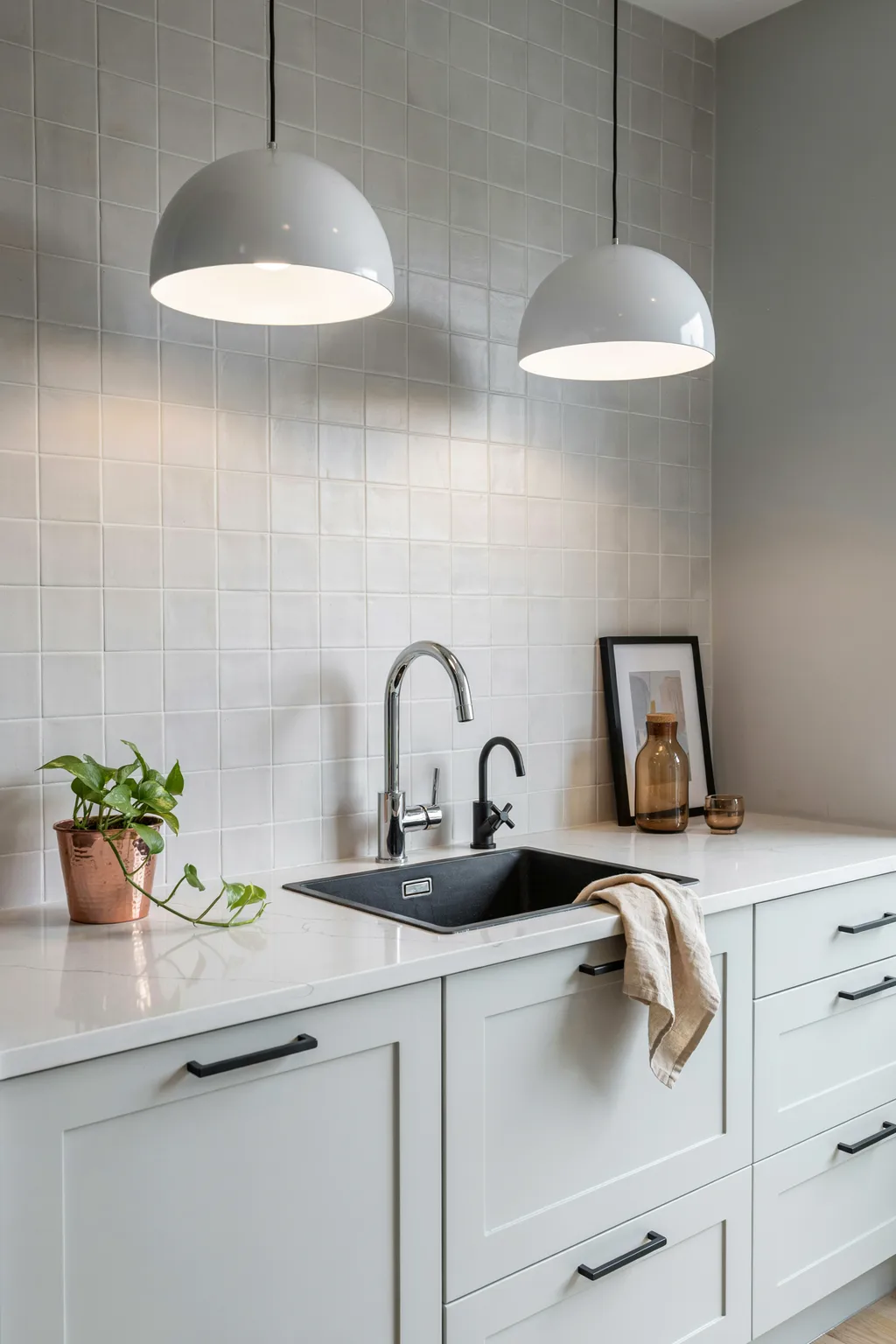
A matte black undermount sink set into white quartz, with two glossy white dome pendants hanging directly overhead, is one of the most design-forward kitchen sink ideas on this list and one of the most livable. Most sink zones rely on a distant ceiling fixture that leaves the basin dim by evening. Pendants right above the sink fix that immediately, making dishwashing at 9 p.m. faster, more pleasant, and surprisingly less like a chore.
The mixed-metal moment here, a polished chrome commercial pull-down faucet alongside a shorter matte black vintage-style tap, adds the collected-over-time character single-finish kitchens rarely reach. A copper plant pot, a small framed print, and an amber glass bottle personalize the counter without creating noise, while large-format grey porcelain tile on the backsplash grounds the whole composition. One spec to nail before installation: pendants over a sink work best when the bottom of the fixture hangs 66 to 72 inches off the floor. Below 66 inches they block the sightline; above 72 inches they lose their visual pull and most of their task-lighting value.
Common Mistakes to Avoid
Mistake 1: Choosing sink size by cabinet width alone
The cabinet opening tells you the minimum sink size, not the ideal one. A 30-inch cabinet can accept a 26-inch sink, and that extra 2 inches of counter on each side is more useful than the extra basin room in most kitchens. Measure your workflow, not just your opening.
Mistake 2: Buying a shallow basin to save $40
Standard drop-in stainless sinks come in 6-inch and 8-inch basin depths. The 6-inch version splashes water onto the counter every time you fill a pot, while the 8-inch (or deeper) version contains it. The price difference is usually $40 to $80, and it is always worth the upgrade. You’ll be reminded of this choice every single day.
Mistake 3: Mismatching faucet deck holes and sink configuration
A deck-mount faucet needs pre-drilled holes in the sink: 1 hole for a single-handle faucet, 3 holes for a bridge faucet, 4 holes for a bridge with a side spray. An undermount on a quartz countertop may need holes drilled into the stone instead. Mismatches cost $200 or more to fix after installation, so confirm the hole count before ordering anything.
Mistake 4: Forgetting garbage disposal clearance
A disposal unit under the sink needs at least 7 to 8 inches of clearance in the base cabinet below the drain. Deep sinks (10 inches or more) combined with a standard 34.5-inch cabinet height sometimes leave only 4 to 5 inches, which isn’t enough. Measure the installed drain depth before committing to a deep basin if you use or plan to add a disposal.
Mistake 5: Choosing unlacquered brass or gold without knowing the upkeep
Unlacquered brass and gold develop patina in uneven patterns unless you wax them regularly. If you want a finish that looks the same in ten years, choose PVD-coated brass or satin gold, which is scratch and tarnish resistant and needs nothing beyond soap and water. The “living finish” pitch is accurate, but it only stays beautiful if you maintain it.
Mistake 6: Installing a farmhouse sink without reinforcing the base cabinet
Fireclay farmhouse sinks weigh 80 to 150 lbs empty. Standard base cabinets aren’t rated for this load, especially in older kitchens. A modified or purpose-built cabinet base, or a reinforced support shelf inside an existing cabinet, has to go in before the sink does. Skip it and you get sagging shelves, cracked countertop corners, and eventually a failed installation.
Mistake 7: Choosing a faucet spout reach that doesn’t fit the basin
A faucet spout has to clear the basin rim and reach the center of the bowl. A compact-reach faucet over a deep 36-inch farmhouse sink leaves the back corners unreachable. Check the spout reach specification, usually listed as 8 to 10 inches from the faucet deck to the water stream, against your sink’s basin dimensions before you finalize the order.
Quick Start Checklist
- Measure the existing sink cutout and confirm the minimum and maximum dimensions that will fit
- Decide between undermount, drop-in, and farmhouse installation based on countertop material and budget
- Choose single-bowl vs double-bowl based on how you actually cook and wash dishes
- Pick a material (stainless, composite granite, fireclay, or copper) matched to your real maintenance habits
- Count the pre-drilled holes on your chosen sink and confirm they match your faucet configuration
- Check garbage disposal clearance in the base cabinet if you have or plan to install one
- For farmhouse sinks, verify cabinet structure and reinforce it before installation day
- Plan backsplash tile, countertop, and cabinet hardware as one complete zone, not as separate choices
- Order a sink grid and drain strainer at the same time as the sink (sold separately, almost always)
- Schedule the install for a window when you can go 24 to 48 hours without kitchen water access
Frequently Asked Questions
What is the most practical kitchen sink for everyday use?
A single-bowl undermount in 16-gauge stainless steel or composite granite handles daily heavy use better than most other options. The single bowl fits large pots and sheet pans without a divider in the way, and undermount installation makes wiping the counter clean a one-motion task. For most households, 30 to 33 inches wide and 9 to 10 inches deep is the right size range.
What is the difference between undermount and drop-in kitchen sinks?
Undermount sinks mount below the countertop surface, so there’s no visible rim and no seam to collect grime. They require a solid surface countertop (quartz, granite, or marble) and professional installation. Drop-in sinks rest on top of the counter with a visible rim all around. They cost less to install, work with laminate countertops, and can be swapped out later without touching the stone. The rim-to-counter joint on a drop-in needs regular caulking to prevent discoloration.
Are farmhouse sinks actually practical day to day?
Yes, for the right kitchen. A 30-inch single-bowl fireclay farmhouse sink is 9 to 10 inches deep and holds substantial volume, which helps with large-batch cooking, flower arranging, soaking cookware, and bathing small children. The exposed apron front also protects the cabinet face below the sink from drips. The downsides are real: fireclay is heavy (80 to 150 lbs), the base cabinet needs reinforcement, and quality models start at $400 to $500 with installation adding $300 to $600 more.
Which kitchen sink material is easiest to maintain?
Dark composite granite in charcoal, graphite, or espresso is the easiest to maintain for most households. It doesn’t show water spots, hides minor surface marks, and wipes clean with dish soap. Stainless steel is close behind and is particularly forgiving of heavy use. White fireclay and white composite show hard water deposits and pigment stains from red foods more readily. Copper is the most maintenance-intensive but also the most visually rewarding over time.
Do matte black sinks scratch easily?
Matte black granite composite sinks are highly scratch-resistant, since the material is hard enough that normal kitchen use leaves no visible marks. Matte black powder-coated or painted sinks are a different situation, because they can chip and scratch with sustained use. Before buying any black sink, verify it’s either composite granite or carries a PVD coating rather than a sprayed-on finish. The product spec sheet will state this; if it doesn’t, ask.
How much does kitchen sink replacement cost in 2026?
Total cost ranges from $200 to $500 for a basic drop-in stainless swap with labor included, up to $1,500 to $4,000 or more for a fireclay farmhouse sink with professional installation, cabinet modification, and a new countertop cutout. The sink itself is typically 50 to 70% of the total project cost. Labor for a standard undermount replacement with no countertop work runs $150 to $300 in most US markets.
What size kitchen sink works for a family of four?
For four people who cook regularly, a single-bowl undermount at 30 to 33 inches wide and at least 9 inches deep handles most daily tasks without feeling cramped. A 60/40 double-bowl undermount at 32 to 36 inches is better if you prefer to keep prep and washing separate. Measure your base cabinet and subtract 2 to 3 inches on each side for the sink reveal and countertop overhang to find your maximum usable width.
Conclusion
Your kitchen sink will outlast most of the other decisions you make in a renovation. Choose it the way you’d choose a good work surface: by function first, looks second, and with a clear-eyed view of the maintenance it actually requires.
The most useful kitchen sink ideas from this list share a few habits. They start with the basin depth that fits your cooking, not just the depth that photographs well. They match the material to the care you’ll genuinely give it, not the care you intend to give it. And they treat the faucet as a continuation of the sink’s visual language rather than an afterthought picked separately.
Spend a little more than you planned on the faucet. You’ll touch it a hundred times a day, every day, for a decade or more. The sink is the investment, and the faucet is the detail that either ties the whole zone together or quietly undermines it. Get both right, and your kitchen will look cleaner, feel more considered, and work better every single morning.