15 Small Bathroom Ideas That Feel Surprisingly Spacious
You walk into your bathroom, your elbow hits the towel bar, and the whole room feels like it is closing in on you. The square footage is fixed. You cannot move the studs or steal a foot from the hallway. But the feeling of size is something you can change, and that is the part most people get wrong. They cram in more storage, paint a dark accent wall, and end up with a room that feels even tighter than before. The best small bathroom ideas do the opposite.
The good news is that small bathroom ideas are mostly about tricking the eye, not gutting the room. A taller mirror, a shower screen instead of a curtain, a vanity that floats off the floor: each one buys back visual space without costing you an inch of real floor. The best part is that many of these swaps cost less than a weekend of takeout and take an afternoon to install.
This guide gives you 15 specific changes, each one tied to a real bathroom you can picture. Some are paint. Some are fixtures. A few are pure styling. I will tell you what works, why it works, and where each idea falls flat, because no single trick fits every room. Pick the three that match your layout and skip the rest.
Quick Answer
To make a small bathroom feel bigger, reflect light and stretch the eye upward. Float the vanity so you can see floor underneath, swap the shower curtain for clear glass, run one tall mirror instead of a small one, and keep wall colors in a single calm band. Pull storage up the walls so the floor stays open. These small bathroom ideas cost little and add no real square footage, yet the room reads twice as roomy.
1. Run a Bold Tile Strip From Floor to Ceiling
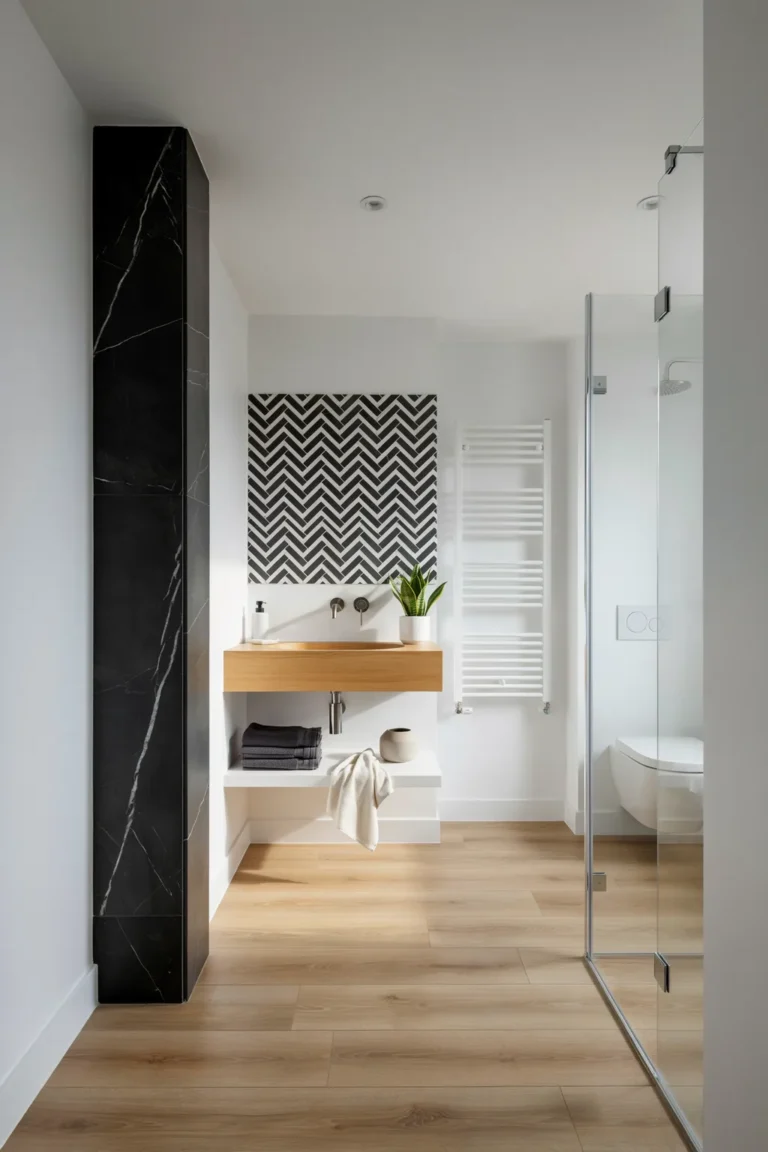
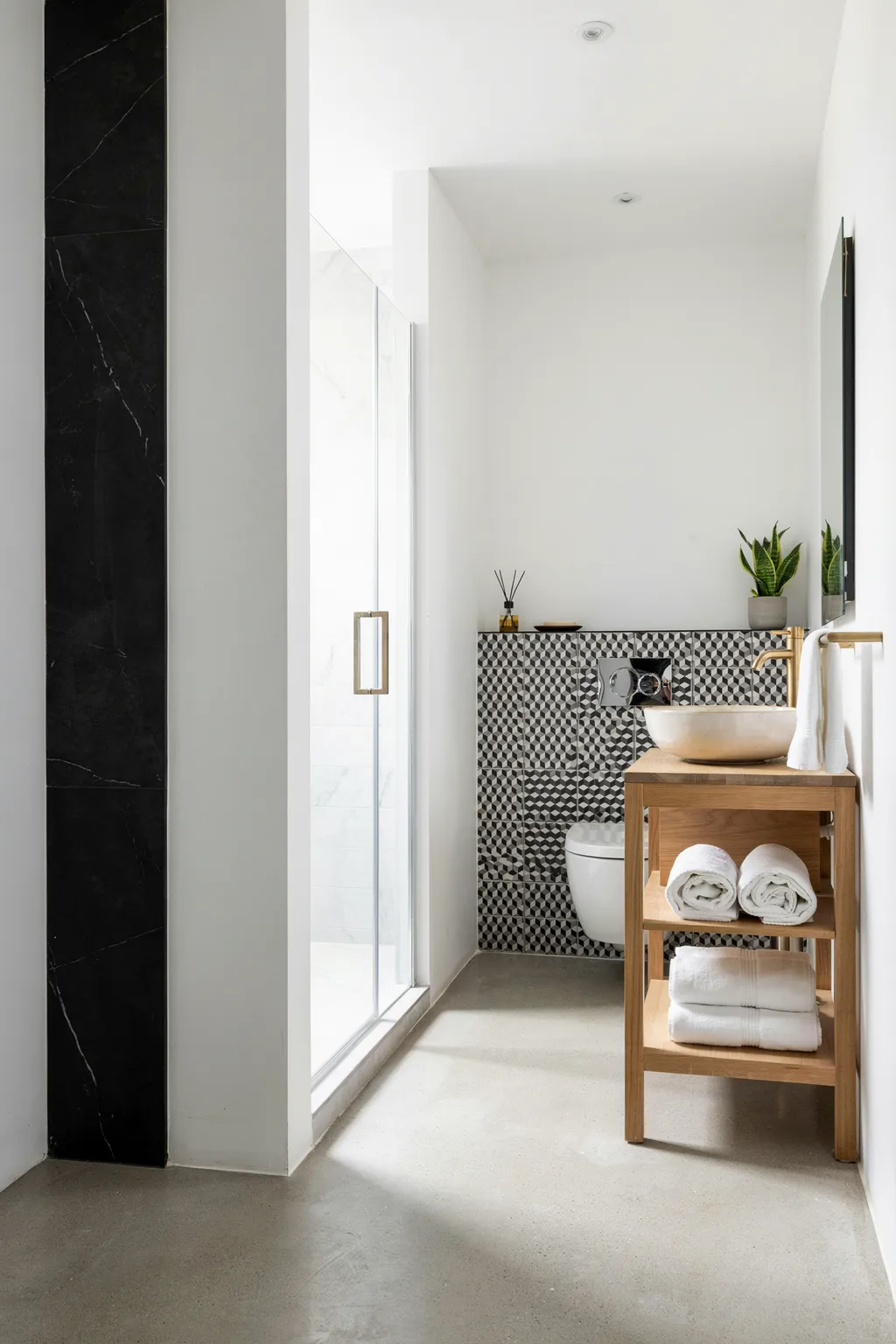
A small room shrinks when your eye stops at chair height. One fix is a single vertical band of dramatic tile that pulls your gaze straight up. Picture a strip of black marble running floor to ceiling beside the shower, set against crisp white and a black-and-white patterned backsplash. The contrast is loud, but because it is vertical and narrow, it stretches the wall instead of crowding it.
This works because the eye follows the longest line in a room. A horizontal border cuts the wall in half and makes it feel low. A vertical strip does the opposite, so even an 8-foot ceiling reads taller. Keep the strip to one wall and let the rest stay quiet. A 12-inch to 16-inch wide band is plenty. Go wider and you lose the slimming effect.
Skip this if your bathroom already has busy tile on three walls. Two bold patterns fighting each other will make the space feel chaotic, not tall.
2. Stack Slim Glass Shelves Over the Toilet
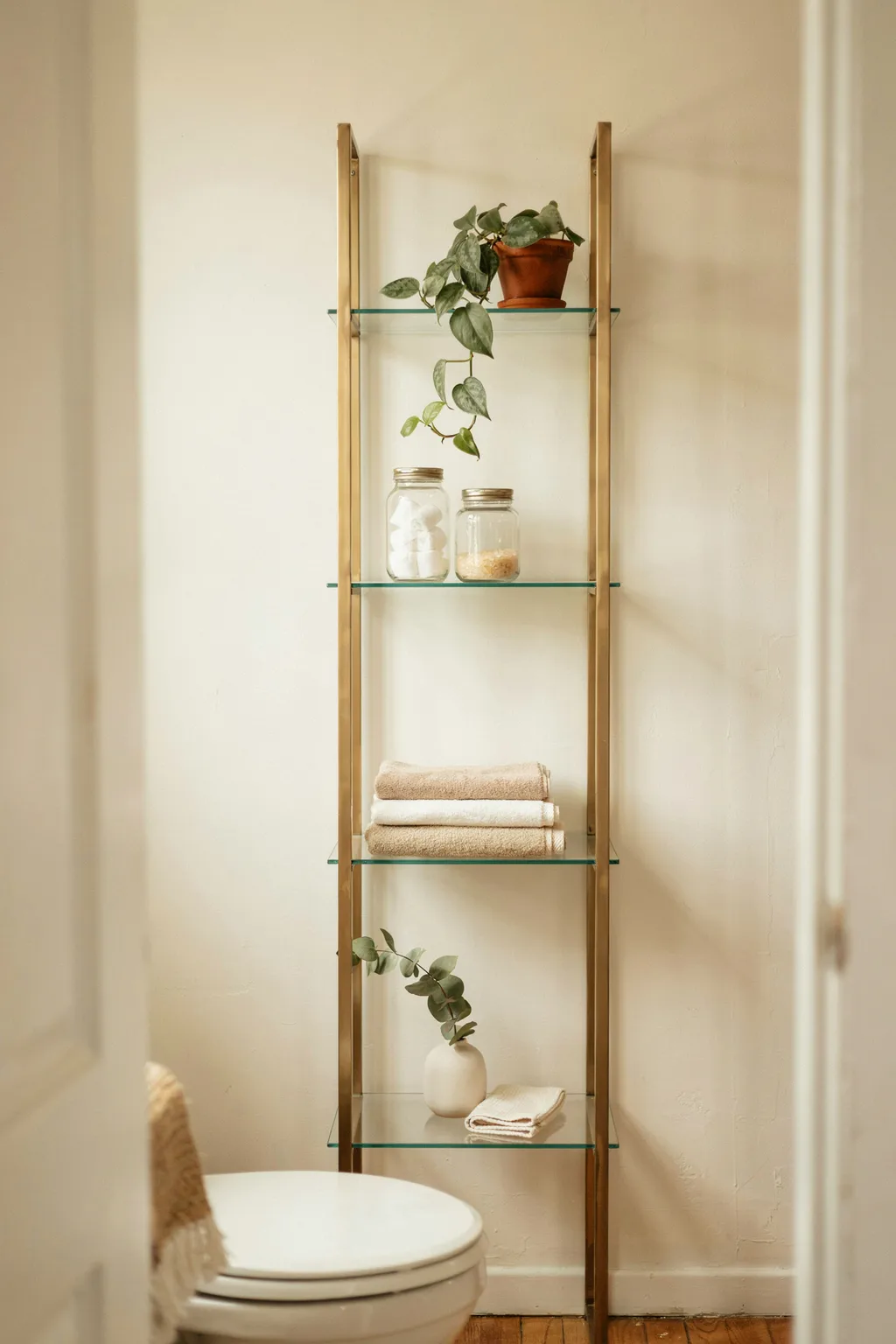
The wall above the toilet is the most wasted real estate in any bathroom. Instead of a chunky cabinet that juts out and eats headroom, mount a tall, narrow tower of glass shelves there. Glass almost disappears, so you get storage for jars, a small plant, and folded washcloths without adding a single visual wall.
Among small bathroom ideas, this one punches far above its cost. The reason it beats a closed cabinet is simple: you can see through it. A solid box reads as a heavy block and steals depth. A metal frame with glass shelves lets light and the wall color pass right through, so the corner stays airy even while it holds a dozen items. Keep the frame finish matte black or brushed brass to match your fixtures, and group items in odd numbers so it looks styled, not stuffed.
The honest drawback: glass shelves show every water spot and dust mote. If you hate wiping things down, pick a satin-finish wood shelf instead and accept a little less openness.
3. Float Wood Shelves and Fill Them With Plants
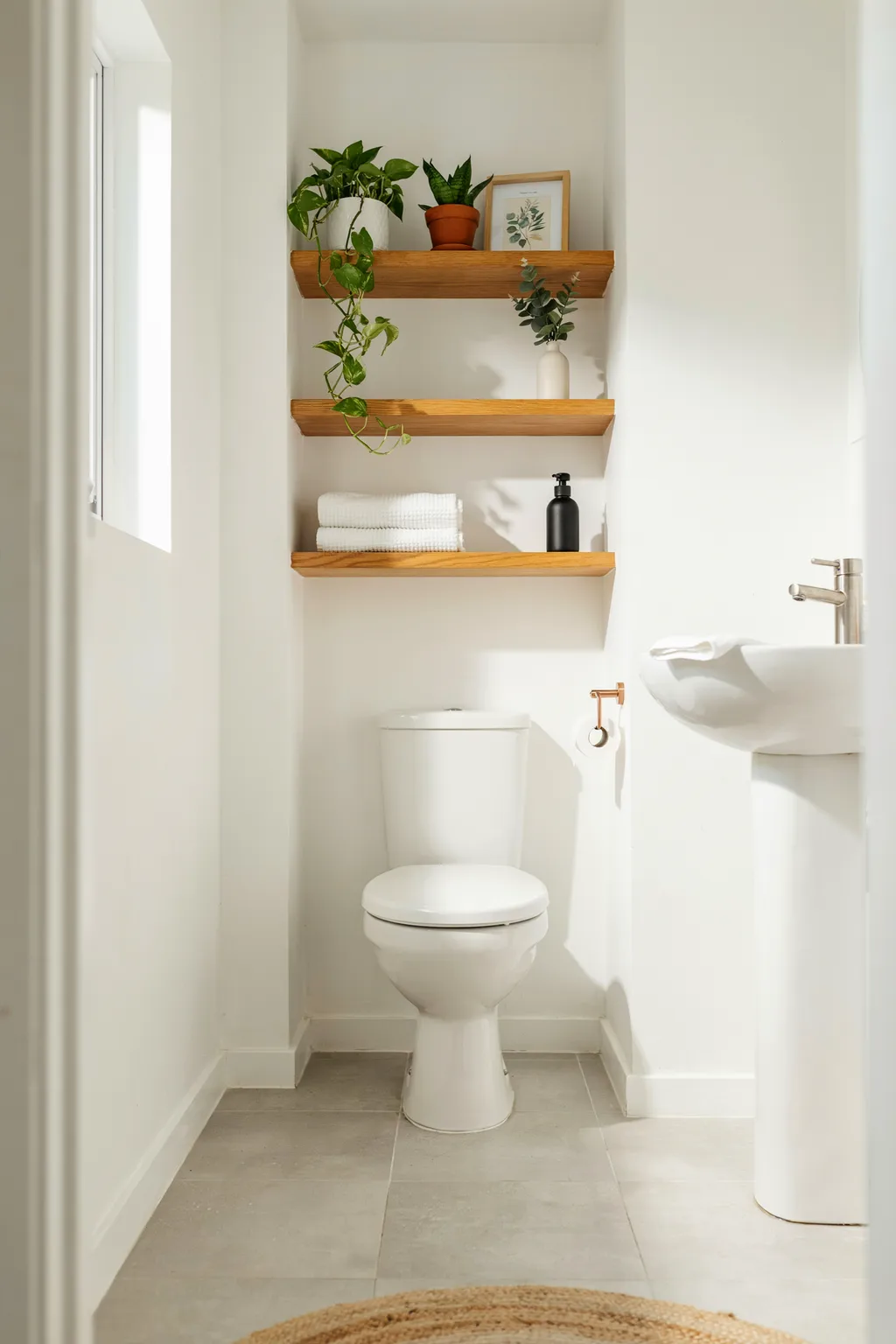
Open wood shelves set into the niche above the toilet do two jobs at once. They give you a spot for towels and bottles, and they turn a dead wall into the prettiest part of the room. Lean into greenery here. A trailing pothos, a snake plant, and one big leafy plant in a dark pot bring life to a space that is usually all hard surfaces.
Plants pull this off because soft organic shapes break up the boxy lines of tile, tub, and toilet. The eye reads a room with living things as calmer and, oddly, larger. Floating shelves keep the look light because there are no brackets or side panels to add bulk. Mount them on solid blocking or heavy-duty anchors, since a shelf full of pots and water can carry 30 pounds fast.
Not a plant person? Swap in faux greenery rated for humidity, or stick to white towels and a couple of ceramic pieces. The shelf still earns its keep.
4. Trade the Curtain for a Clear Glass Bath Screen
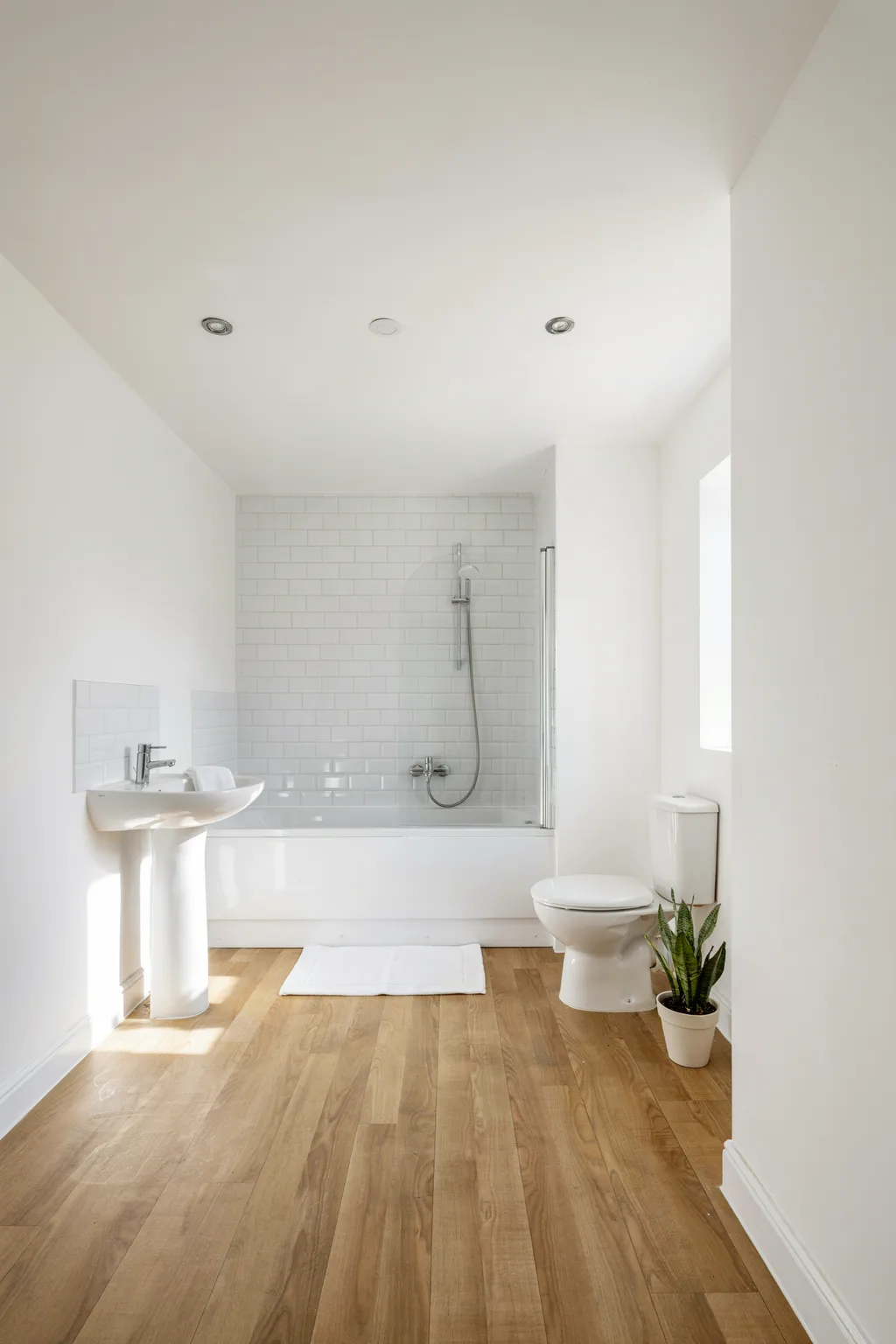
A fabric shower curtain is a wall. It slices your bathroom in two and hides half the floor, which is the fastest way to make a small room feel smaller. Replace it with a fixed clear glass panel on your tub. Suddenly your eye travels all the way to the back tile wall, and the room reads as one open box instead of two cramped halves.
The science is visibility. Any solid divider stops the eye and signals “the room ends here.” Clear glass lets your gaze pass through to the full depth of the tub-shower combo, so you perceive every inch you actually own. A half-panel hinged screen also keeps water off the floor without a track to trip over. Pair it with white subway tile and recessed lights for the biggest open feel.
The trade-off is cleaning and cost. Glass needs a quick squeegee to stay clear, and a screen runs more than a curtain. If your budget is tight, a clear or semi-clear curtain on a curved rod is the cheap middle ground.
5. Hang Clear Globe Pendants Instead of a Bar Light
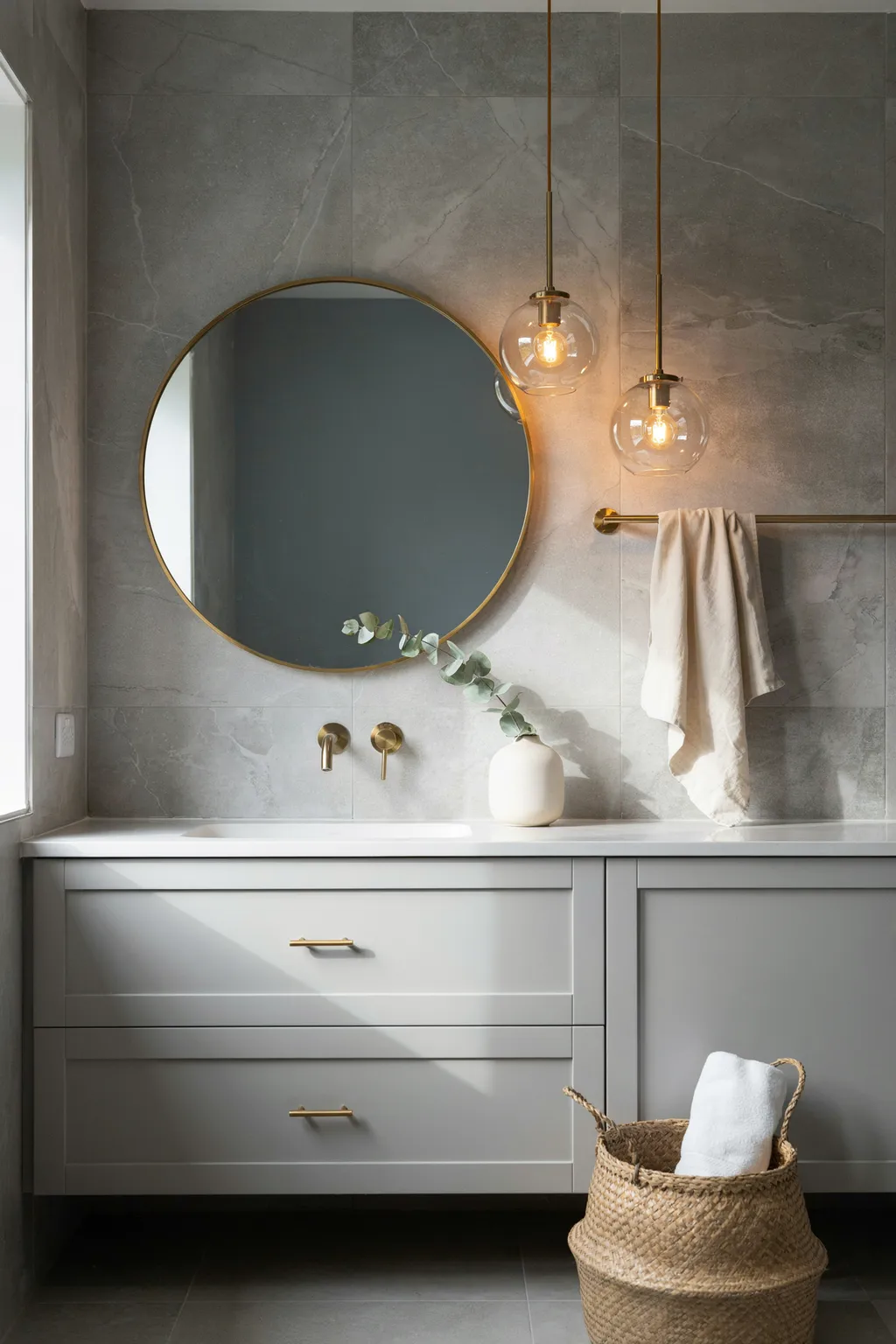
The standard vanity bar light sits flat against the wall and does nothing for the sense of space. Swap it for a pair of clear glass globe pendants that drop from the ceiling beside the mirror. Clear glass globes throw light in every direction and, because you can see straight through them, they never feel like clutter hanging in the air.
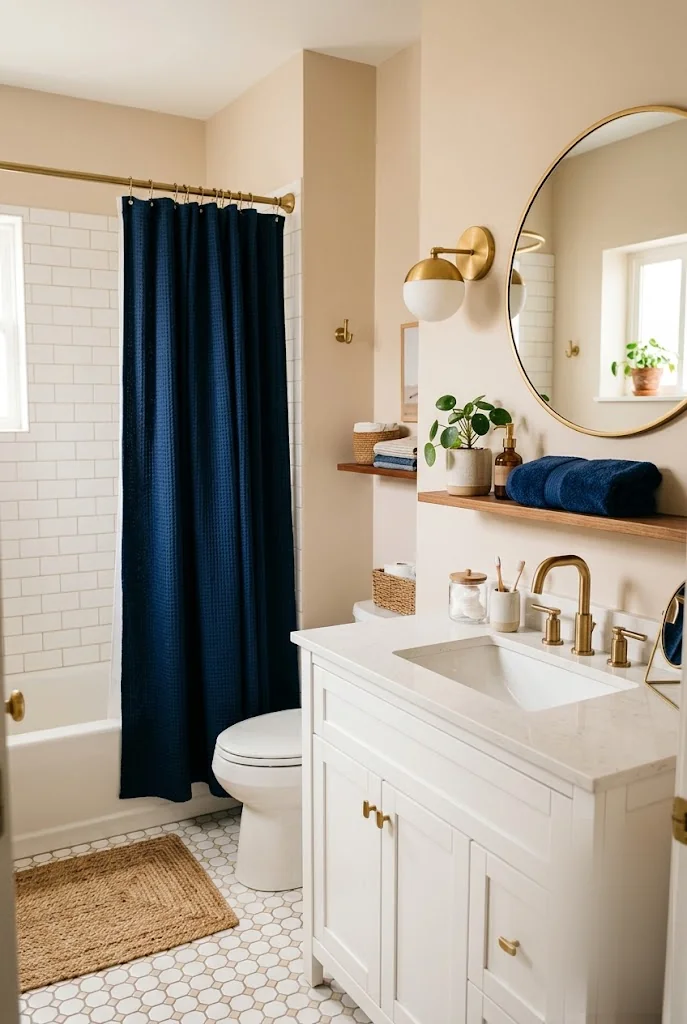
Lighting is one of the most underrated small bathroom ideas, and this swap works on two levels. First, the pendants draw the eye up to the ceiling, which makes the room feel taller. Second, light bouncing off a round mirror and grey stone tile fills the corners that a flat bar light leaves dim. Dark corners read as boundaries, so lighting them up makes the whole room feel like it extends further. Hang the globes so the bulb sits around eye level when you stand, roughly 65 to 68 inches off the floor.
For more on layering bathroom light well, the American Lighting Association’s home lighting guides break down ambient, task, and accent layers in plain terms. Skip pendants only if your ceiling is under 7.5 feet, where they may feel cramped.
6. Layer Light Around a Round Mirror
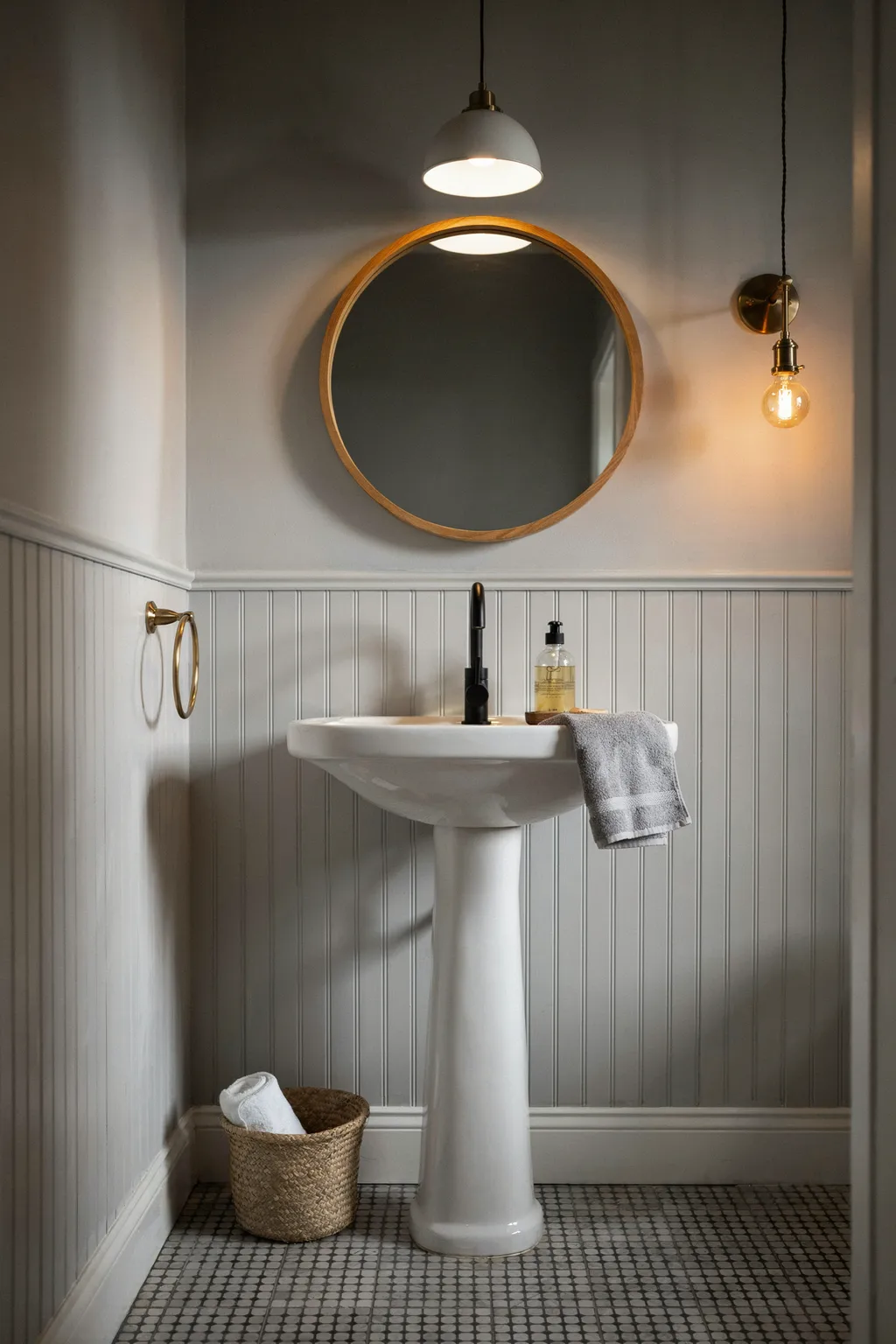
In a long, narrow powder room, a single ceiling fixture leaves the sink in shadow. The fix is to layer: a dome pendant overhead plus an exposed-bulb sconce mounted on the wall just above a round, wood-framed mirror. The two light sources erase shadows and, because the mirror sits in the brightest spot, it bounces that light back across the room.
A round mirror matters more than people think in a skinny space. Straight walls, a rectangular sink, and a door all give you hard right angles. A circle breaks that grid and softens the whole room, which keeps a narrow layout from feeling like a hallway. White wainscoting on the lower wall and a patterned floor tile add interest without shrinking anything, since they sit low and let the bright upper wall breathe.
The caveat: an exposed-bulb sconce throws glare if you pick a too-bright bulb. Stick to 2700K warm white around 450 to 800 lumens so the light flatters skin and does not blind you at the mirror.
7. Mount One Floor-to-Ceiling Mirror
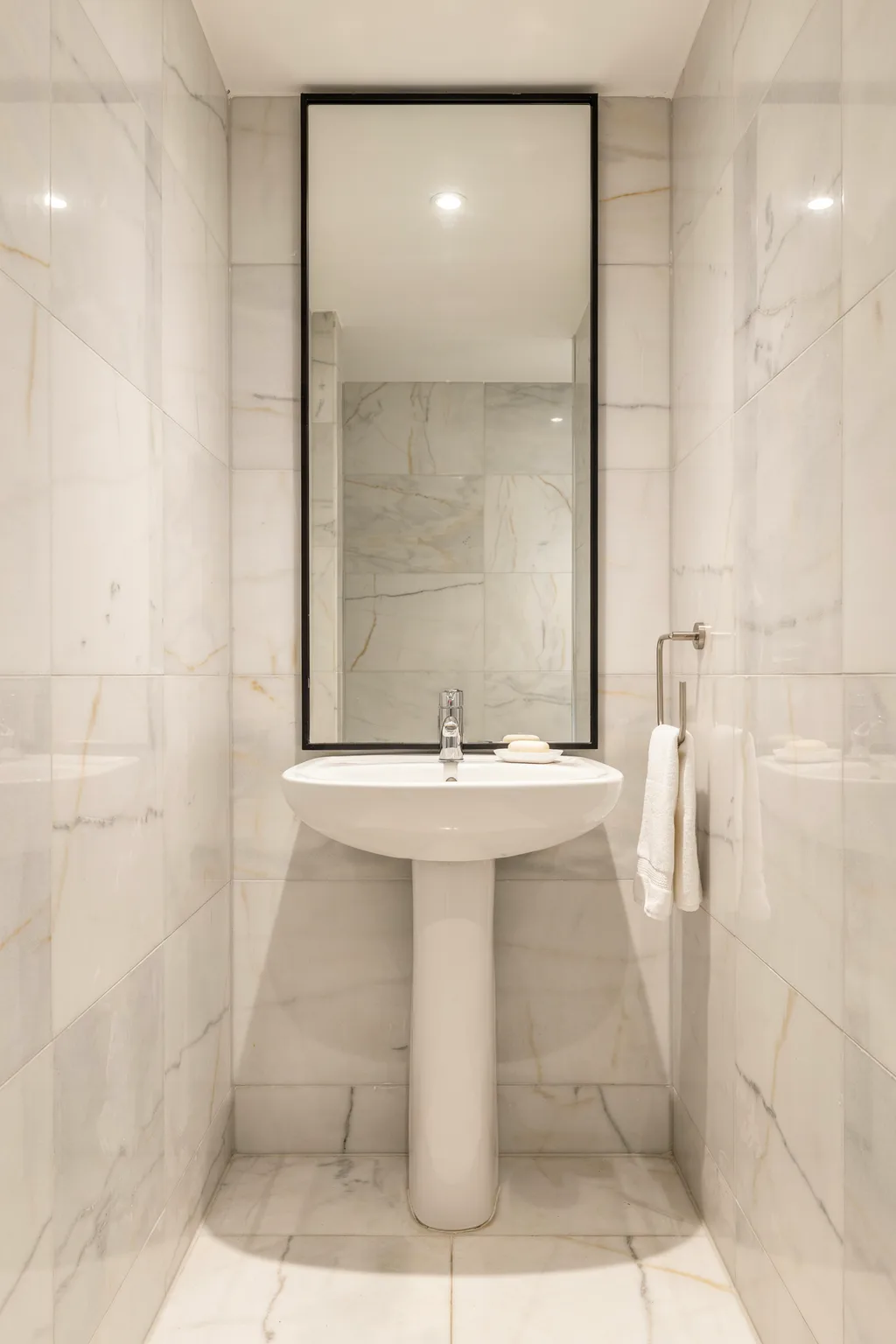
When a bathroom is barely wider than the door, one big mirror does more than any other change. Mount a single floor-to-ceiling mirror on the wall above the sink so it covers nearly the full height. The reflection doubles the apparent depth and pours every bit of light back into the room, so a closet-sized water closet suddenly feels like it has somewhere to go.
A tall mirror beats a small one because of how reflection reads to the brain. A little mirror frames a slice of the room; a full-height mirror reflects the whole wall, the ceiling line, and the light fixture, so your eye believes the space continues past the glass. Frameless or thin-framed is best here, since a chunky frame reintroduces the boundary you are trying to erase. Run it edge to edge over the vanity for the strongest effect.
This is one of the few small bathroom ideas with almost no downside, beyond the cost of a large mirror and careful anchoring into studs. Just avoid placing it where it reflects clutter or the toilet straight on.
8. Split the Walls Into Two Calm Color Bands
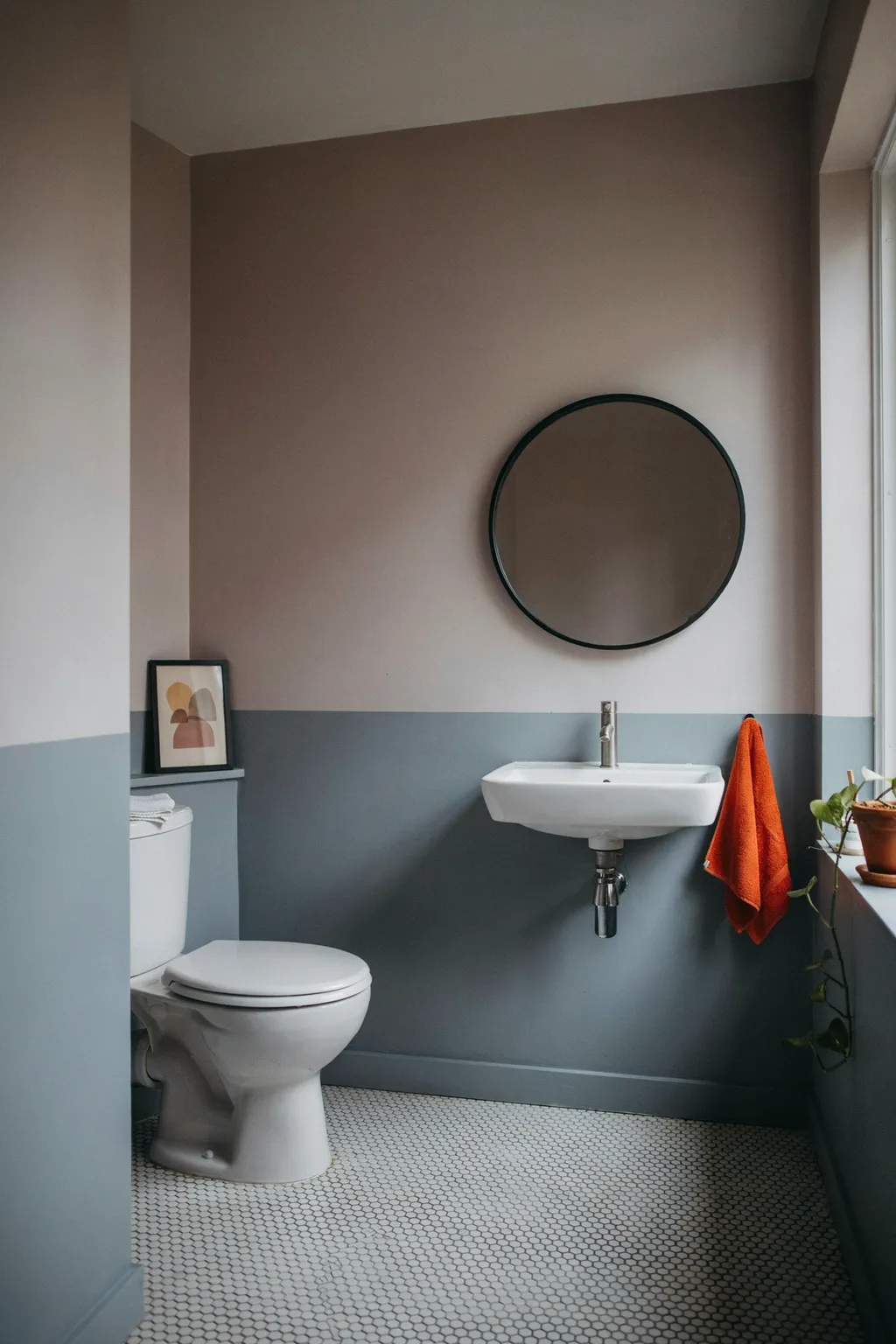
Bold color and small rooms are not enemies, as long as you place the color right. Try two-tone walls: a muted mauve up top meeting a slate blue below, divided by a clean horizontal line near the sink. It sounds risky in a tight space, yet the calm, dusty tones keep it grounded instead of loud, and the color gives the room personality most small baths never get.
Two bands work because the lighter color sits at eye level and above, where it keeps the room feeling open, while the deeper tone anchors the bottom like a baseboard. The split also adds a subtle horizontal rhythm that makes the wall feel wider. Keep both colors low in saturation, almost greyed out, so they recede rather than press in. A round mirror and a pop of orange in a towel keep it from feeling flat.
The honest caveat: this needs decent natural or warm light. In a windowless bathroom with cool LEDs, muted colors can turn muddy and gloomy. Test big swatches first.
9. Add Pattern With Soft Textiles, Not More Tile
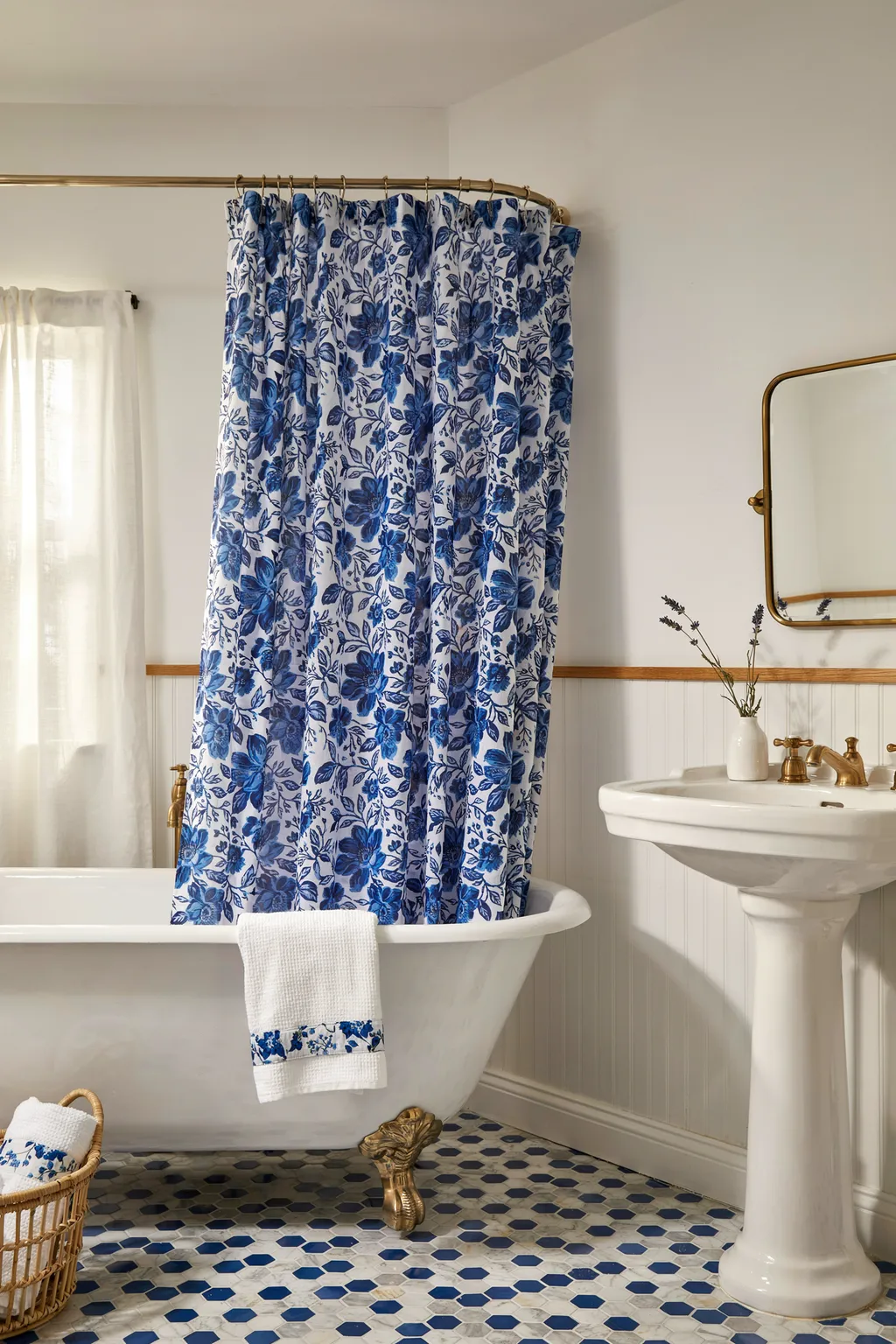
You want pattern, but retiling is expensive and permanent. The renter-friendly answer is to bring the pattern in through textiles instead. A bold blue-and-white floral shower curtain, a matching trim towel, and a patterned bath mat give the room a designed, layered look you can swap out any season without a contractor.
Textiles win here because they are soft, removable, and cheap. Tile locks you into one look for a decade; a curtain costs the price of lunch and changes the whole mood in five minutes. The fabric also softens the echo and hard edges of an all-tile room, which makes it feel cozier and, because the pattern draws the eye to one focal wall, larger by contrast. Keep the rest of the room plain white so the pattern has room to sing.
The drawback is upkeep. Fabric in a wet room needs washing to fight mildew, so pick machine-washable pieces and hang the curtain to dry fully between showers.
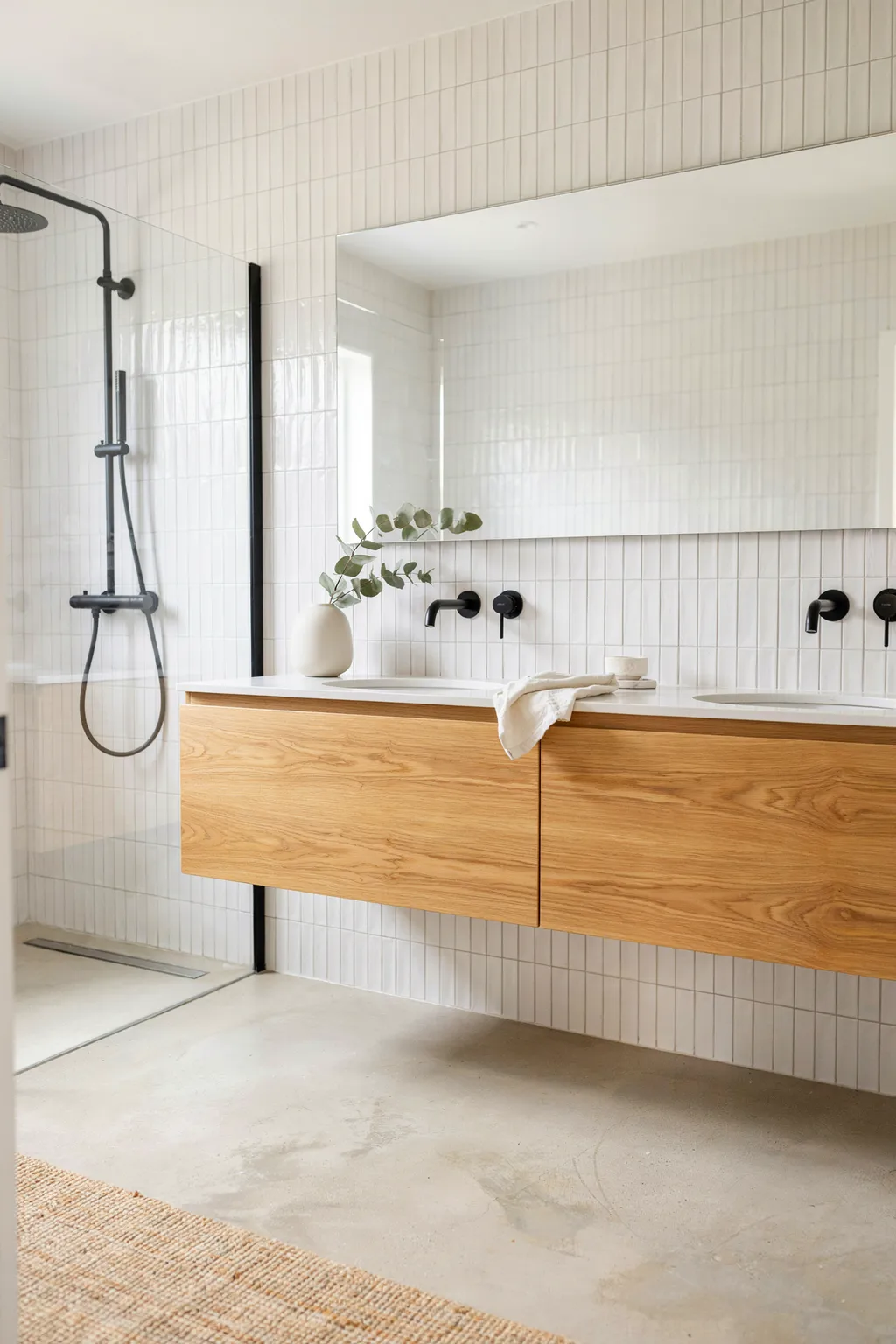
10. Wall-Mount a Floating Vanity to Show More Floor
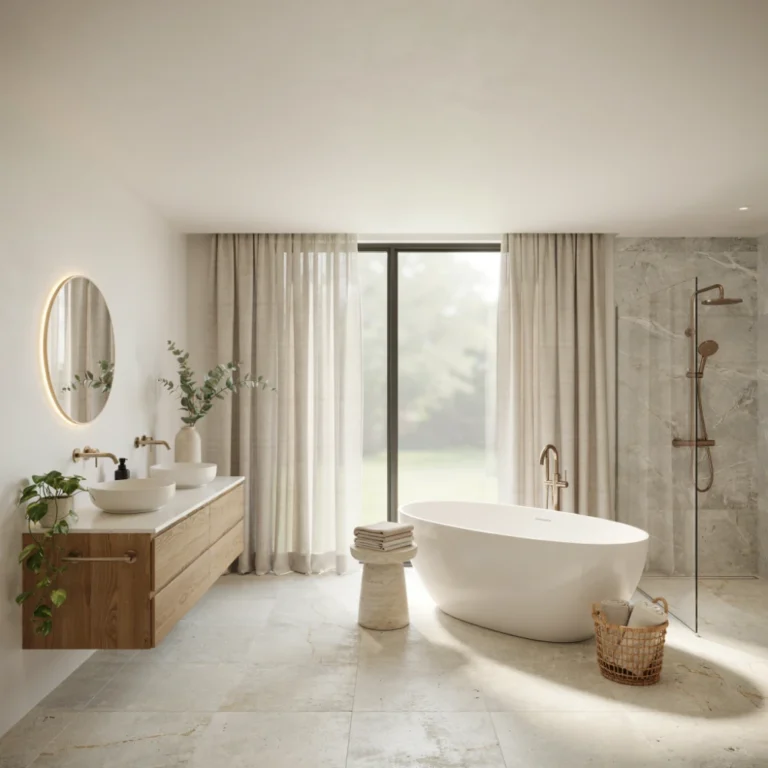
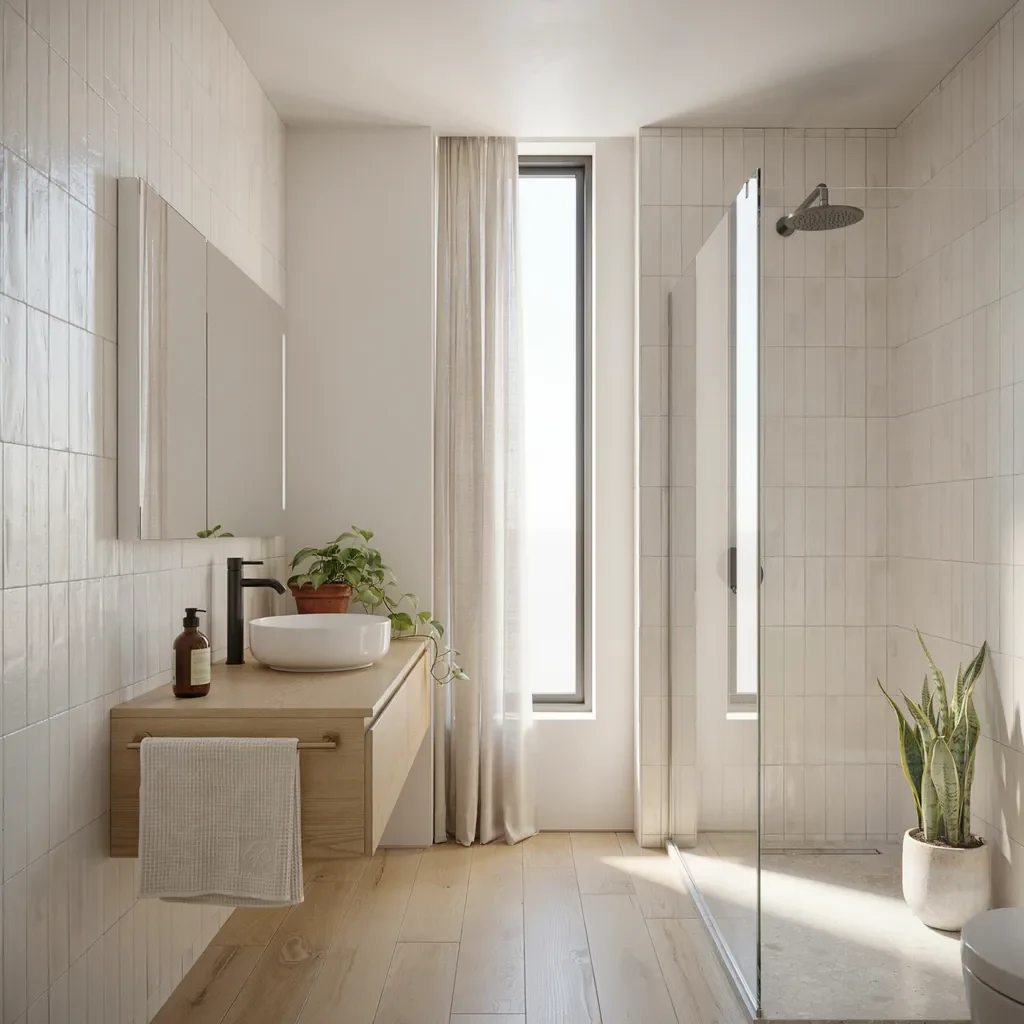
The single biggest spaciousness trick is showing more floor. A vanity that sits on the ground hides a big rectangle of tile and reads as a heavy block. Wall-mount it instead, so it floats with open floor visible underneath, and the room instantly feels lighter. A clean floating double vanity in light wood under a full mirror is a textbook example of the light, open feel this brings.
Visible floor is the whole game. The brain judges room size partly by how much floor it can see, so every square foot of tile that peeks out under a floating vanity registers as more space. The look also reads as modern and intentional, and the gap underneath makes cleaning the floor far easier. Mount it into solid blocking, since a floating vanity carries real weight from the basin and counter.
If you store a lot under the sink, a floating unit gives you slightly less volume than a floor cabinet. Choose drawers over a single deep cupboard to claw back usable space.
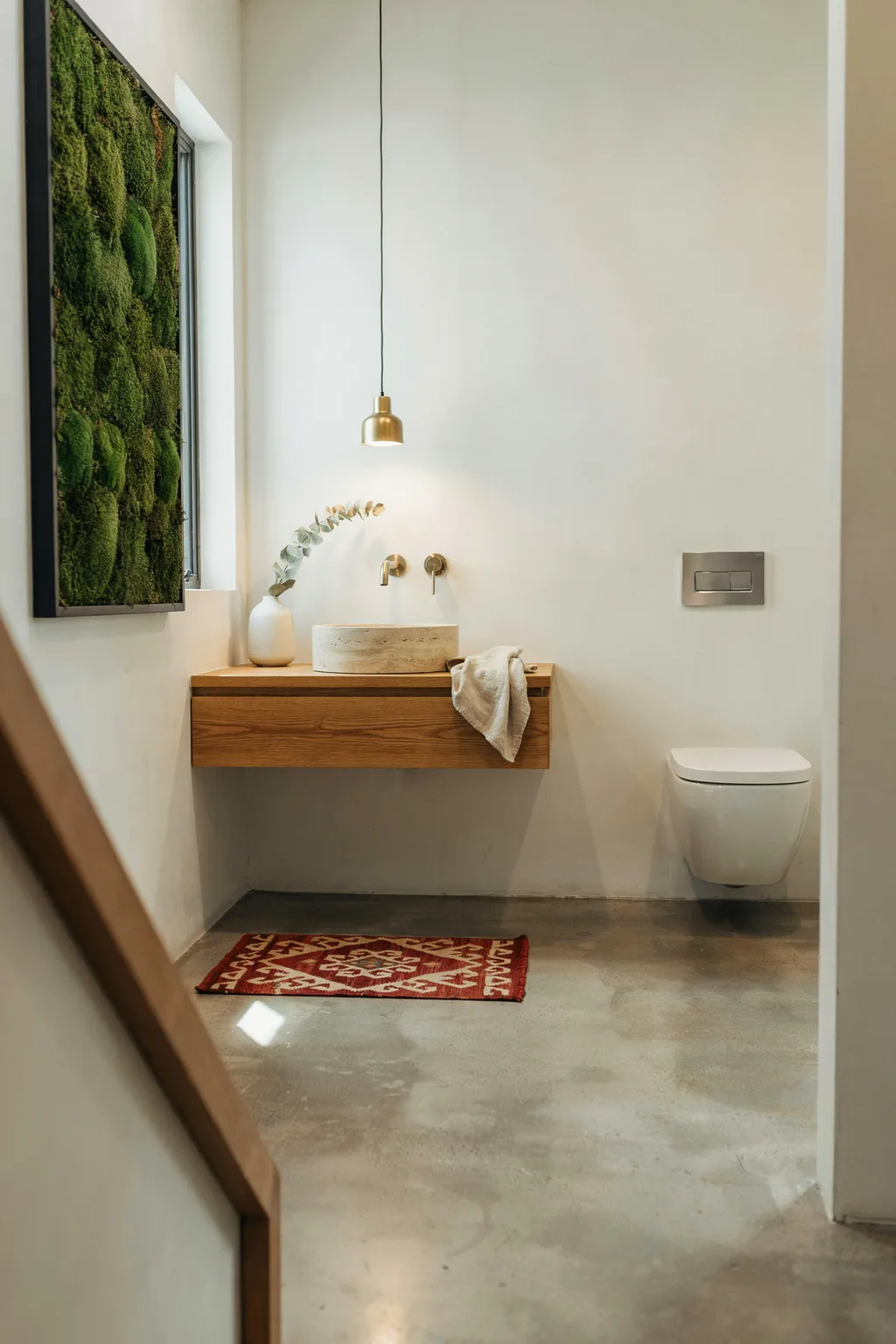
11. Build a Living Green Accent by the Window
Bring the outdoors in with a vertical green accent, like a moss or preserved-plant panel set on the wall beside the window. Against warm wood and a vessel sink, the strip of living green becomes the focal point and gives a small bathroom a spa-like calm that paint alone cannot match. It is unexpected, and unexpected reads as designed.
Greenery works because it adds depth and texture without adding bulk. A flat panel of moss sits nearly flush to the wall, so it takes no floor and no counter, yet it fools the eye into reading the room as deeper and more layered. Placing it by the window also ties it to the natural light, which keeps the green looking alive. A floating wood vanity and a soft area rug warm up the rest of the palette.
Real plants need humidity and light they may not get, so preserved moss or quality faux panels are the practical pick for a windowless or low-light bathroom. Check that the panel is rated for damp rooms.
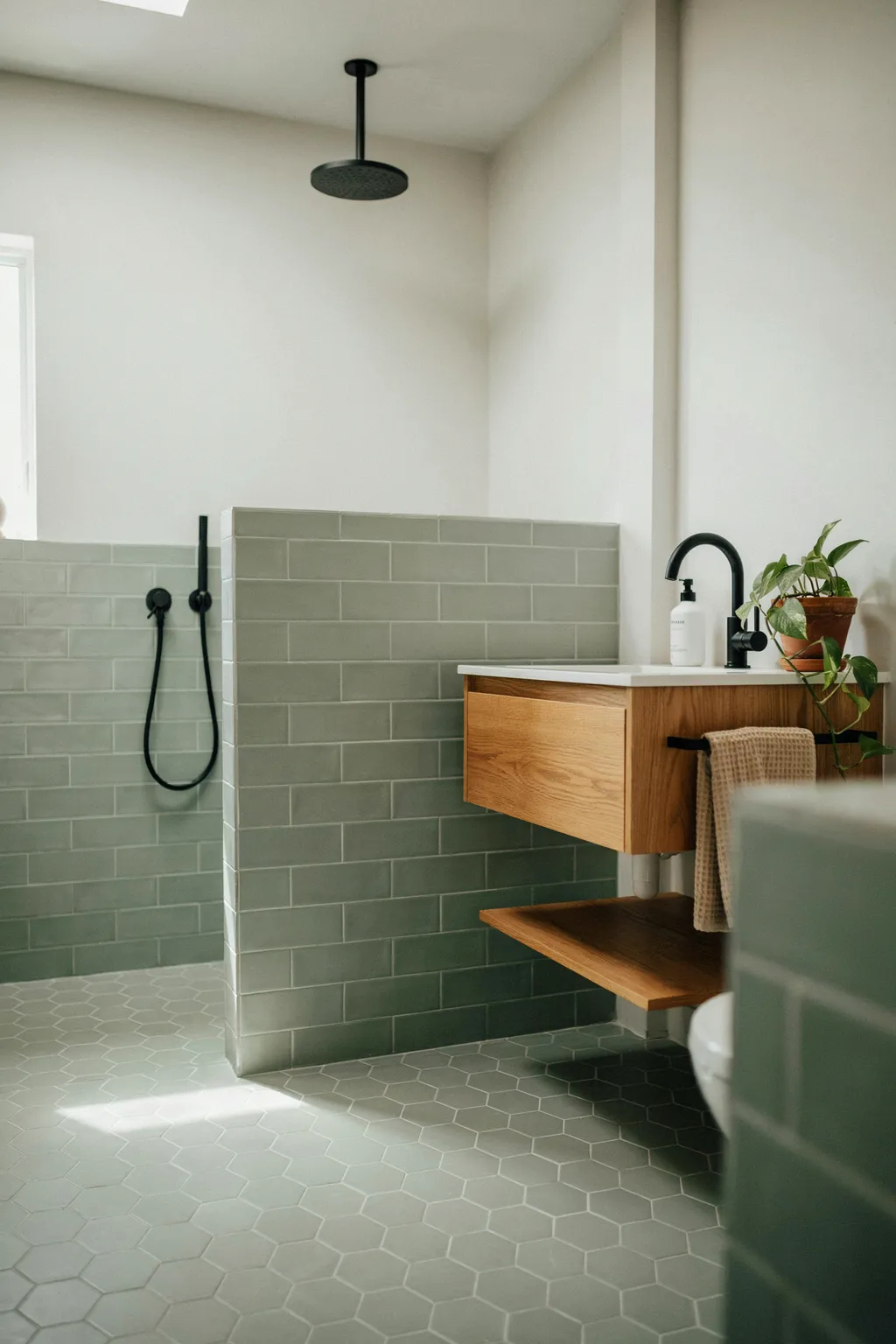
12. Use a Half-Wall to Split the Shower Without Closing It In
An open walk-in shower feels great until water sprays the whole room. The middle path is a tiled half-wall: a partial divider, maybe waist to chest height, that contains the splash while leaving the top half open. In a sage-green subway-tiled bath with a wood vanity, the half-wall defines the shower zone without boxing it off behind a full glass enclosure.
The reason it keeps the room feeling big is sight lines. A full wall or frosted enclosure stops your eye and chops the floor plan into rooms. A half-wall lets your gaze sail over the top to the tile and light beyond, so the bathroom still reads as one connected space while the shower stays its own zone. It also gives you a small ledge for soap and a spot to anchor a glass panel if you want a little extra splash control up top.
The honest limit: a half-wall alone will not stop all spray from a strong rainhead. Add a short fixed glass panel above it, or keep the showerhead angled away from the open side.
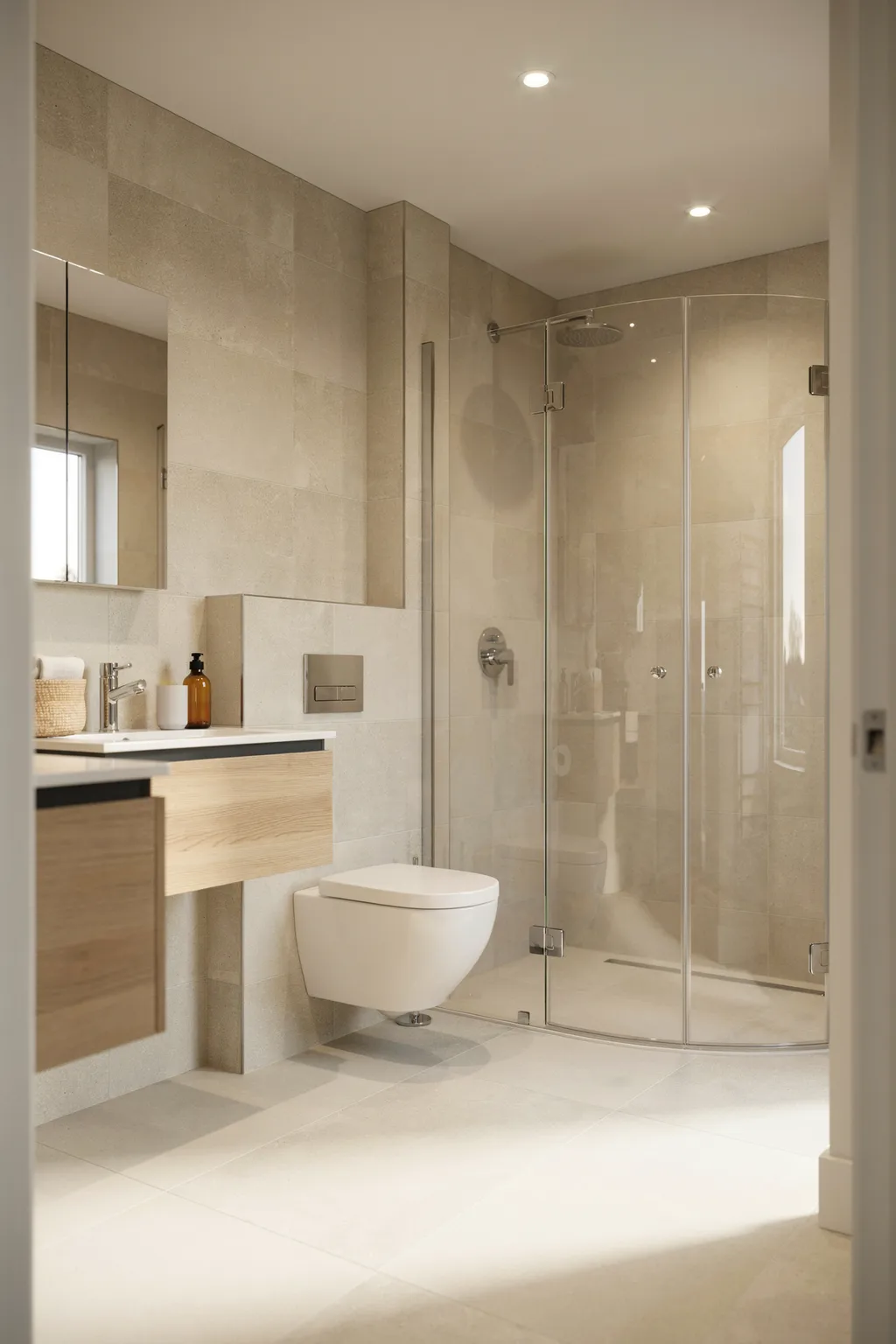
13. Tuck a Curved Corner Shower Into the Tightest Wall
When floor space is brutal, push the shower into a corner with a neo-angle, curved glass enclosure. The rounded front takes up far less of the room than a square shower box, and the corner placement frees the center of the floor for everything else. In a soft neutral bathroom, a curved glass corner shower beside a wall-hung toilet keeps the whole layout breathing.
This shape is efficient because the curve cuts the corner instead of squaring it off, so you keep a usable shower while reclaiming the floor a boxy unit would steal. Clear curved glass also keeps the openness, since you see right through to the tiled corner. Pair it with a wall-hung toilet and a vanity with an open shelf, and the floor reads almost empty, which is exactly the feeling you want. A neo-angle unit fits a standard corner footprint around 36 by 36 inches.
The trade-off is showering room. A corner unit is snug inside, so if you want elbow space, this is not your pick. Taller folks especially should test the footprint before buying.
14. Keep One Seamless Color Across Every Surface
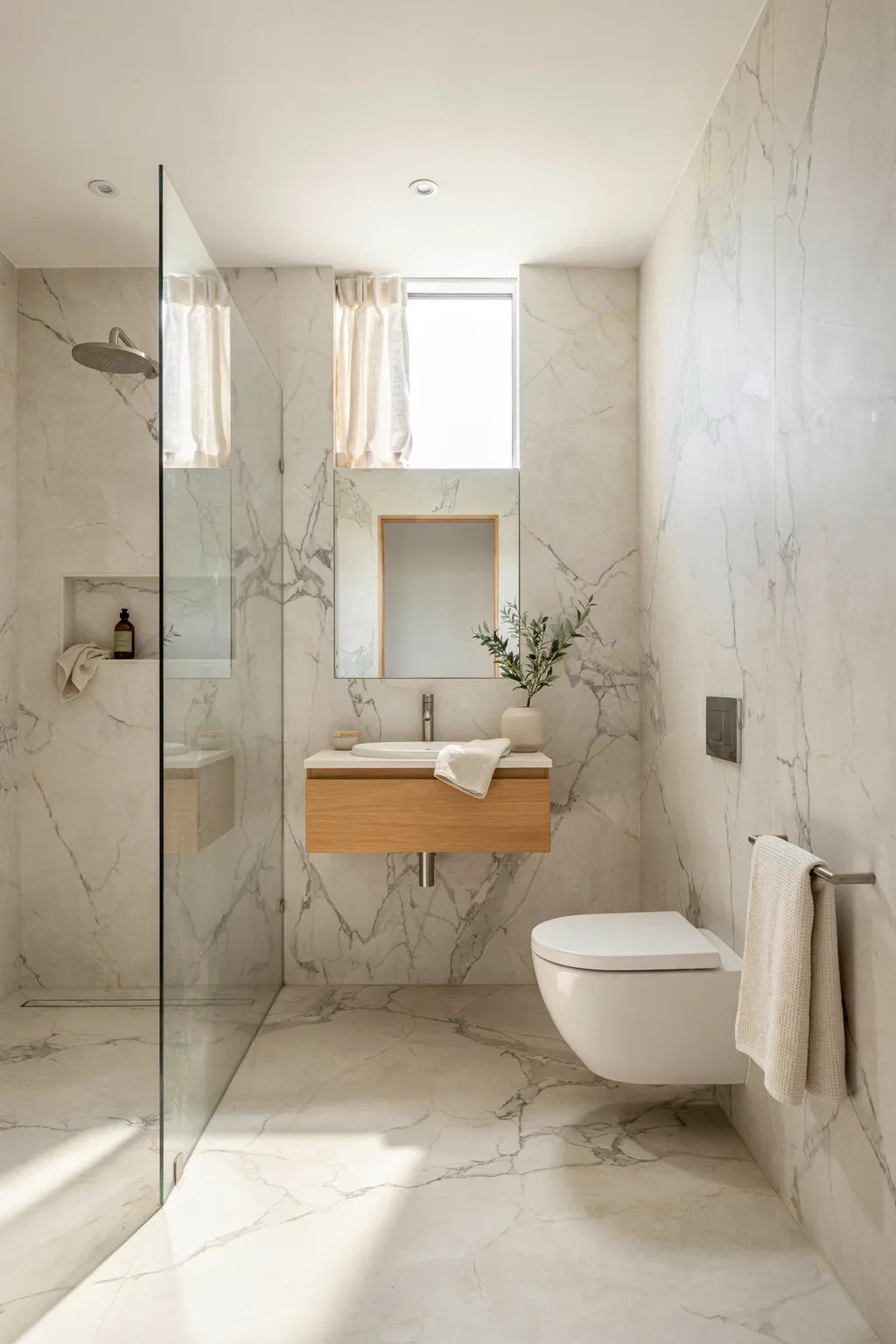
Sometimes the most spacious look is the quietest one. Run a single seamless palette, like a soft cream marble, across the walls, floor, and shower so nothing interrupts the eye. With no hard color breaks, the surfaces blur together and the boundaries of the room seem to dissolve, which makes a modest bathroom feel calm and noticeably bigger.
Of all the small bathroom ideas here, this is the most restrained, and that restraint is the point. Every contrast line tells your brain “edge here.” Strip those lines out and the eye glides from floor to wall to ceiling with nothing to stop it, so the room reads as one continuous, larger volume. A monochrome scheme also feels intentional and high-end, and it hides a lot of visual clutter. Keep textures varied, a matte floor against a polished wall, so seamless does not turn into boring. A glass shower and a wall-hung toilet keep the floor line clean.
The caveat: an all-one-color room can feel cold or clinical without warmth. Add a wood stool, a soft towel, or a heated towel rail to break the chill.
15. Layer Open Corner Shelves for Storage Without Bulk
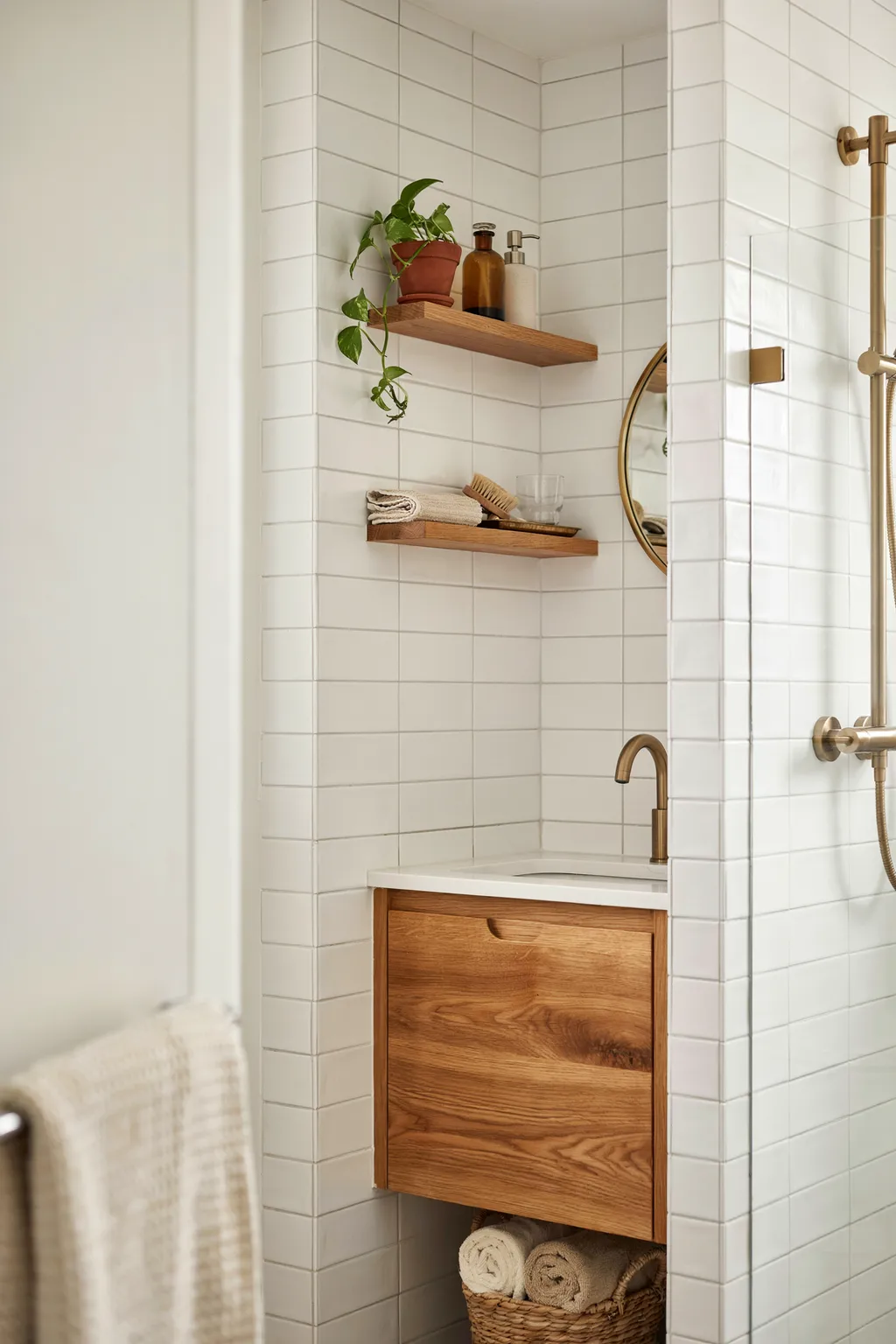
Awkward corners are usually wasted, but they are perfect for layered open shelves. Stack two or three slim wood shelves into the corner above the vanity, mix in a round mirror and a few brass fixtures, and you get real storage that never reads as bulky. The open shelves hold daily bottles and a folded towel while keeping the wall light and the corner alive.
Open shelving works in a small bathroom because there are no cabinet doors to swing into your space and no solid box to block light. Floating the shelves in a corner also uses a spot a standard cabinet cannot reach, so you gain storage from dead square footage. Stagger the shelf lengths and leave breathing room between items, since a packed shelf reads as clutter and clutter shrinks a room fast. Brass fixtures and white subway tile keep it warm and bright.
The trade-off is that everything is on display, so you have to keep it tidy. If your counter overflows with bottles, add one closed drawer below for the messy stuff and reserve the shelves for the pretty pieces.
Common Mistakes to Avoid
Mistake 1: Painting the walls a dark, heavy color
A deep navy or charcoal can look stunning in photos, but in a windowless small bathroom it soaks up light and presses the walls inward. The fix costs a weekend and a can of light, warm paint. Save the drama for one narrow accent strip, not all four walls. If you still want the dark look done properly, our black bathroom decor ideas show how to keep it feeling open.
Mistake 2: Hanging one small mirror over the sink
A little mirror reflects a sliver of the room and wastes your best space-doubling tool. Go as large as the wall allows, ideally floor to ceiling or at least the full width of the vanity, so the reflection adds real perceived depth.
Mistake 3: Choosing a bulky vanity with a solid base
A floor-standing cabinet hides floor and reads as a heavy block. A floating vanity or a pedestal sink shows more floor and lightens the room. If you need storage, get it from the walls instead.
Mistake 4: Using a fabric shower curtain across the room
A solid curtain cuts the room in half and hides the tub. A clear glass screen or even a clear curtain lets the eye reach the back wall, which makes the whole space feel open and connected.
Mistake 5: Cramming in too much open storage
Open shelves are great until they overflow. A wall of visible clutter shrinks a room faster than any wall color. Keep open shelves styled and sparse, and hide the daily mess in one closed drawer.
Mistake 6: Skipping ventilation and good light
A dim, stuffy bathroom feels small and unpleasant no matter how you style it. A proper exhaust fan and bright, layered, warm lighting do more for the feel of space than most decor. Damp, dark corners always read as cramped.
Mistake 7: Matching grout to a busy patterned floor
Loud floor tile with high-contrast grout chops the floor into a grid and makes it feel smaller. Match grout close to the tile color, or pick a calmer floor, so the floor reads as one continuous surface.
Quick Start Checklist
- [ ] Measure your bathroom and note the one wall with the most usable height
- [ ] Pick three ideas from this list that fit your actual layout, not all 15
- [ ] Swap any small mirror for the largest one your wall allows
- [ ] Replace a fabric shower curtain with a clear screen or clear curtain
- [ ] Move at least one storage item from the floor up onto a wall shelf
- [ ] Choose a light, warm wall color and test a big swatch before buying
- [ ] Add layered lighting: one overhead plus one task light at the mirror
- [ ] Clear the counter down to three styled items and box the rest
- [ ] Add one living or faux plant for softness and life
- [ ] Confirm your exhaust fan actually clears steam in a few minutes
Frequently Asked Questions
What is the best color for a small bathroom?
Light, warm, slightly off-white tones win most often, since they bounce the most light and blur the wall edges. Soft greige, pale sage, and warm white all open a room. If you want color, keep it low in saturation and put the lightest shade at eye level so the walls still feel like they recede.
Do large tiles or small tiles make a bathroom look bigger?
Large tiles usually win because they create fewer grout lines, and fewer lines mean fewer visual breaks to chop up the surface. A large-format floor tile run wall to wall reads as one continuous plane. If you love small tile, keep the grout color close to the tile so the pattern stays calm.
How do I add storage to a tiny bathroom without clutter?
Go vertical and go up the walls. Slim glass shelf towers over the toilet, floating corner shelves, and a mirrored cabinet all add storage without eating floor. Keep open shelves styled and sparse, and tuck daily mess into one closed drawer so the room still feels open.
Should a small bathroom have a tub or just a shower?
It depends on your needs and resale market. A walk-in shower, especially a corner or curved unit, frees the most floor and feels biggest. But if you have young kids or buyers expect a tub, a tub-shower combo with a clear glass screen gives you both without losing the open feel.
Can renters make a small bathroom feel bigger?
Yes, and several of these small bathroom ideas need no permission at all. Swap in a clear or patterned shower curtain, add a large leaning or adhesive mirror, bring in plants and textiles, and pull storage onto removable wall shelves. None of it touches the tile or the plumbing.
How much does it cost to make a small bathroom feel more spacious?
Less than you would guess. A new mirror, a glass curtain rod, paint, and a couple of wall shelves can run well under a few hundred dollars. Bigger swaps like a glass screen, a floating vanity, or a corner shower cost more, but you can stage them one at a time.
Conclusion
A small bathroom does not need more square footage to feel bigger; it needs fewer things stopping your eye. Show more floor, reflect more light, and stretch your gaze upward, and the same room reads as open and calm instead of cramped.
If you take just a few things from this list, make them these. First, go big on the mirror, because nothing else doubles perceived space so cheaply. Second, get storage and the vanity off the floor so you can see the tile underneath. Third, trade any solid curtain for clear glass so your eye reaches the far wall. Fourth, keep the walls light and the palette calm so the surfaces blur together. Fifth, pull the clutter off the counter, because a tidy room always feels larger than a busy one.
Pick one change this weekend. Hang the bigger mirror or swap the curtain, live with it for a few days, then add the next. Stack a handful of these small bathroom ideas and the room you dreaded will start to feel like one you actually enjoy.
You Might Also Like
- ▸15 Black Bathroom Decor Ideas That Feel Luxe, Not Dark
- ▸21 Creative Small Bathroom Ideas to Make Tight Spaces Feel Bigger
- ▸19 Bathroom Towel Hanging Ideas That Look Stylish
- ▸24 Gorgeous Mediterranean Bathroom Tile Ideas
- ▸19 Modern Bathroom Ideas That Look Effortlessly Luxe
- ▸19 Spa Bathroom Ideas for a Relaxing Retreat at Home