15 Ways to Style Navy Blue Kitchen Cabinets in Any Light
The paint looks incredible for about four days. Then you notice the room goes dim earlier than it used to, every fingerprint near the fridge shows up like evidence, and the white countertop you always liked now reads faintly blue and slightly cold.
Navy is not a difficult color. It is an unforgiving one. It shows more, it absorbs more light, and it depends far more on what surrounds it than a soft white ever did.
Which is why most advice about navy blue kitchen cabinets jumps straight to hardware. Hardware is the easy part, and it is the part somebody can sell you.
The harder questions are which navy suits the light you actually have, whether the uppers should be navy at all, what sheen survives a working kitchen, and what goes on the counter beside it.
Fifteen decisions below, in roughly the order you have to make them. Four of them cost nothing. Two work in a rental without a drill.
1. Classic Navy Shaker Kitchen with White Quartz and Brass Hardware
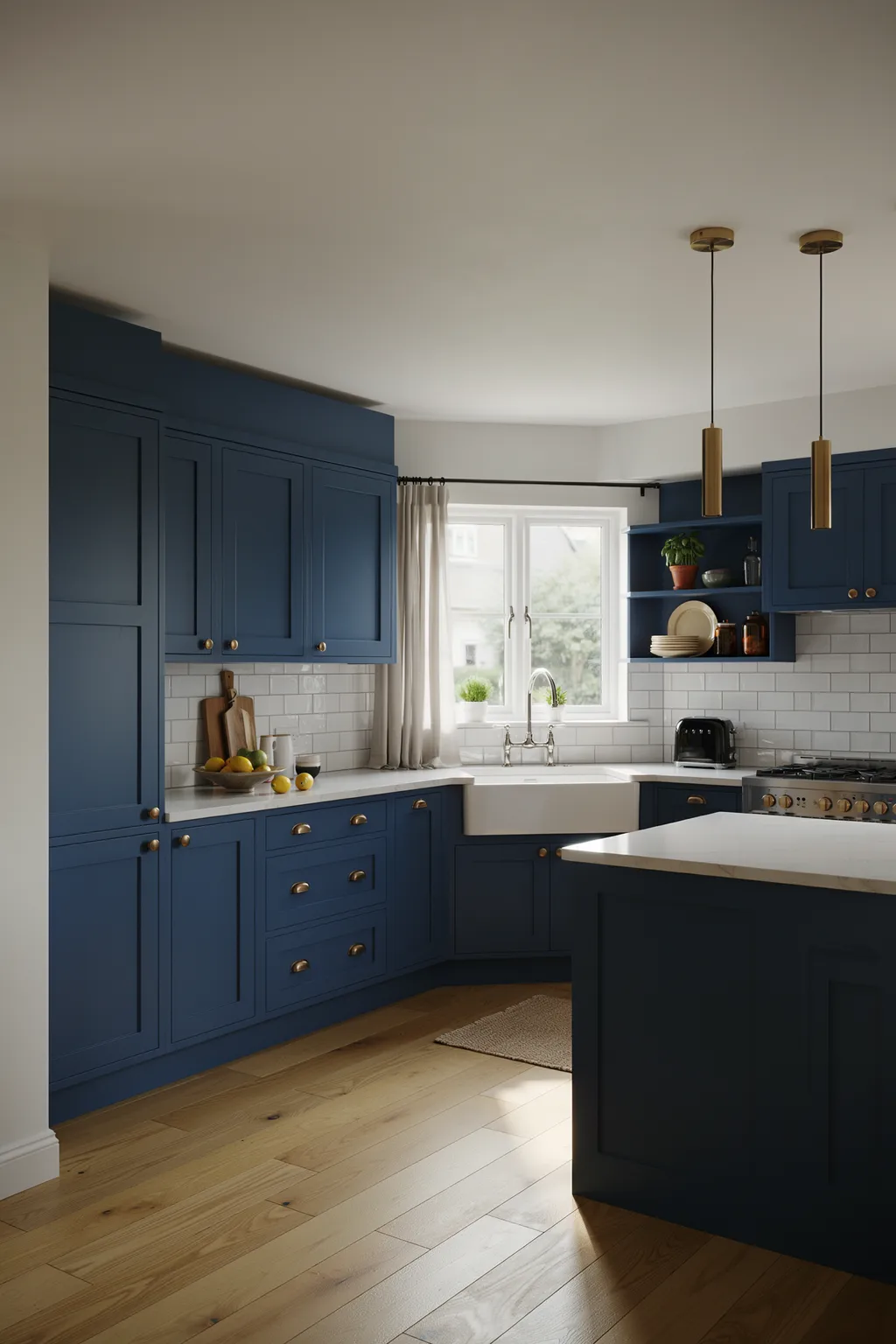
Shaker doors are the reason this look barely dates. The flat centre panel and simple frame trace back to Shaker furniture-making, and that same restraint is why it shows up in real kitchens decade after decade rather than just in a single trend cycle.
White quartz counters and a plain subway tile backsplash keep everything else quiet, so brass hardware becomes the one clear accent in the room. Repeat that same brass across the tap and the pendant lights rather than introducing a second metal, and the kitchen reads considered rather than assembled from separate purchases.
2. Two-Tone Navy and White Kitchen with a Matching Navy Island
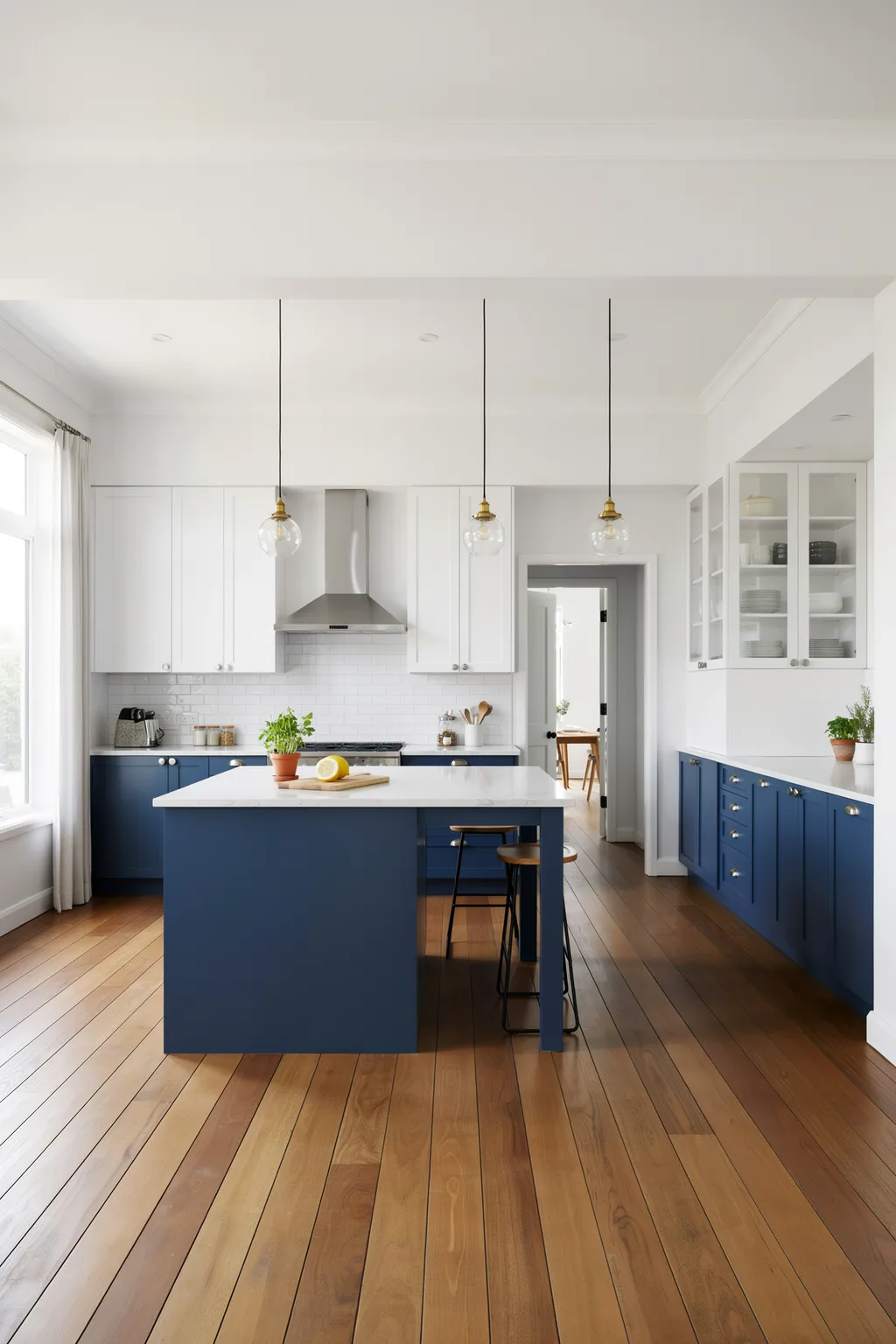
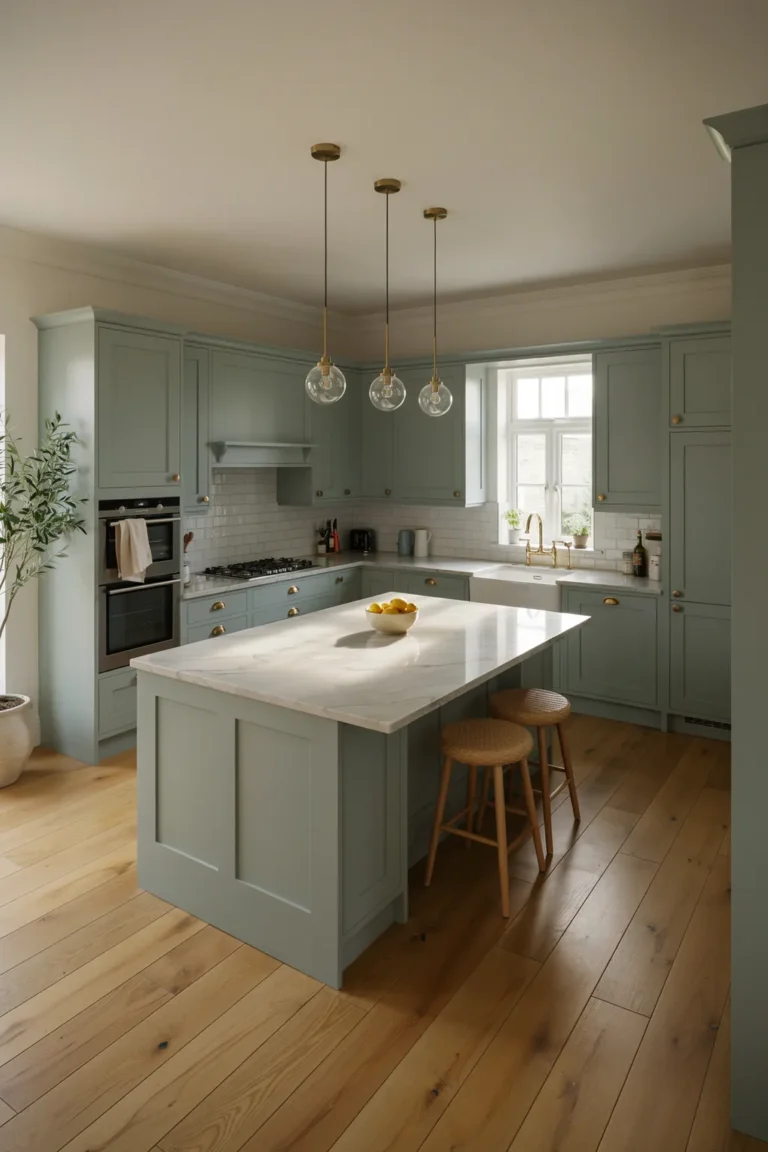
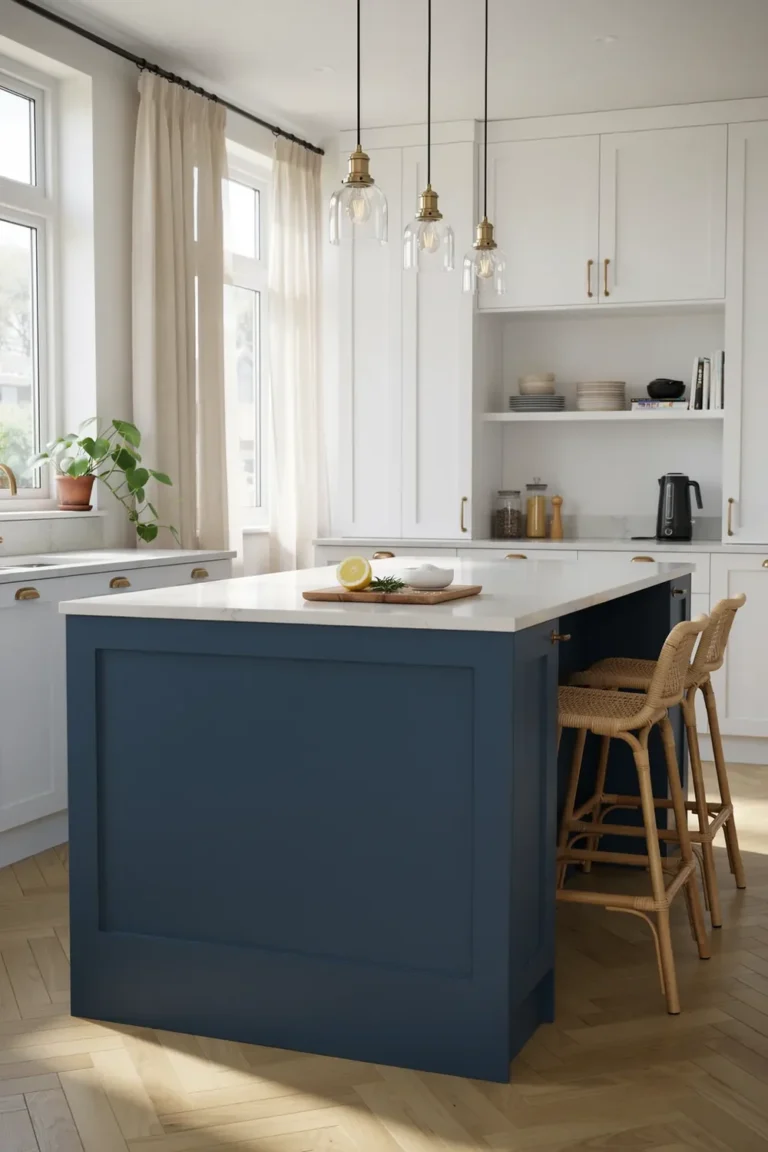
Paint the island the same navy as the lower cabinets and leave the perimeter white, and you get two rooms in one: a bright working wall near the windows, and an island with enough visual weight to anchor the space without asking the whole kitchen to go dark.
Pendant lighting over the island reinforces it as the focal point, which is most of the job here. Keep one metal finish across both zones, since a two-tone kitchen with two different hardware finishes reads as unfinished rather than intentional. This version is also the easiest to walk back if navy stops appealing, since only the island needs repainting.
Island blends into the perimeter cabinets. No clear focal point for the room to organise around.
The island reads instantly as the centrepiece, while the perimeter keeps the room feeling bright.
3. All-Navy Modern Flat-Panel Kitchen with Black Hardware
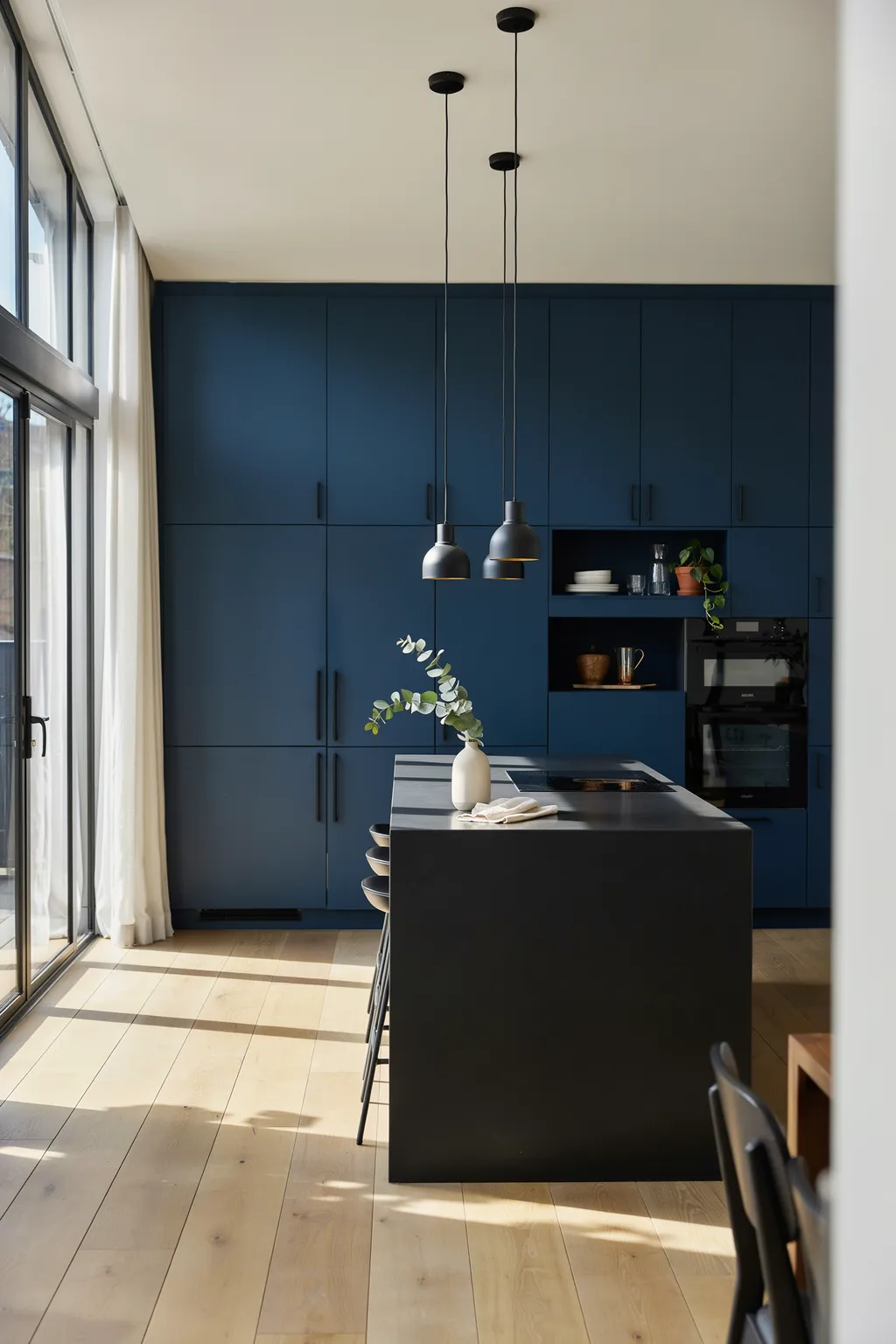
A flat, handleless-leaning door style is what makes an all-navy kitchen work without drowning the room. The lack of visible framing lets the color read as one continuous surface instead of a wall of individual doors, which is the detail that keeps a fully committed navy kitchen from feeling heavy.
Black hardware disappears into the color rather than breaking it into segments, and a waterfall-edge island in a contrasting dark stone or matte black finishes the monochrome effect. This is the version for a kitchen with real daylight, since fully committed navy blue kitchen cabinets in a flat-panel style lean hard on natural light to keep the room from feeling closed in.
| Flat-panel doors | Shaker doors |
|---|---|
| Reads as one continuous surface, sleeker for an all-navy room. | Shows more detail and shadow line, more traditional. |
| Leans harder on natural light to avoid feeling heavy. | More forgiving in a dimmer room. |
4. Navy Farmhouse Kitchen with an Apron Sink and Open Shelving
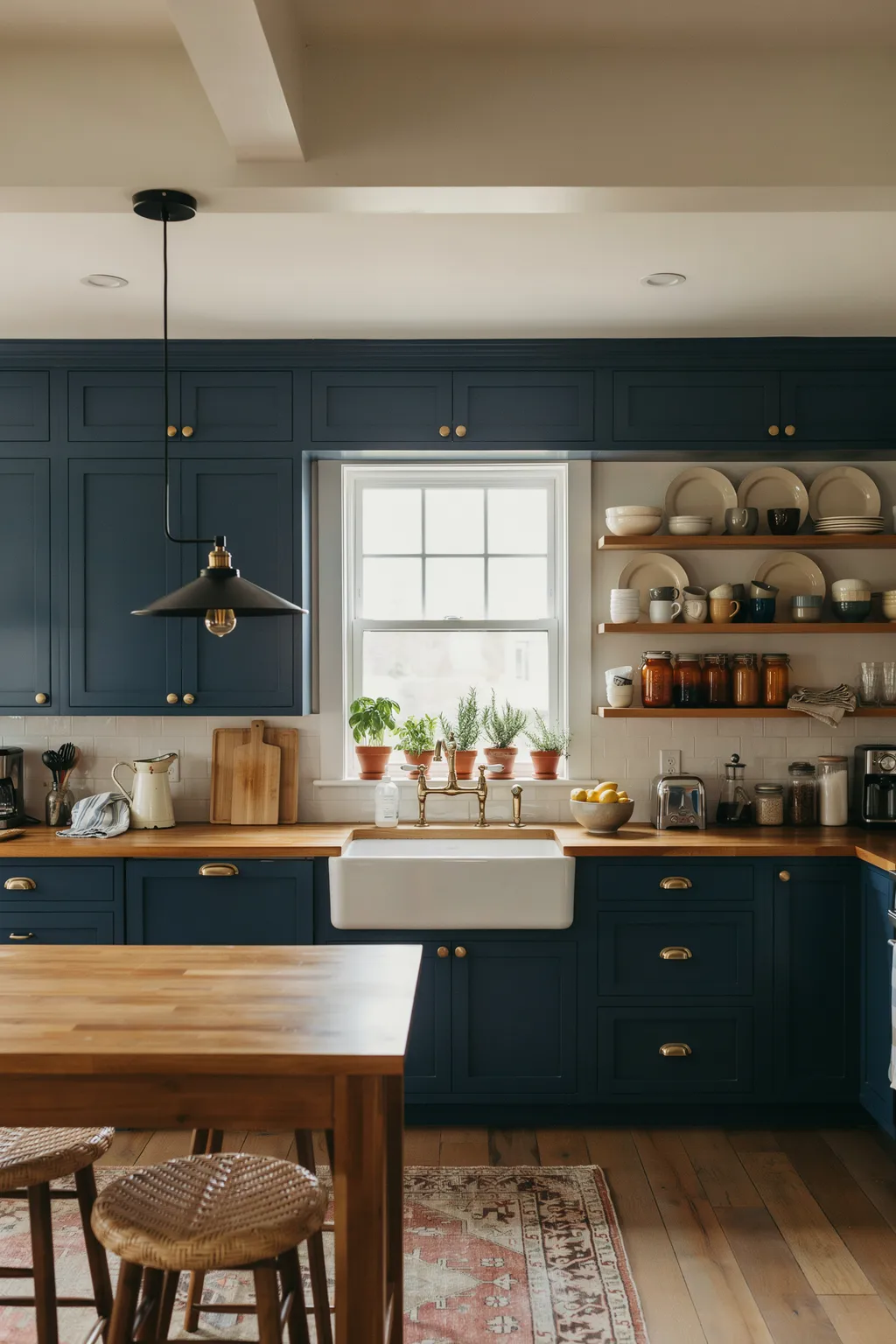
The sink is what you notice first in a navy farmhouse kitchen. A plain white apron front against dark cabinetry does more work than almost any other single choice, since the contrast reads instantly even from across the room.
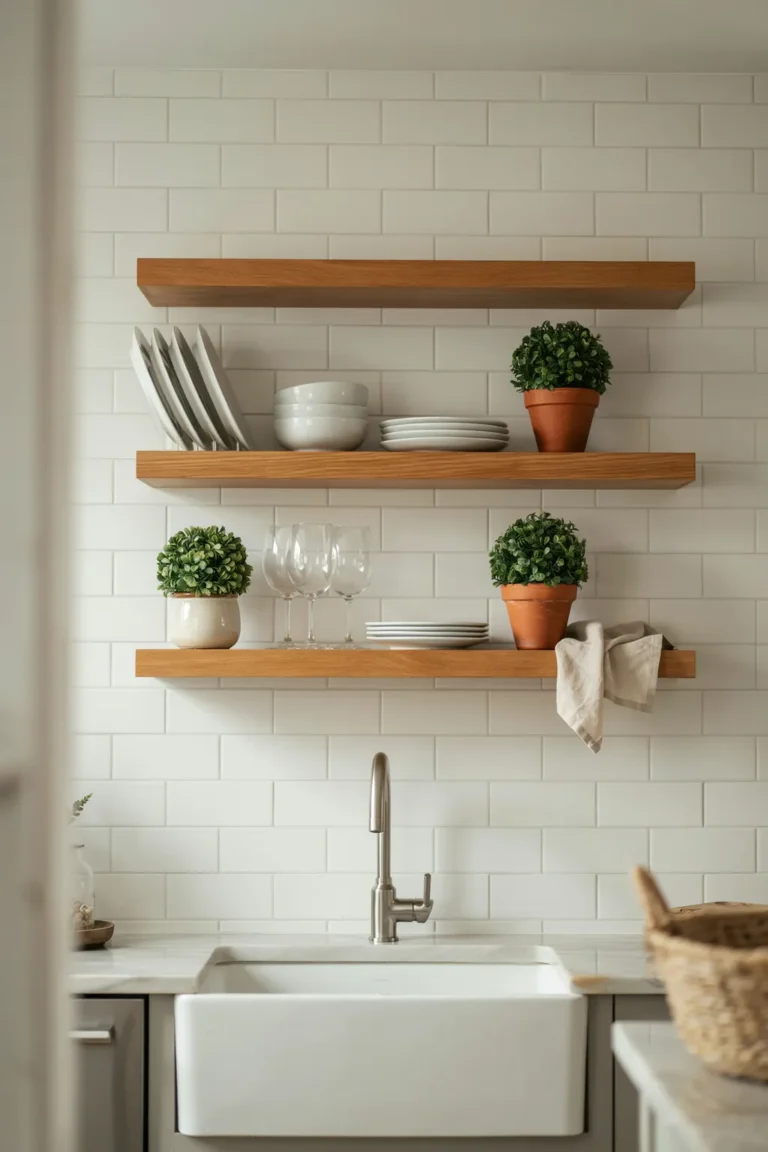
Open wood shelving above the counter keeps the whole kitchen from feeling too formal, and it gives you somewhere to display everyday dishware instead of hiding it behind another navy door. Butcher block counters add a warmth that stone never quite matches. This combination suits an older or character home especially well, where a fully modern kitchen would look out of place.
5. Navy Galley Kitchen with Warm Butcher Block Counters
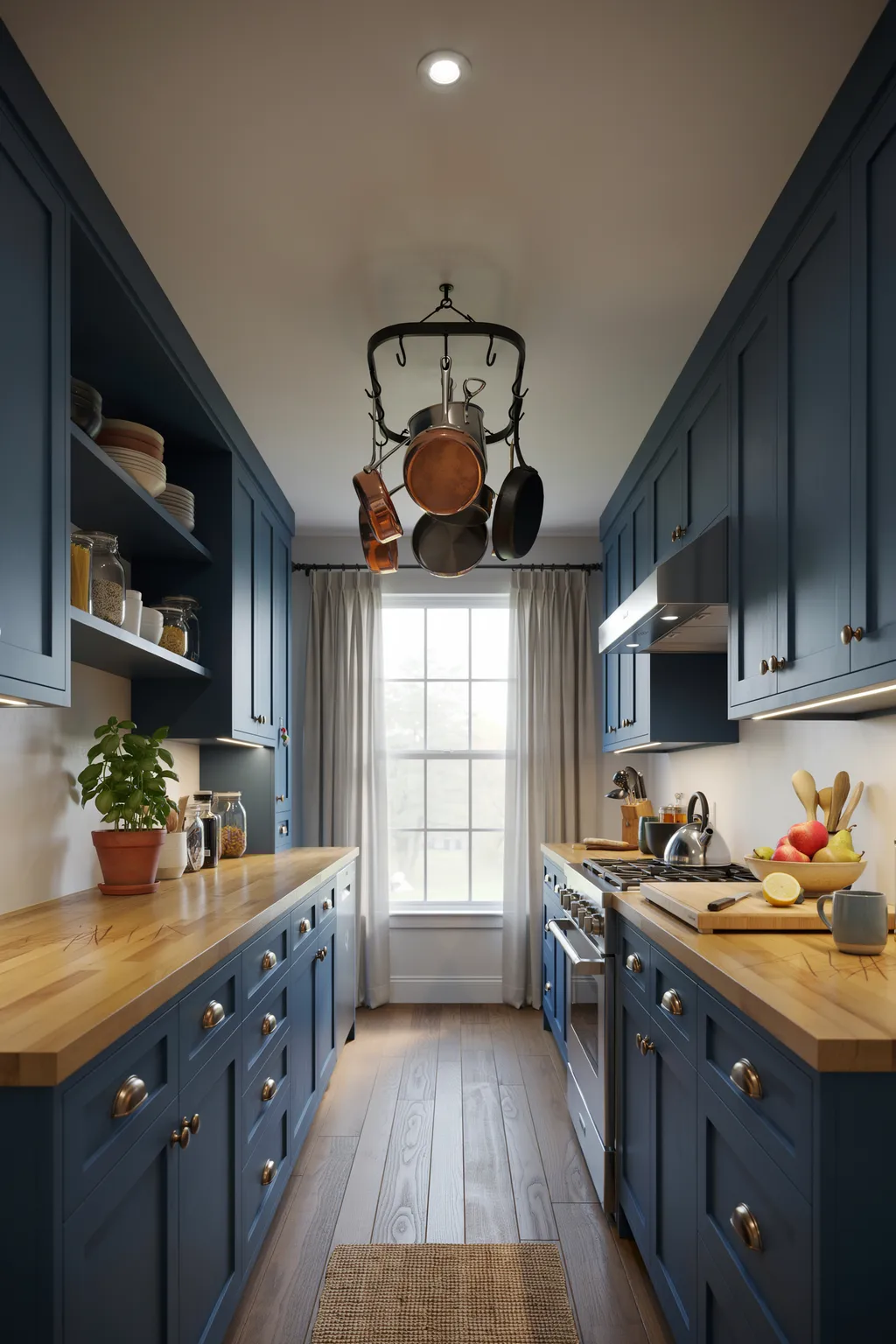
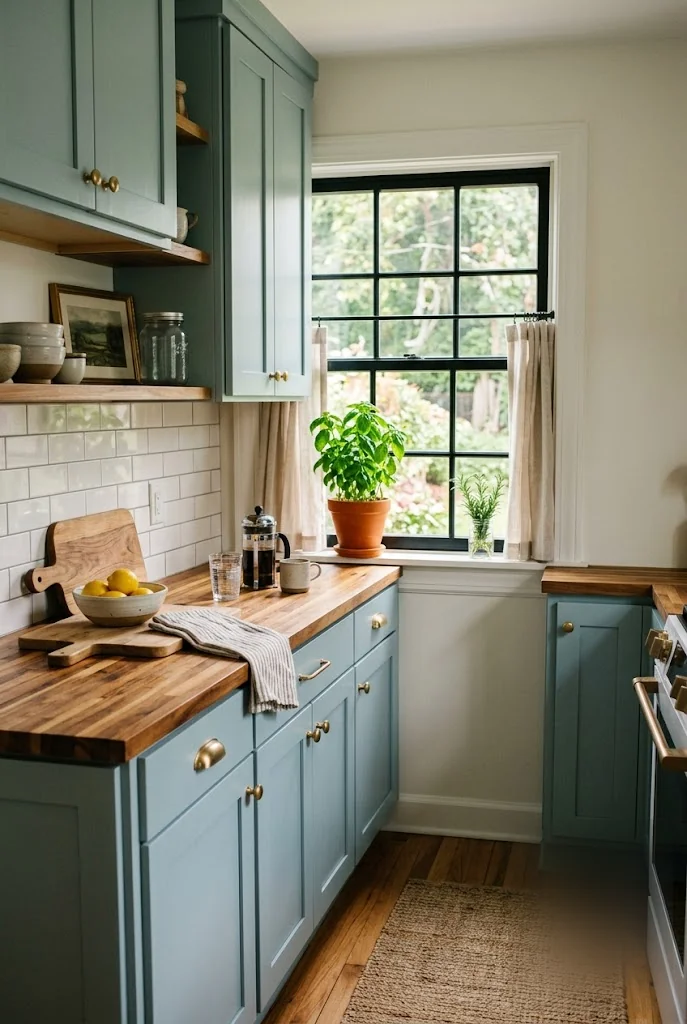
A galley kitchen only feels narrow if both walls compete for attention. Keep the cabinet color and the counter material identical on both sides, navy cabinets with matching butcher block running the full length, so the eye reads the space as one continuous room instead of two facing walls arguing with each other.
A window at the far end pulls the eye down the length of the room, which makes the whole galley feel longer than it measures. Hanging storage overhead keeps the counters clear in a layout with no room to spare, and a rack of pots hanging above the counter borrows storage space you would otherwise not have.
What matters most in a galley
6. Navy Island Only, Paired with White Perimeter Cabinets
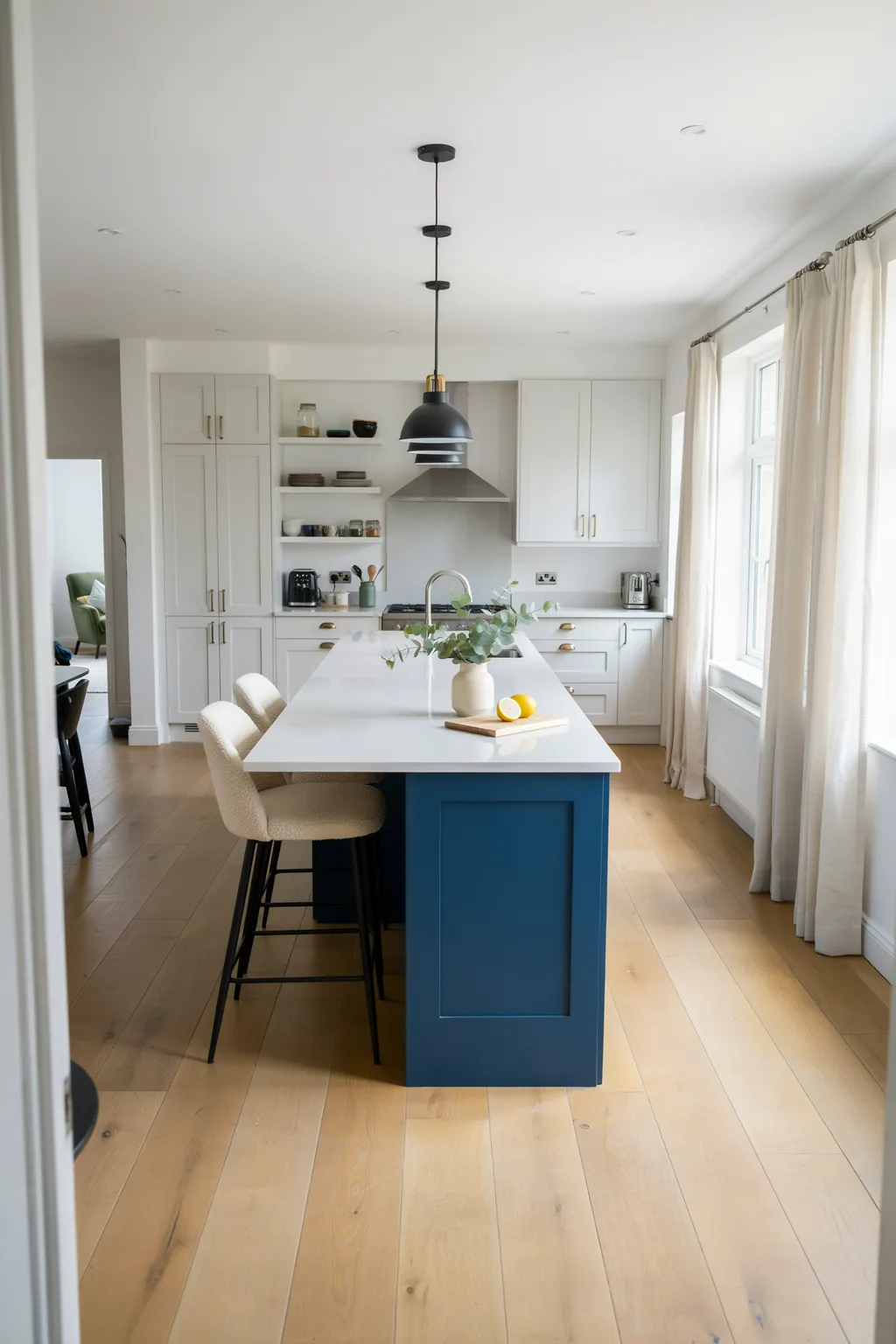
A navy island commits to less than a fully navy kitchen and still makes nearly the same impression. Keeping the perimeter cabinets white means you can repaint the island again later without touching the rest of the kitchen, which matters more than it sounds once you actually live with a color for a few years.
It also keeps resale broader, since a neutral perimeter reads well to more buyers than a fully committed dark kitchen does. Of all the navy blue kitchen cabinets ideas here, this is the lowest-risk one, since only the island commits to color. Add barstools in a matching or contrasting fabric so the island doubles as casual seating.
Keep the perimeter neutral, commit color to the island only.
Add barstools to make the island double as seating.
Matching every surface to the island color.
A second hardware finish just for the island.
7. Coastal Navy Kitchen with White Subway Tile
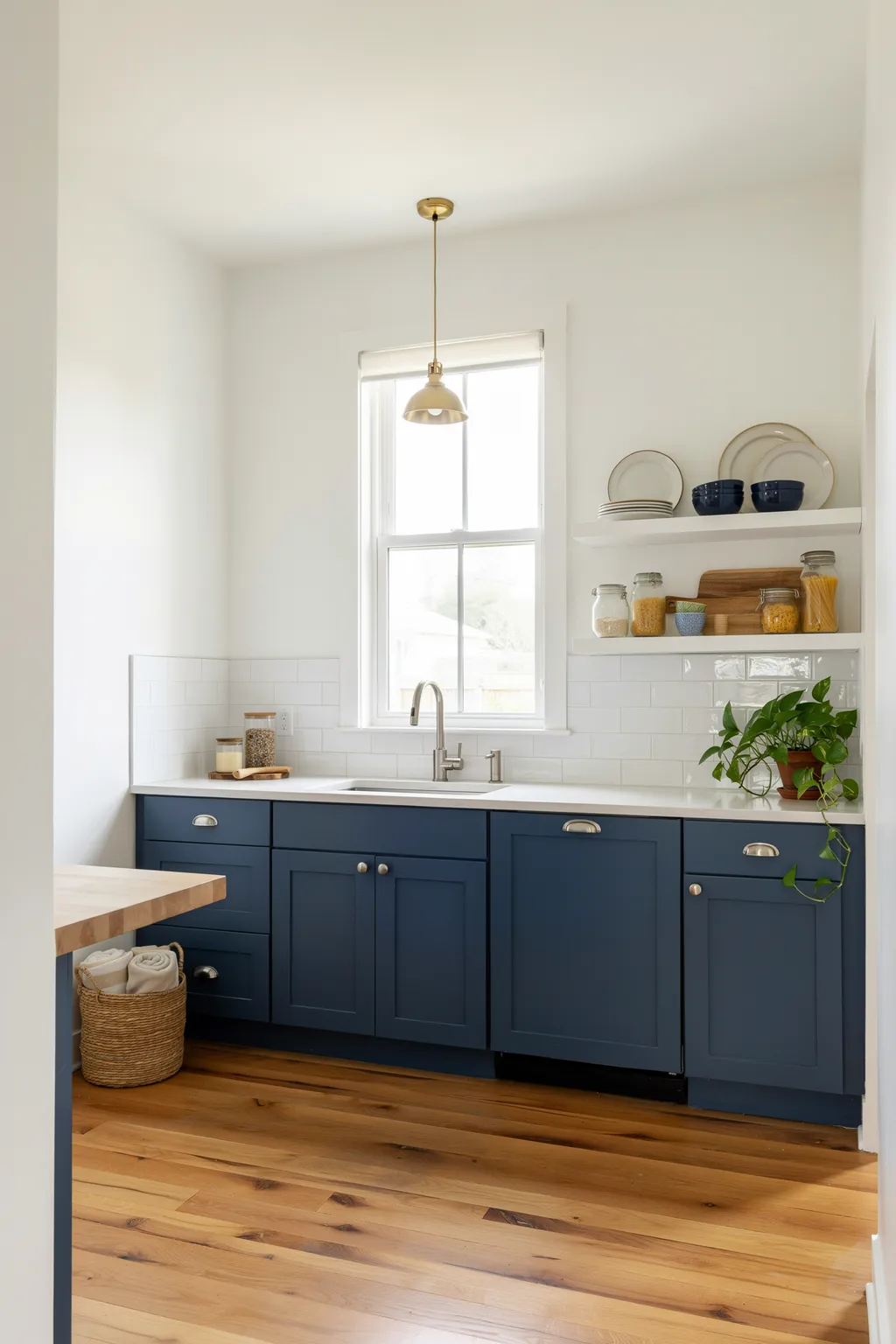
Morning light hits white subway tile differently than it hits paint, it bounces instead of absorbing, and that is the real reason this pairing feels so bright despite dark lower cabinets underneath it.
Run the tile as high as the upper cabinets allow, since a short backsplash cuts the effect short right where you need it most. Open wood shelving in place of some upper cabinets keeps the room feeling airy rather than boxed in, and a single trailing plant on the counter finishes the coastal feeling without adding real clutter to a small working surface.
Run white subway tile up to the underside of the upper cabinets.
Swap one run of upper cabinets for open wood shelving.
Add one real, living plant on the counter for the coastal touch.
8. Navy U-Shaped Kitchen with a Marble Waterfall Island
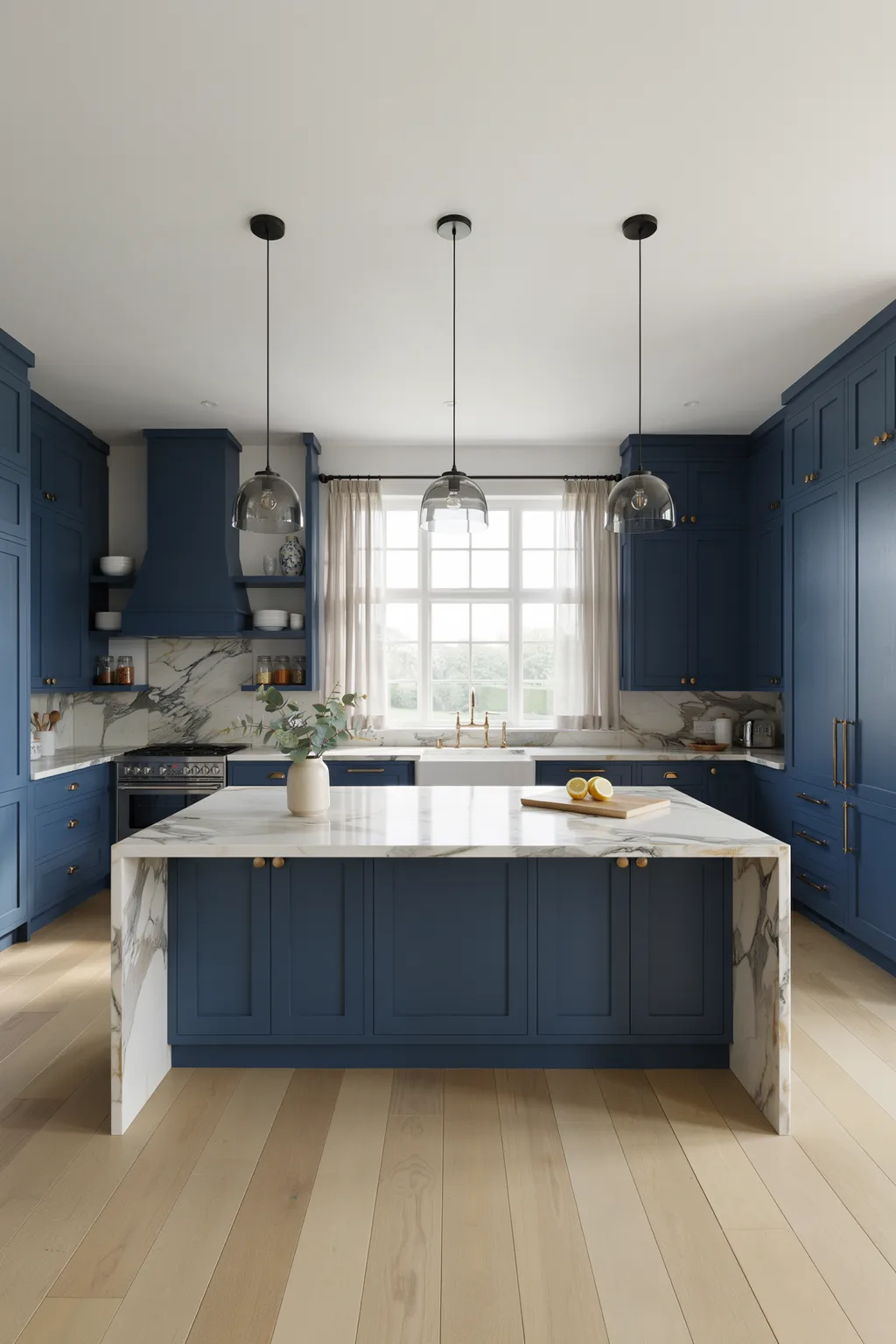
A U-shaped layout gives you three full walls of navy cabinetry, which is the fastest way to make navy blue kitchen cabinets feel like a real design decision rather than an accent someone talked you into.
A marble waterfall island breaks up all that color with movement and veining, so the room never reads as one flat block of blue. Multiple pendant lights over the island add rhythm across a wide room, and the extra counter space on three sides means this layout only really earns its keep in a kitchen with enough square footage to keep walking paths clear.
9. Navy Kitchen with Glass-Front Cabinets and Gold Hardware
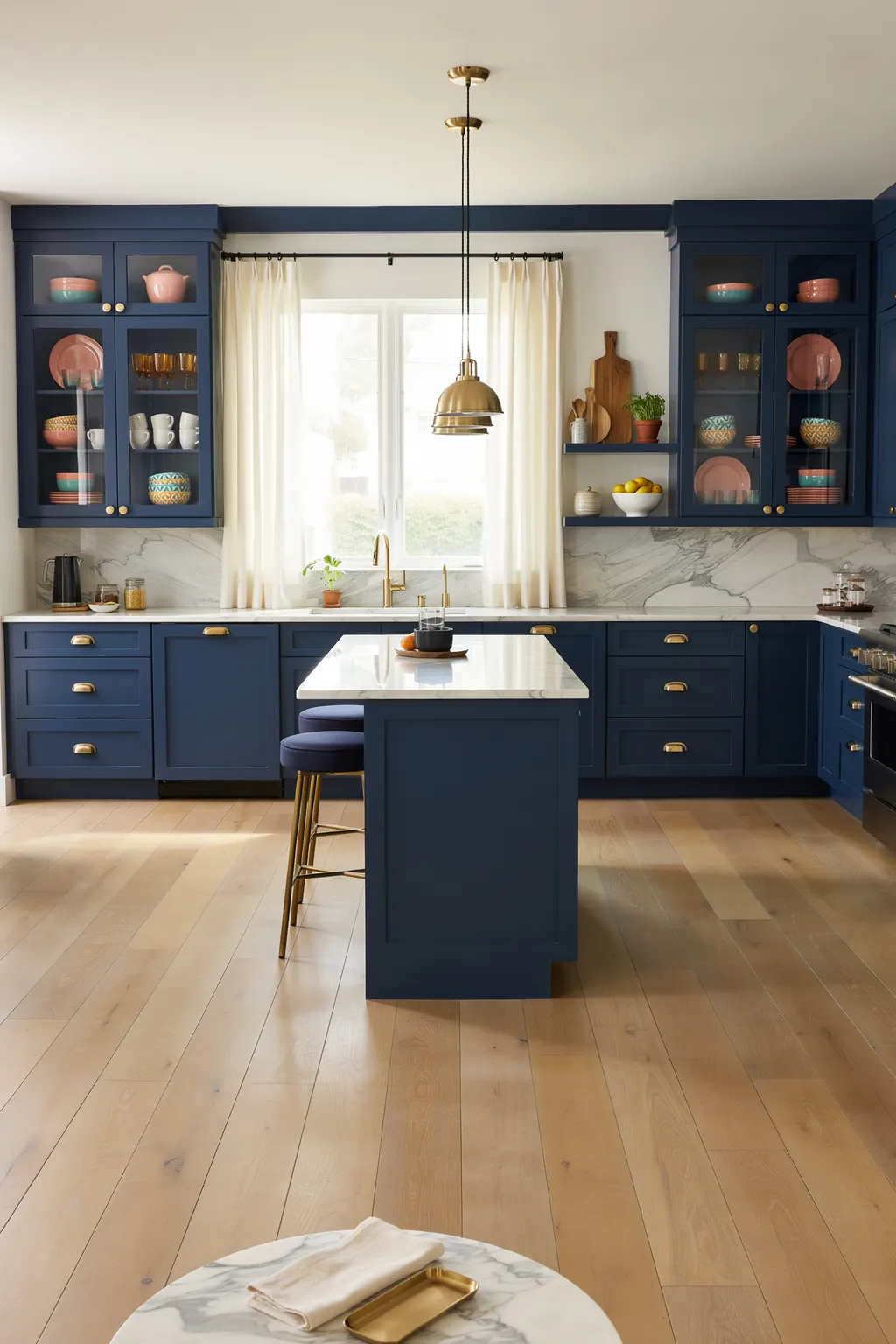
Glass fronts only work if what is behind them earns the attention. Reserve them for your best dishware, the pieces with color and shape worth showing off, and keep the mismatched everyday items behind solid doors somewhere else in the kitchen.
Gold hardware picks up the light passing through the glass, which is a large part of why this combination photographs so well. A marble backsplash ties the gold and navy together without introducing a third competing material, and grouping the dishware by color inside the cabinet does more for the finished look than any styling trick applied to the rest of the room.
💡 Quick Tip
Group dishware by color inside glass-front cabinets. Random stacking reads cluttered even with genuinely beautiful pieces.
10. Transitional Navy Kitchen with a Contrasting Wood Island
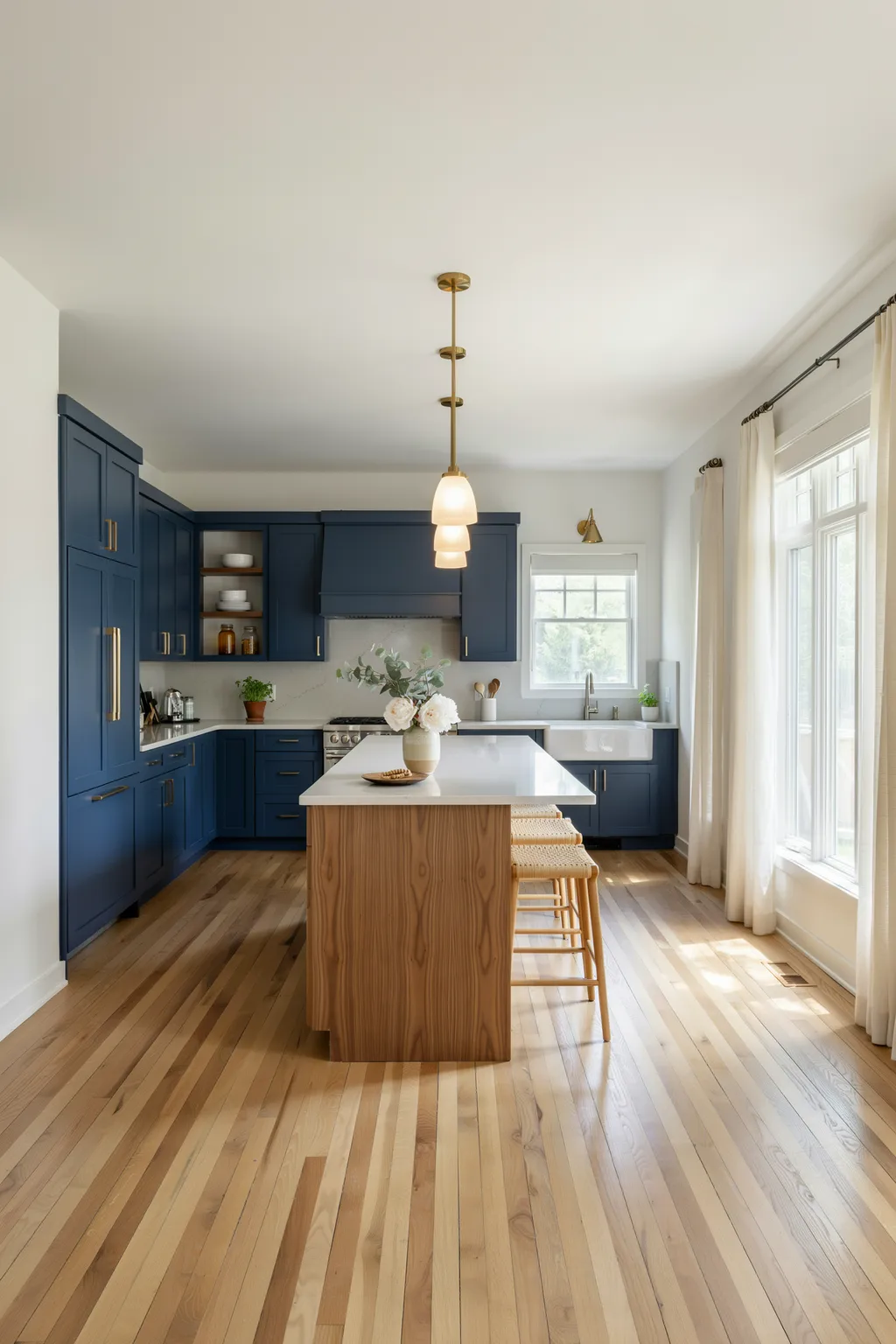
Pick a wood tone for the island that already exists somewhere else in the room, the floor, a light fixture, a stool, so the contrast feels planned instead of accidental. Leave the wood unpainted and let the grain show, since that natural texture is what separates the island from the navy perimeter cabinets around it.
Light countertops on both the island and the perimeter keep the two tones from fighting each other for attention. This pairing suits a kitchen that wants some warmth without going fully rustic, and it gives you a natural place to add barstools without needing to match them to the cabinet color.
Including the island. No visual break in the color across the whole room.
Navy perimeter, natural wood island. The room gains contrast and warmth at once.
11. Small Navy Kitchen with Light Wood Floors
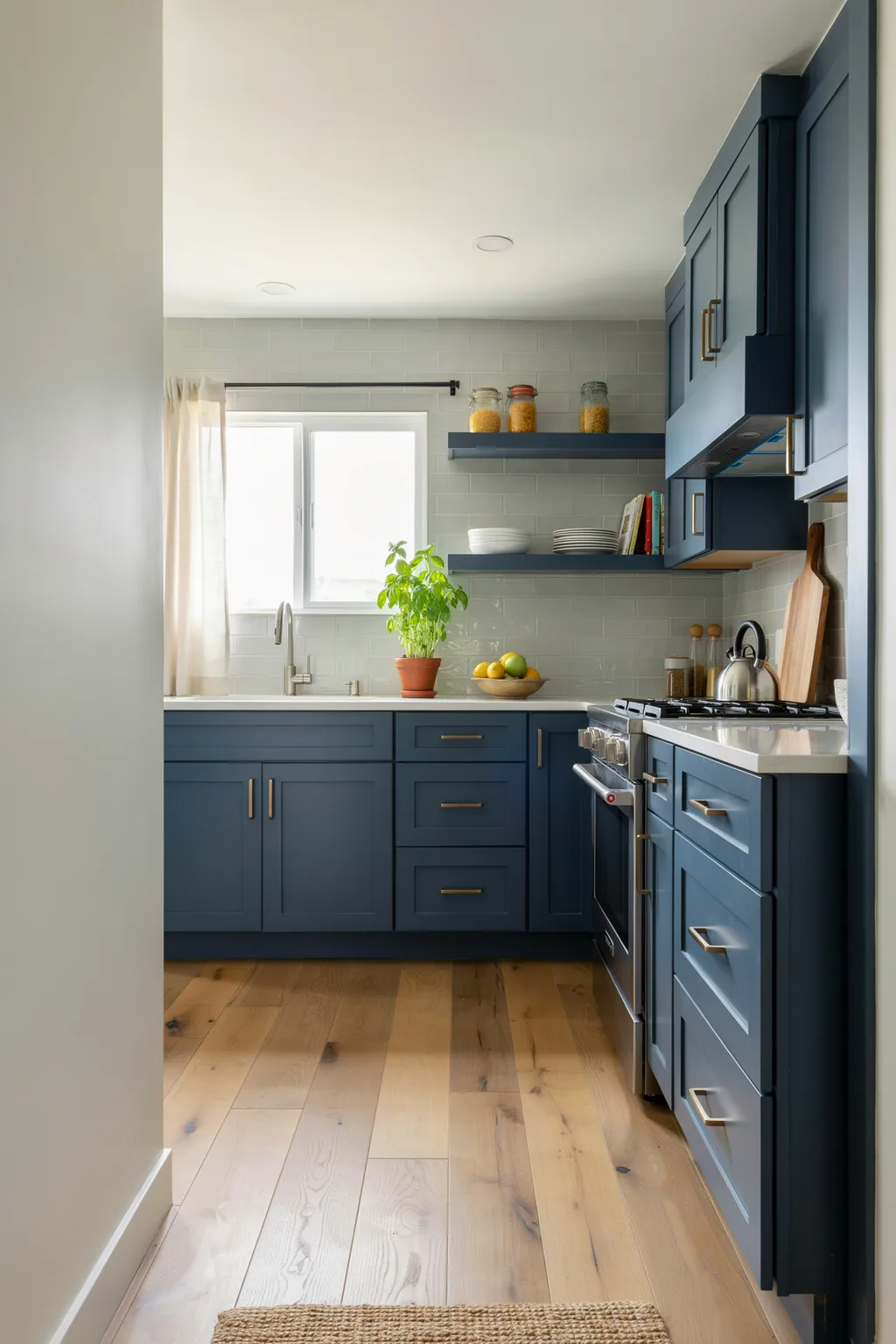
A small kitchen can absolutely go navy, as long as the floor stays light. Dark cabinets over a dark floor make a small room feel like it is shrinking further, while a pale wood floor keeps the base of the room feeling open even when the cabinets above it are fully committed to the color.
Skip upper cabinets where you reasonably can and use open shelving instead, since floating shelves read lighter than boxed cabinetry ever will. A single plant and a small herb pot are enough greenery for a compact counter, more than that starts to crowd a surface that has no space to spare.
What matters most in a small kitchen
12. Navy Kitchen with a Herringbone Tile Backsplash
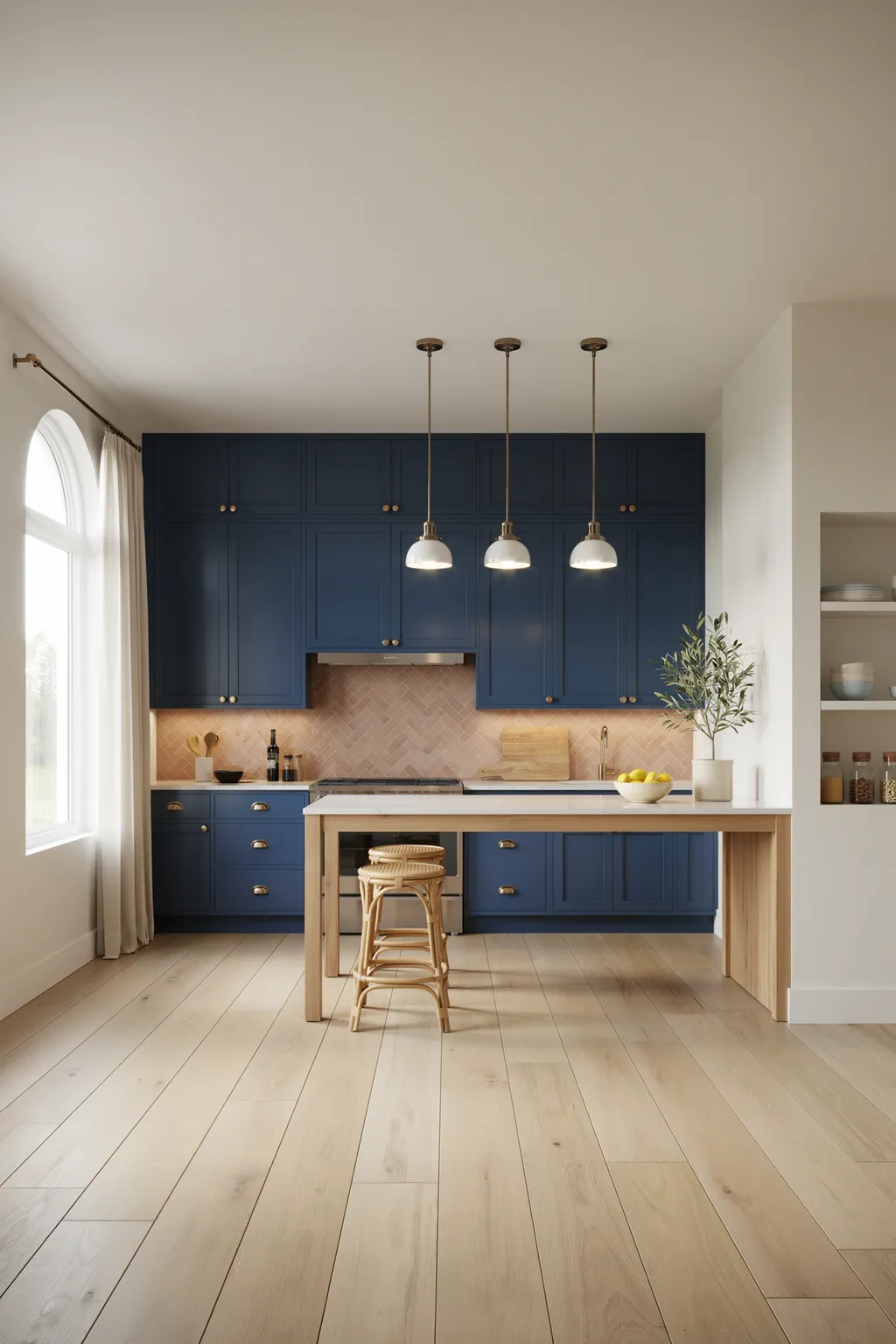
A patterned backsplash gets treated as too bold for a kitchen that is already a strong color, but herringbone tile in a warm neutral tone actually settles a navy kitchen down rather than adding to the noise.
The diagonal pattern reads as texture more than color from a normal viewing distance, so it does not compete with the cabinets the way a bright or busy tile would. Keep the grout close to the tile tone so the pattern stays subtle rather than graphic, and this is one of the more forgiving navy blue kitchen cabinets pairings, since it works alongside almost any warm wood elements elsewhere in the room.
13. Navy Blue Beadboard Cottage-Style Kitchen
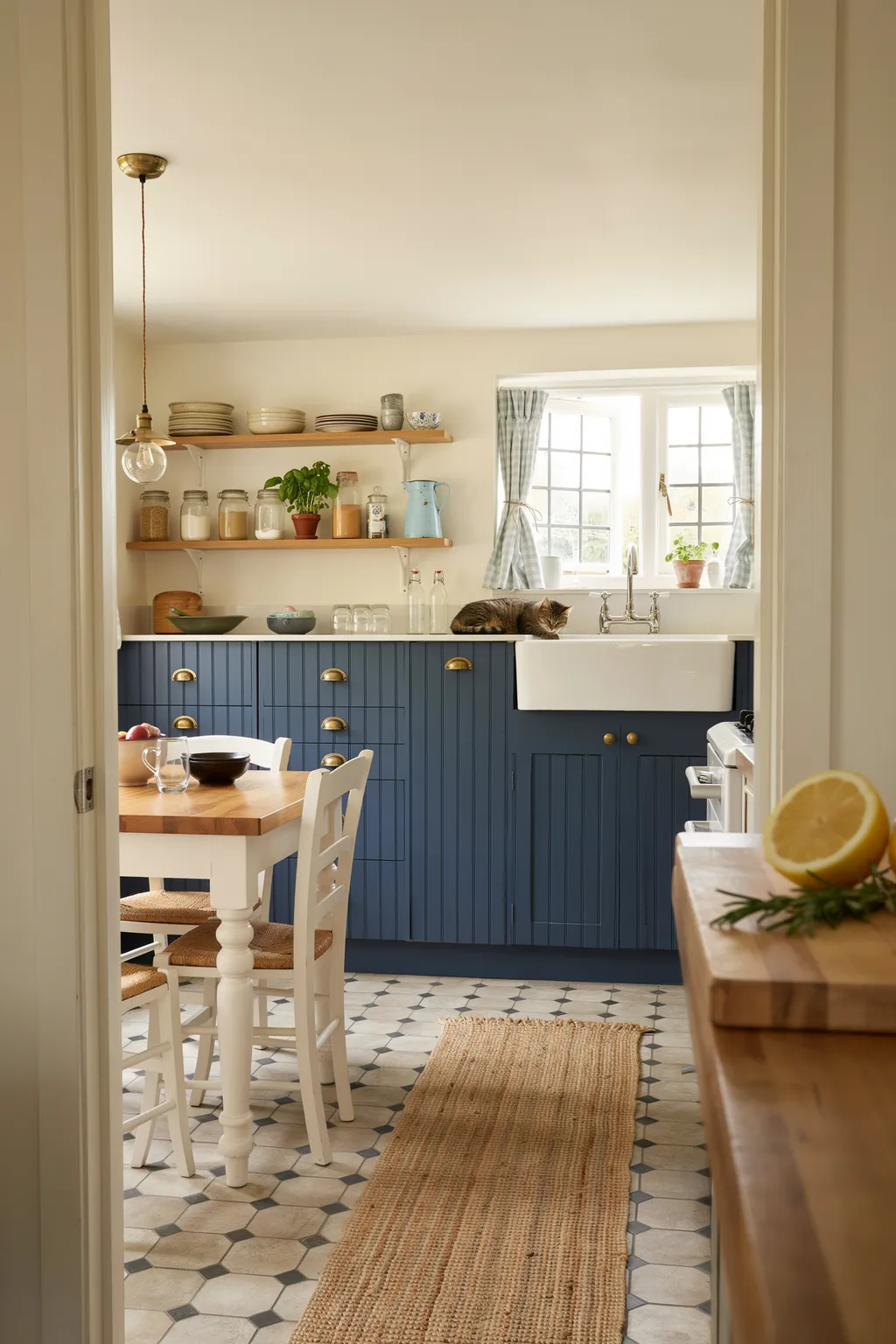
Beadboard cabinet doors are the detail that makes a navy kitchen feel like a cottage instead of a showroom. The vertical grooves catch light differently than a flat panel, which softens the whole look even in a fully saturated color like navy.
Pair it with a farmhouse table, a couple of mismatched vintage chairs, and a patterned tile floor for the complete effect. Brass cup pulls finish the vintage feeling better than a sleek bar pull ever could, and this is one of the few navy directions that genuinely welcomes a bit of clutter, since the whole point is that it looks lived in.
Choose beadboard style doors over flat or shaker panels.
Add a farmhouse table and a couple of mismatched chairs nearby.
Finish with brass cup pulls and a patterned tile floor.
14. Navy Kitchen with Black Appliances and Wood Open Shelving
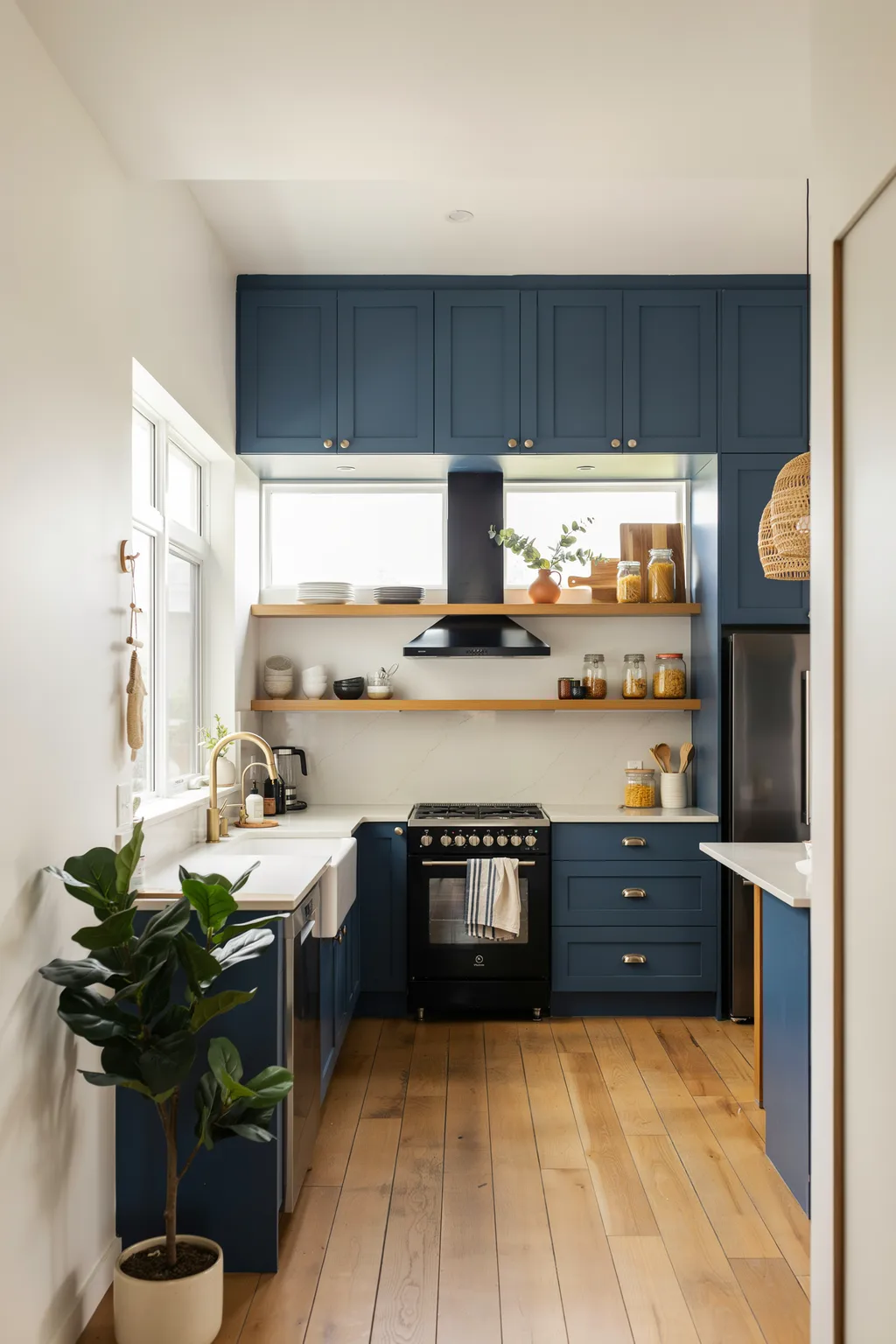
Black appliances recede into navy cabinetry in a way stainless steel never quite manages. The two dark tones read as one family instead of competing for attention, which keeps the kitchen looking calm even with a range, hood and refrigerator all in view at once.
Open wood shelving above the counter breaks up the dark palette with warmth and gives you somewhere to display everyday jars and dishware instead of hiding everything behind more navy doors. A real potted plant nearby adds the one bright green note the room actually needs, and it is worth resisting the urge to add a second one, since this look works because of what it leaves out.
Black appliances blend into navy cabinets instead of standing out against them, which is why this pairing looks calmer than stainless steel ever does.
15. Whether Navy Dates, and How to Leave Yourself an Exit
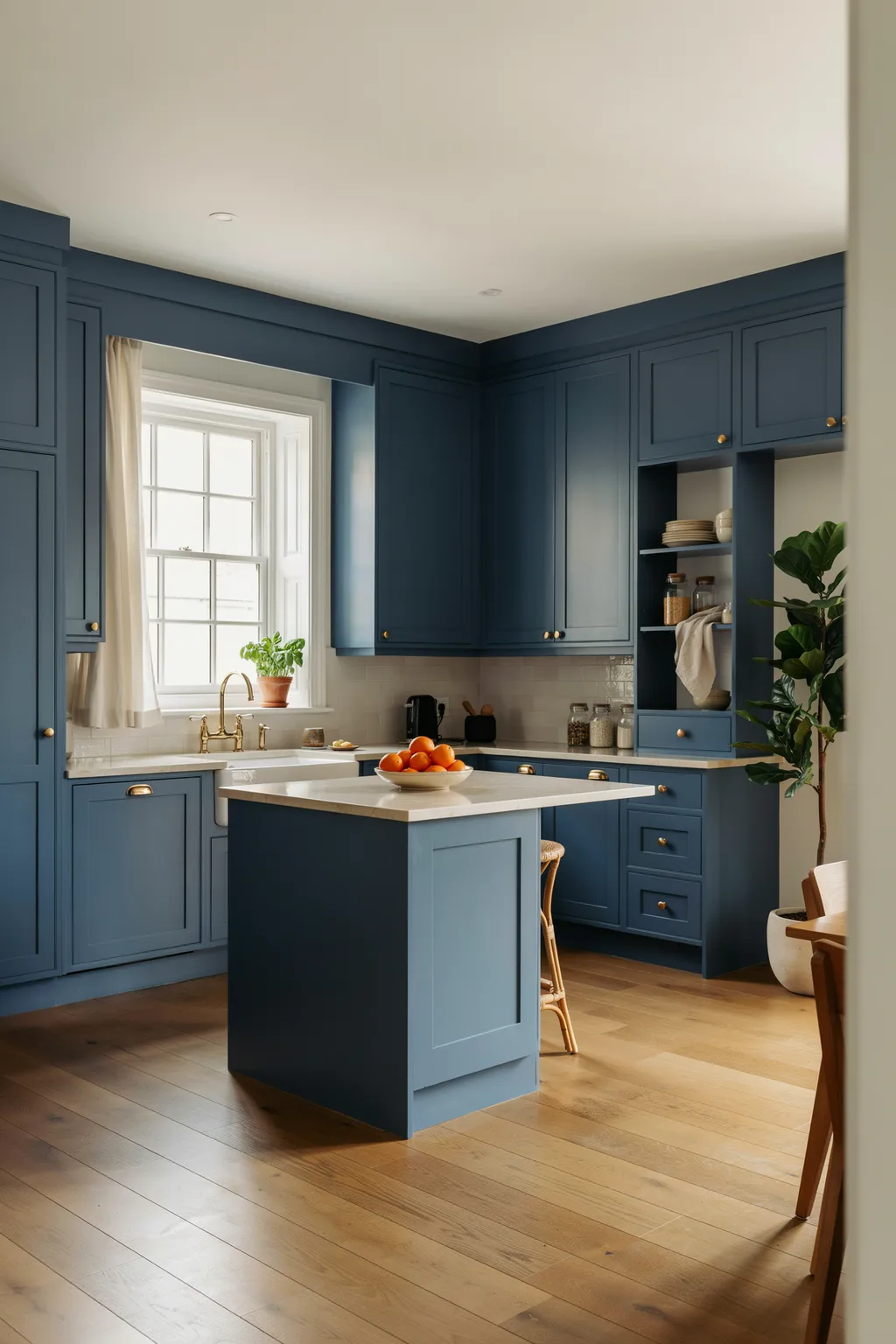
Every color dates. The honest question is what it costs you when it does.
Navy has held on longer than most kitchen colors of the past decade, largely because it behaves almost like a neutral. It sits beside wood, brass, white, black and most stone without argument, which is not something you can say about a strong green or a deep red.
The good news is that with navy blue kitchen cabinets the color lives on the cheapest surface in the room. Paint is inexpensive to change. Countertops, tile and flooring are not.
So keep the expensive layers neutral and let the paint carry all the personality. Then changing your mind is a weekend rather than a renovation.
Cabinet paint. Cheapest surface to redo and the one carrying all the character.
Hardware. Unscrews in an afternoon and sells on easily if you change direction.
Textiles, stools, and anything sitting on the counter.
Countertops. The single most expensive surface to replace on a whim.
Backsplash tile. Removing it usually damages the wall behind it.
Flooring, which typically runs into neighbouring rooms and cannot be changed in isolation.
Bringing It Together
Navy rewards planning more than most colors do. Nearly everything that goes wrong with it traces back to a decision made in the wrong order: paint bought before the light was tested, handles ordered before the holes were measured, a cool counter chosen before anyone thought about temperature.
Get the sequence right and it turns into one of the more forgiving choices in a kitchen, because the character lives on paint rather than on stone.
If you take three things from this list, test the color after dark, keep the uppers light unless your room is genuinely bright, and spend real money on under-cabinet lighting. Those three decide how navy blue kitchen cabinets feel to stand in.
Sample first, decide second. Two coats on a board, moved around the room for a full day and checked once after dark. Costs a sample pot.
Settle how far the navy goes. Lowers only, or everything. That single answer determines the backsplash, the counter and the lighting budget.
Sort the light before the styling. Under-cabinet lighting and warm bulbs go in before you shop for handles, stools or anything decorative.
Save this to your kitchen board so the sequence is with you the day you are standing in the paint aisle holding three navy chips.