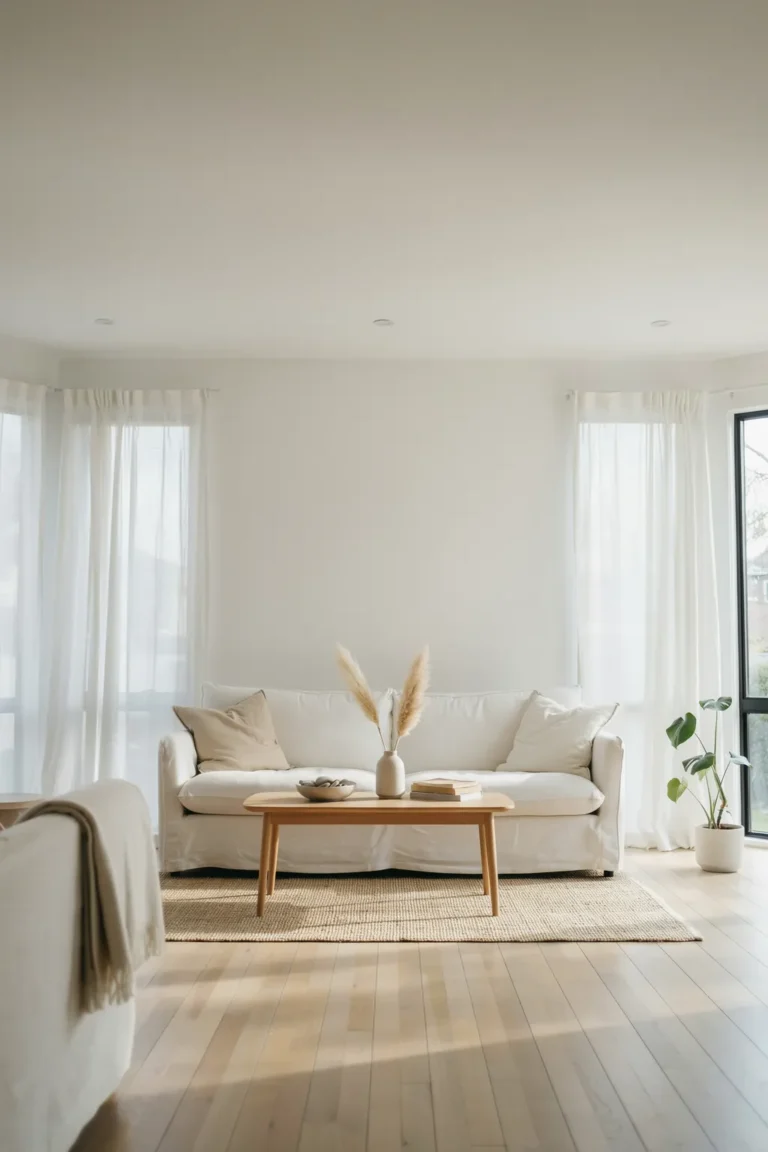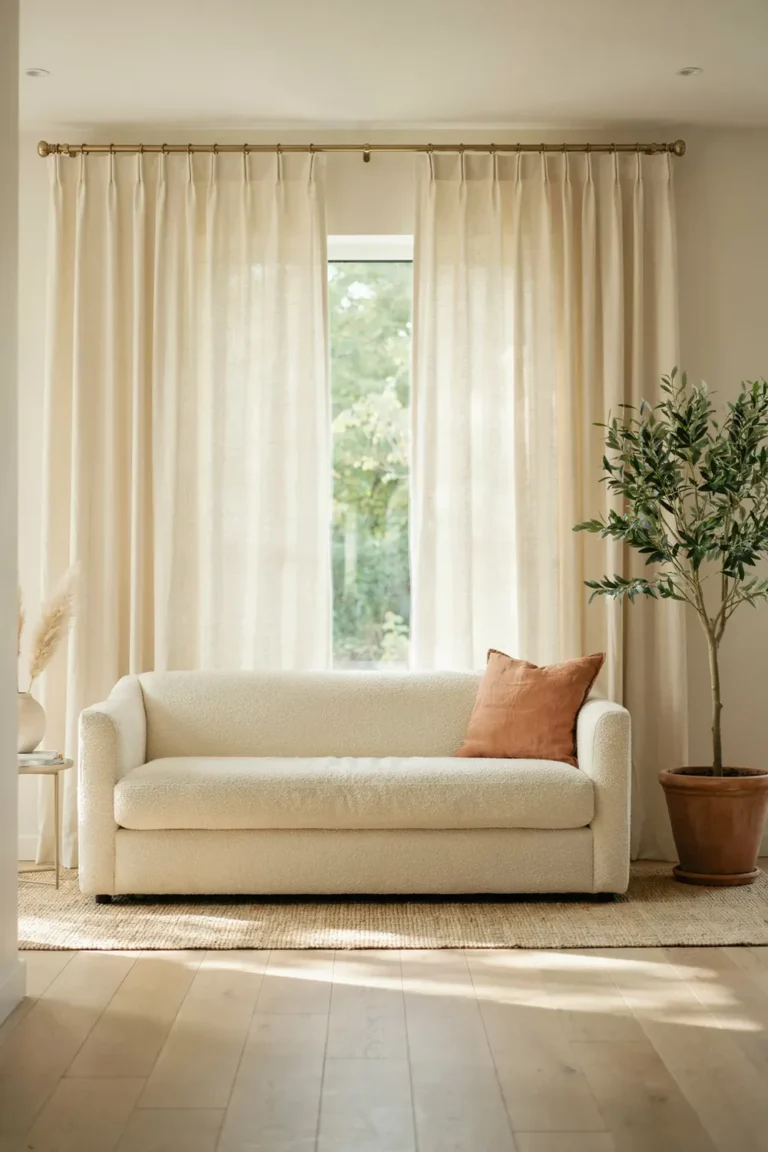
19 Living Room Ideas That Make a Small Space Bigger
You walk into your living room and it feels tight. The sofa eats the wall, the coffee table blocks the path, and no matter how much you tidy, the room still feels boxed in. A bigger house is not the fix. The right living room ideas are, because square footage matters far less than how you use light, height, and sightlines.
Small rooms are not a design problem. They are a design puzzle with known answers. Designers make cramped spaces feel open every day using the same handful of moves: lift furniture off the floor, bounce light with mirrors and pale colors, draw the eye upward, and keep the middle of the room clear. Once you see these tricks, you cannot unsee them, and you can copy every one on a normal budget.
This guide gives you 19 living room ideas, each built around a real look you can recreate and each chosen because it helps a small space breathe. Some lean cozy and dark, and for those I will tell you straight when they will shrink a room and how to adapt them. Others are pure space-expanders you can lift wholesale. You do not need to try all 19. Pick the three or four that fit your room’s light, your rental rules, and your style, then watch the walls seem to push back. Let’s get into the looks that actually work when every inch counts.
Quick Answer
To make a small living room feel bigger, use light and reflection to trick the eye: pale walls, a large mirror, leggy furniture that shows the floor, and a clear central path. The best small-space living room ideas raise pieces off the ground, draw sightlines up with tall shelving or art, and keep one calm color across walls and big furniture so nothing chops the room into pieces.
1. Lighten the Boho Look So It Breathes
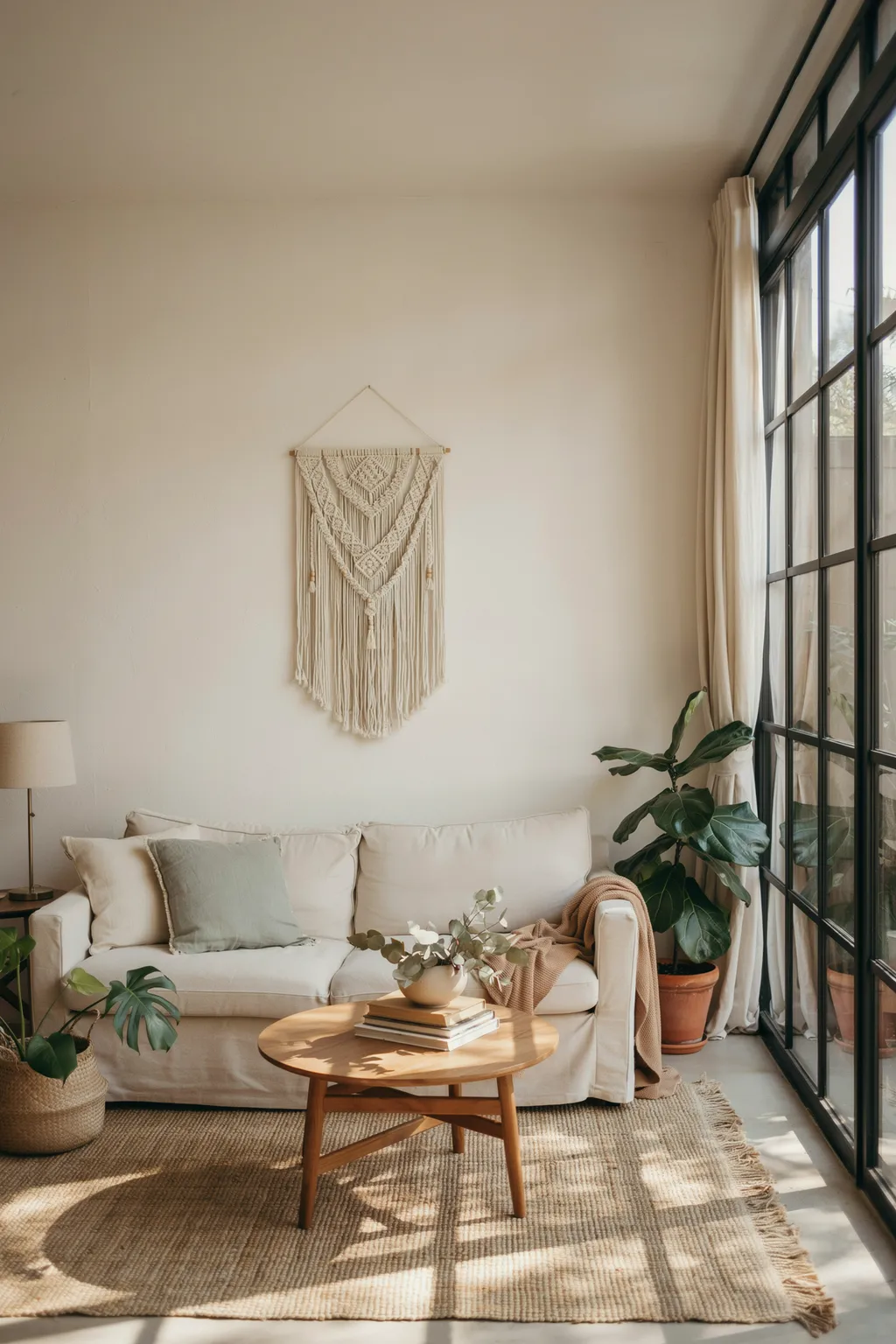
Boho can go heavy fast, but this version stays open. A cream sofa sits against a soft, warm wall, with a single macrame hanging and a few tall leafy plants near a big grid window. The palette is all sand, oatmeal, and green, so the room feels layered without feeling crowded. Natural texture does the decorating instead of clutter, which keeps a small space from closing in.
The trick is restraint. Pick one woven wall piece, one low wood coffee table, and two big plants instead of ten small trinkets, and the eye gets room to rest. Tall plants near a window pull your gaze up and out toward the light, which makes the ceiling feel higher. For proof, compare a shelf of tiny knickknacks to a single six-foot fiddle-leaf fig: the plant reads as calm, the shelf reads as busy.
Great for renters who love warmth but have limited floor space. Skip the heavy floor cushions and dark tapestries if your room is under 150 square feet, since they soak up light.
2. Float Low Furniture for Minimalist Airiness
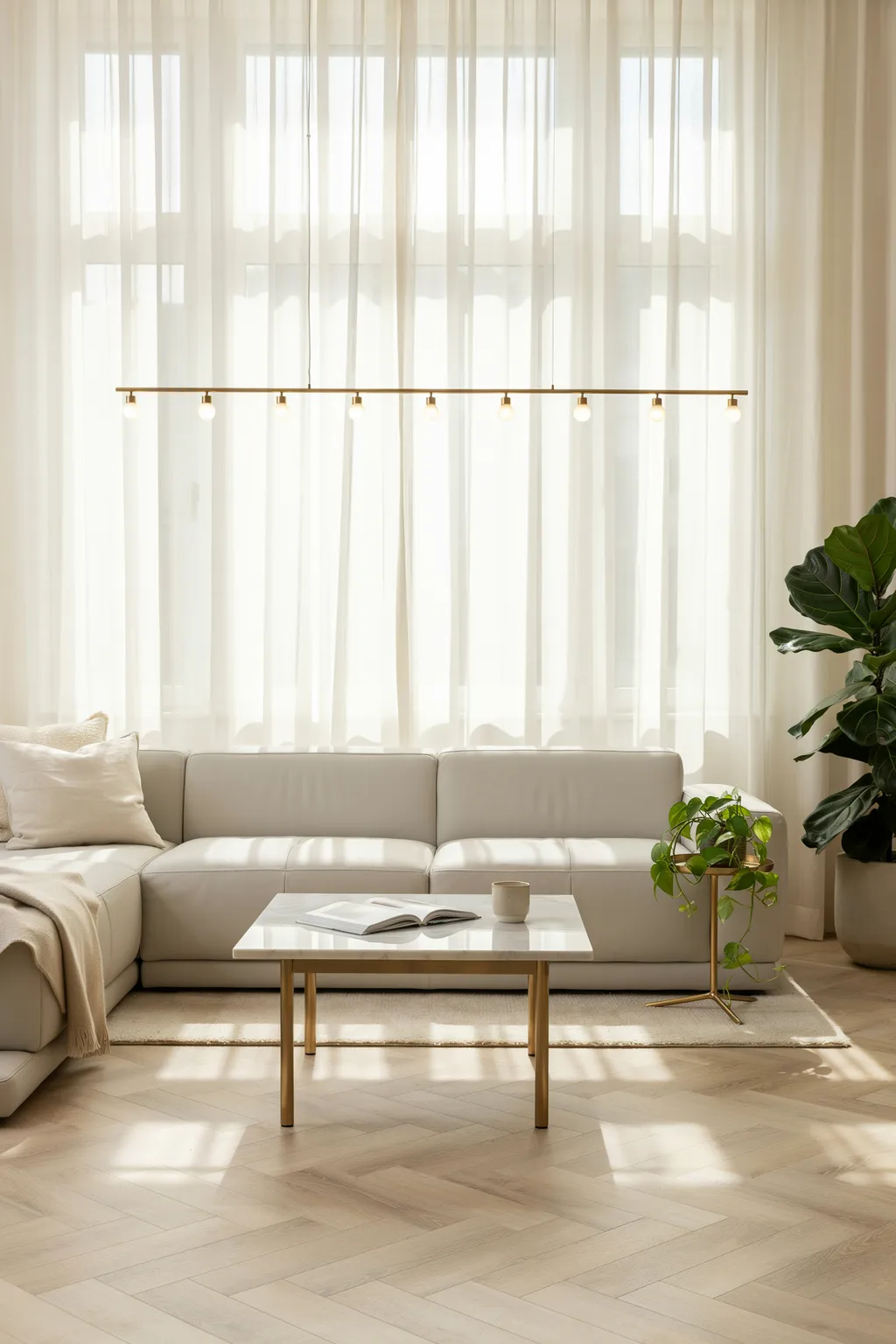
Minimalism is a small room’s best friend, and this lounge shows why. A pale gray modular sofa sits low and long under floor-to-ceiling sheer curtains, with a marble-and-brass coffee table and a thin linear chandelier overhead. Everything is quiet and horizontal, so your eye glides across the room without hitting clutter. Low pieces leave more wall showing above them, and more visible wall means a taller-feeling space.
Height control is the secret weapon. Choosing a sofa with a low back and hanging curtains from the ceiling, not the window frame, stretches the walls upward and makes the glass feel grander. One clear example: mount your curtain rod six inches below the ceiling and let panels graze the floor, and a standard window suddenly reads floor-to-ceiling.
This suits modern renters and anyone who hates dusting. It will feel cold if you skip texture, so add one soft rug and a couple of linen pillows to keep it from looking like a showroom.
3. Warm It Up Rustic Without Closing It In
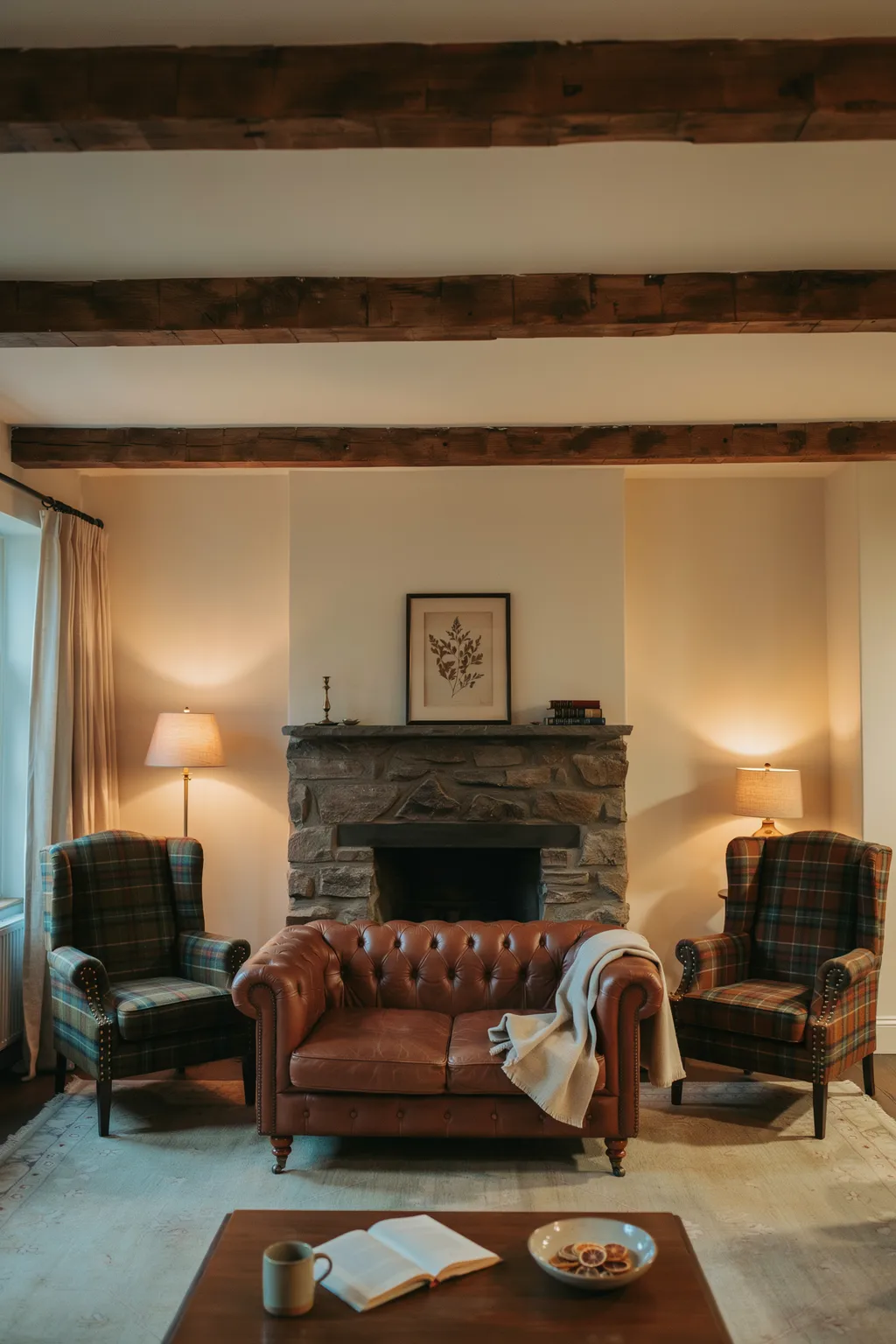
Rustic rooms feel cozy, but dark wood and heavy stone can shrink a space, so this look needs a careful hand. Picture exposed ceiling beams, a stone fireplace, a cognac leather chesterfield, and plaid wingback chairs lit by a warm lamp. It is inviting, no question. In a small room, though, all that dark timber overhead can press the ceiling down on you.
The fix is balance. Keep the rich leather and one stone feature, then lighten everything around them with cream walls, a pale rug, and plenty of lamps at different heights. Layered lighting matters more than any single fixture: three warm sources at eye level and above trick the brain into reading depth. Swap a bulky sofa for a leather loveseat with exposed legs so the floor still shows beneath it.
Best for cabins, basements, or rooms with real architectural beams, and one of the coziest living room ideas here. If your ceiling is under eight feet, paint the beams a shade lighter than you think so they do not feel like they are closing in.
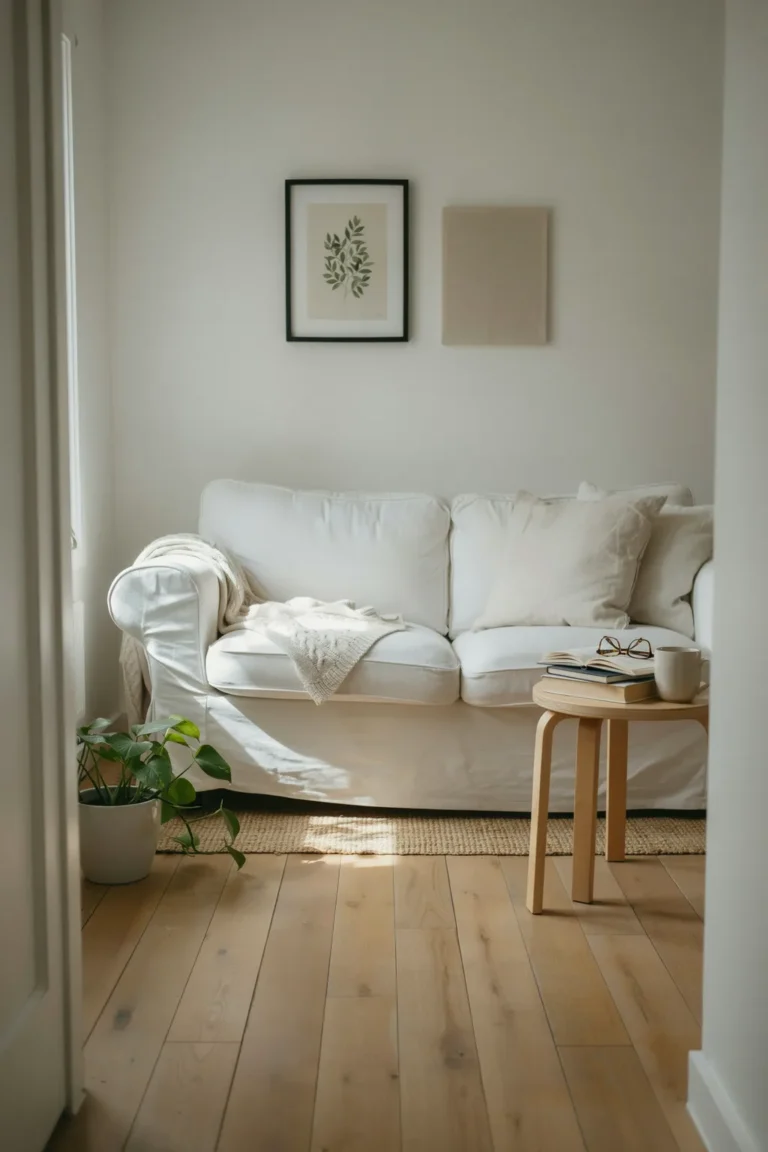
4. Keep It Neutral to Blur the Walls Away
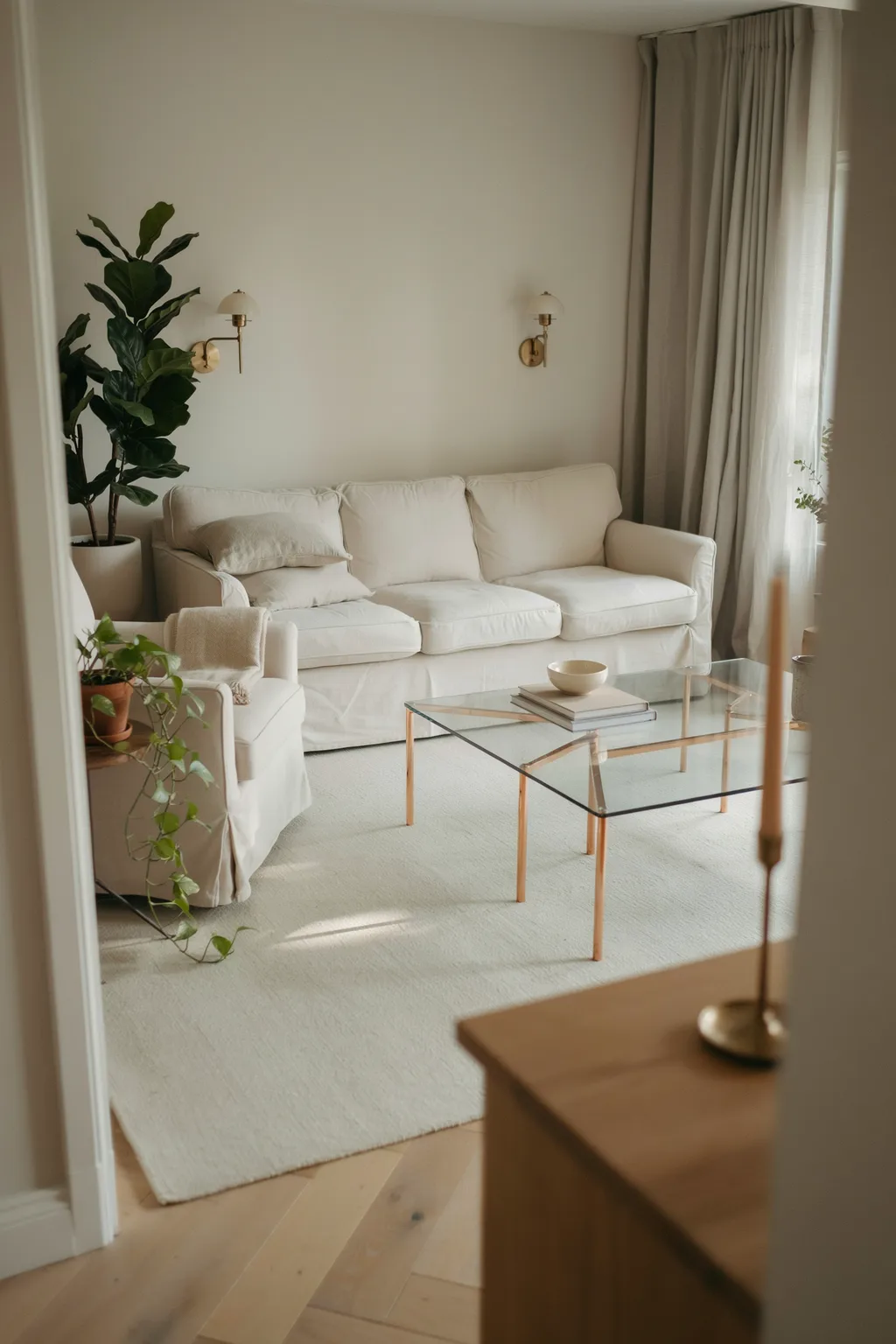
When walls, sofa, and rug share one soft tone, the corners seem to disappear. This neutral haven pairs cream slipcovered sofas with gray drapes, brass sconces, and a glass-and-copper coffee table. There is no hard line where the furniture stops and the wall begins, so the room reads as one continuous, roomy whole. Pale and cool colors also recede, which makes surfaces feel farther away than they are.
Color psychology backs this up. Light, cool paint reads as more distant, which is why designers reach for soft whites and greiges in tight rooms; paint maker Sherwin-Williams has a free color visualizer so you can test a shade on your own walls before you commit. A glass coffee table helps too, since you see straight through it to the floor beyond.
This is for anyone who wants a calm, timeless base. If you crave color, add it in swappable pillows and art, not the big pieces, so the room stays open underneath.
5. Go Coastal With Whites and Sea Glass Tones
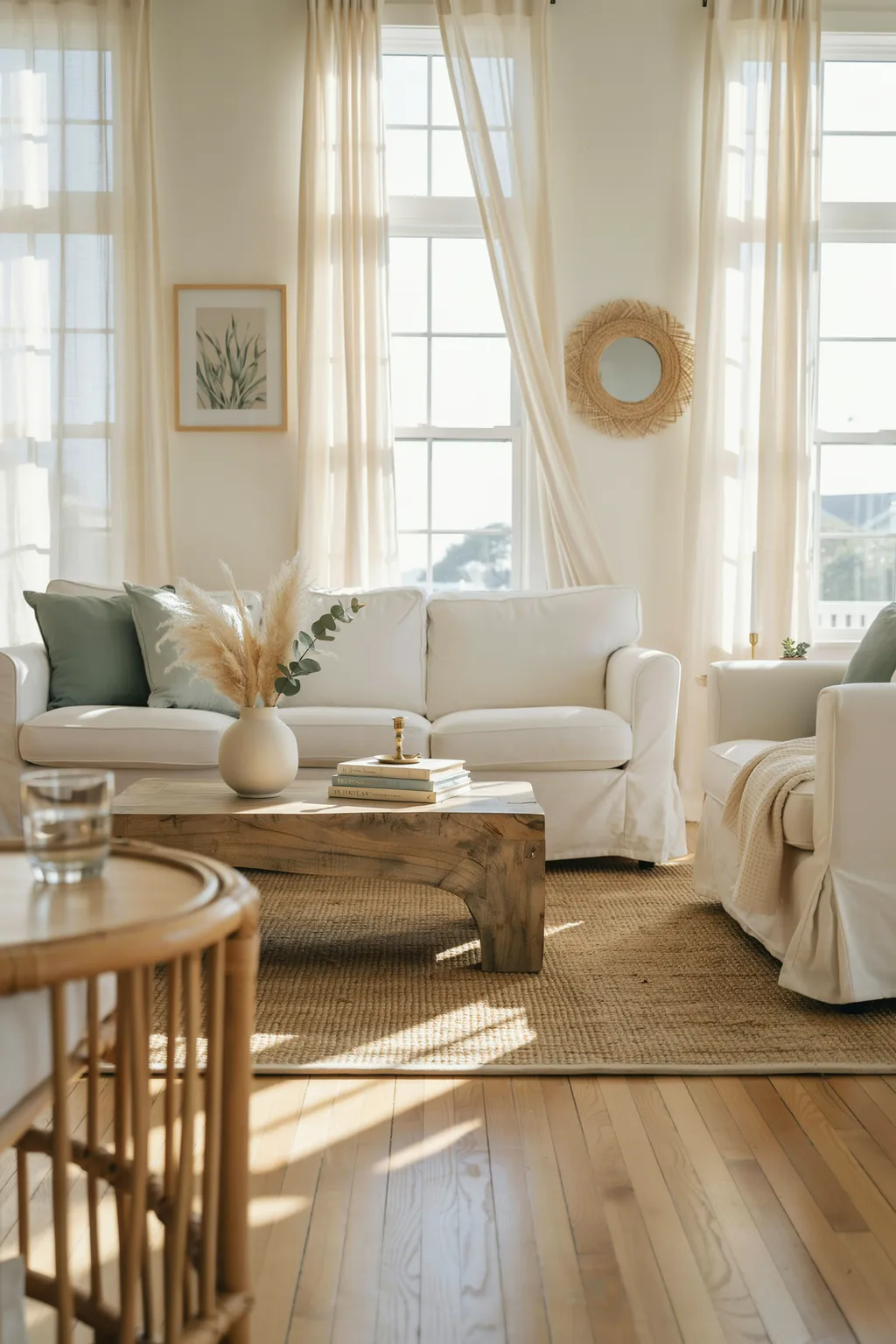
Coastal style is basically a small-space toolkit in disguise. White slipcovered sofas, sage and seafoam pillows, a driftwood coffee table, and a jute rug bounce daylight around a room full of big windows. The airy palette and natural light do the heavy lifting, so the space feels breezy and open even when the furniture is full-size. Pale blues and greens read as fresh air, not walls.
Reflection and light are the whole game here. White surfaces near lots of glass throw sunlight into every corner, and a low driftwood table keeps the sightline to the floor open. Picture a north-facing room that felt gray before: swap heavy drapes for sheer white ones and the same room brightens without a single new lamp.
Perfect for homes with good natural light, and one of the brightest living room ideas on this list. If your windows are small or north-facing, lean on white walls and mirrors to fake the brightness, and skip navy accents that can weigh the room down.
6. Borrow Industrial Height With Tall Shelving
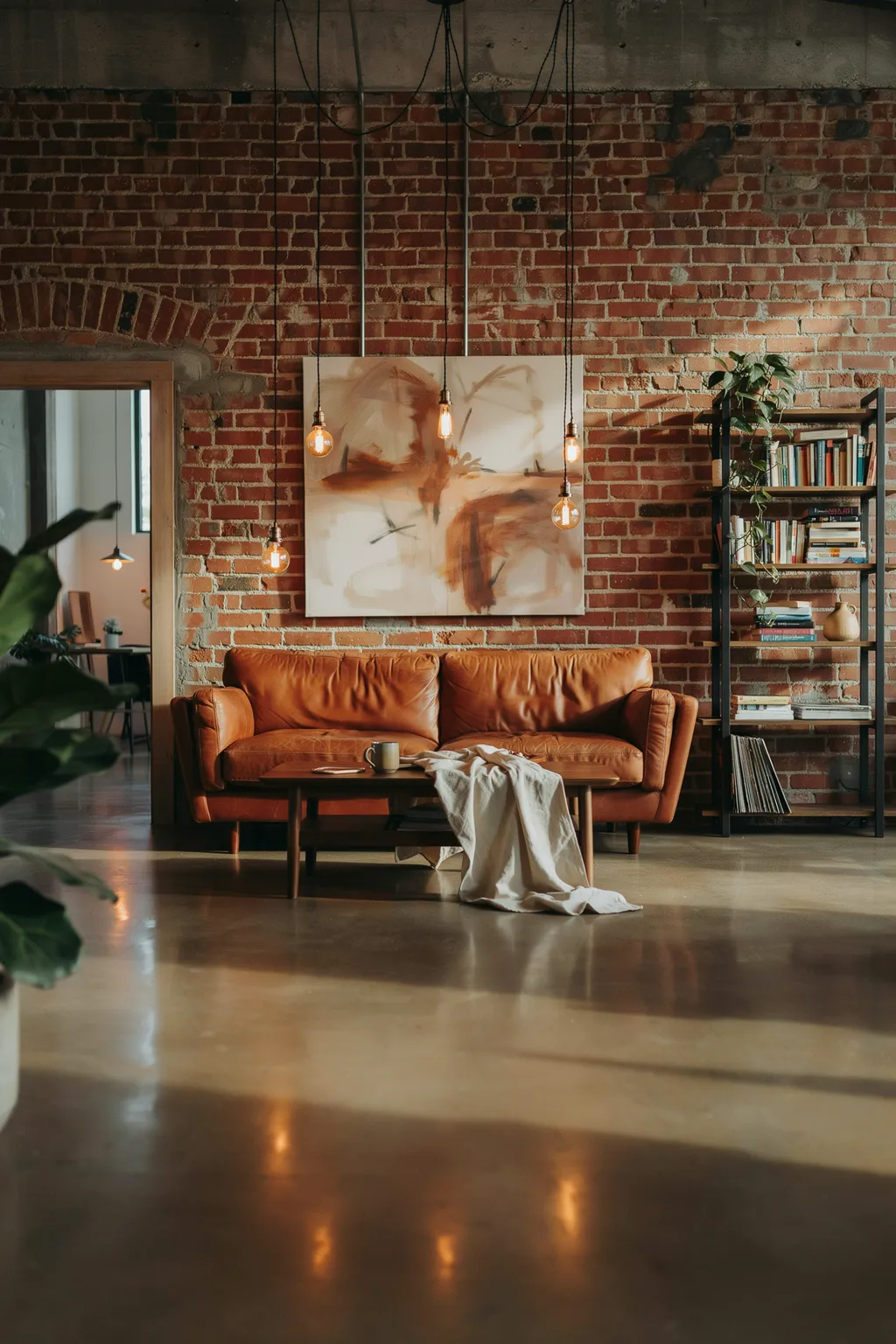
Industrial style loves to look up, and that habit is gold in a small room. An exposed brick wall, tall metal shelving, a cognac leather loveseat, and a couple of Edison bulbs make the space feel loft-like even at modest size. Drawing the eye vertically with floor-to-ceiling shelves makes the ceiling read as taller than it is. Storage that climbs the wall also frees up precious floor.
Verticality is the lesson to steal. A tall, narrow metal shelf holds books and plants in the same footprint as a squat cabinet, but it pulls your gaze up and clears the ground below. One example: replace a low sideboard with a five-shelf industrial rack and you double the storage while making the wall feel a foot taller.
This works in apartments with a bit of raw character or any wall you can mount into. Keep the palette to brick, black, and warm wood, and avoid filling every shelf, or the openness disappears.
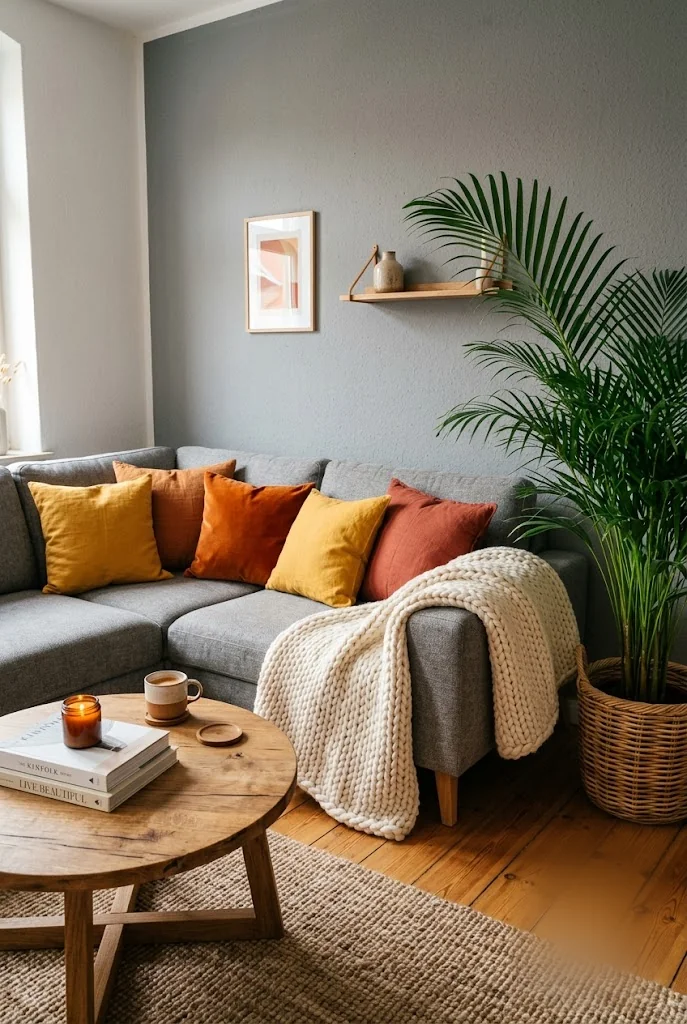
7. Steal the Scandinavian Small-Space Playbook
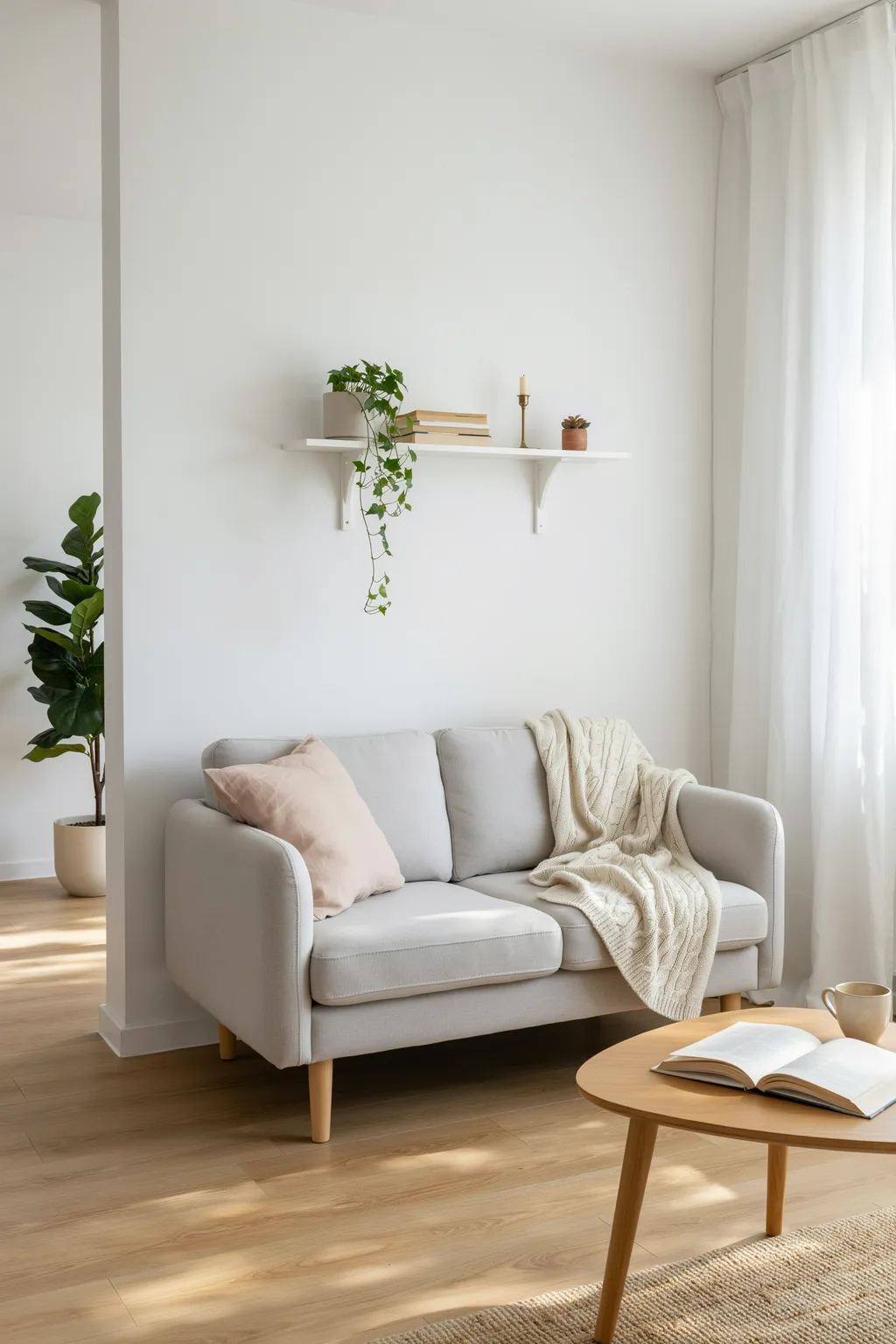
If any style was built for tiny rooms, it is this one. A compact light-gray sofa, a chunky knit throw, wall-mounted white shelving, and warm wood floors keep the room simple and bright. Scandinavian design assumes small footprints, so every piece earns its place and nothing is oversized. Pale wood and white walls throw light around, while wall shelves keep the floor clear.
Floating storage is the move to copy. Mounting shelves on the wall instead of standing a bookcase on the floor keeps the ground open, which instantly makes the room feel larger. A blush pillow and one trailing plant add warmth so it never feels sterile. Think of a 10-by-12 room: a slim two-seat sofa plus wall shelves leaves a clear walking path a bulky sectional would swallow.
Of all these living room ideas, this is the safest pick for a genuinely small room. There is almost no caveat, just do not crowd the walls with too many shelves, or you lose the calm.
8. Build a Vintage Gallery Wall That Lifts the Eye
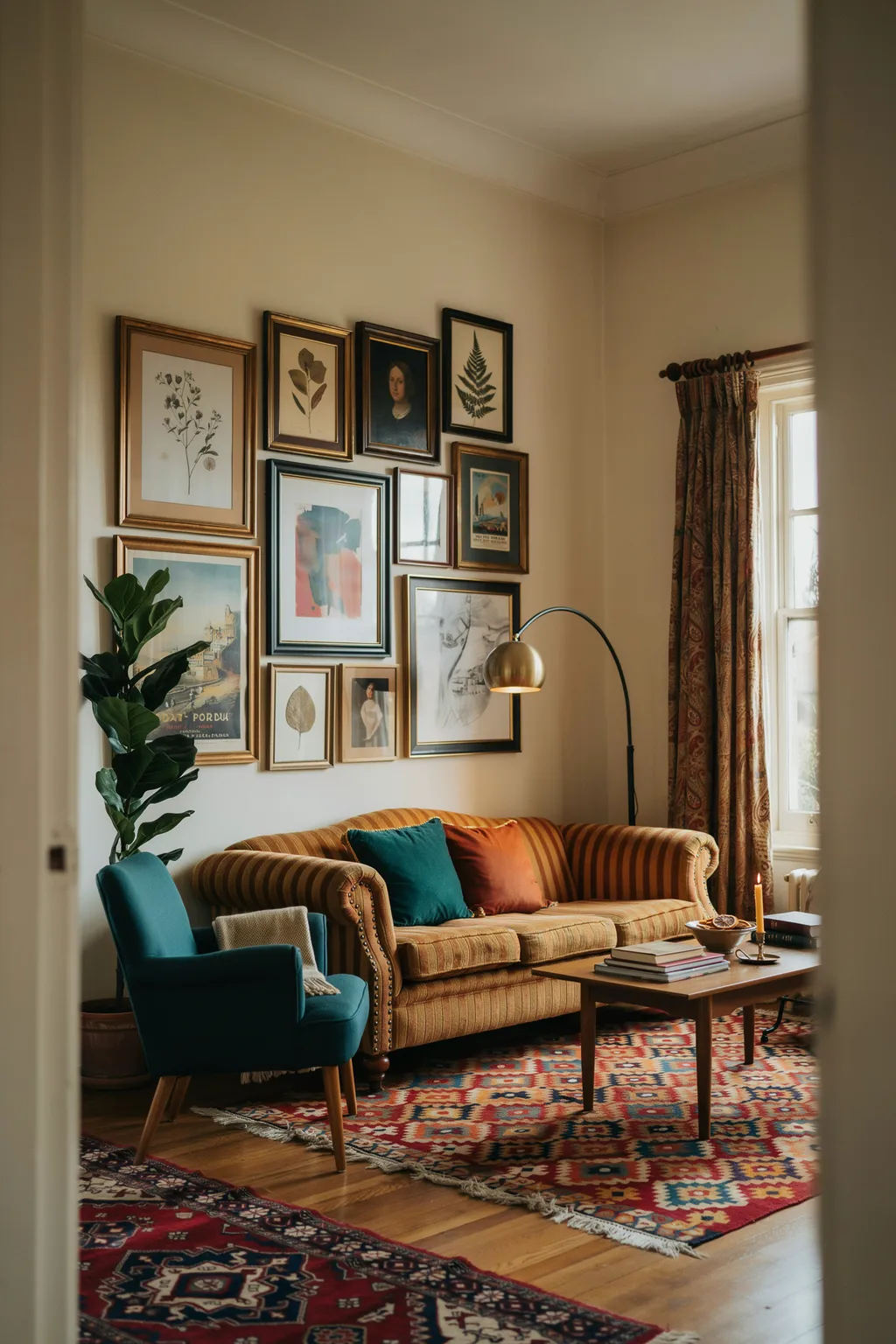
A gallery wall turns a blank wall into height, and height is what small rooms crave. This vintage corner stacks framed art from sofa-back to ceiling above a striped antique sofa, flanked by teal armchairs, a kilim rug, and an arc lamp. The eye climbs the frames upward, so the wall feels taller and the room feels less boxed. Vertical arrangements always beat one lonely picture hung at eye level.
Composition is what sells it. Hanging art in a column that reaches toward the ceiling, rather than a single row, tricks the eye into reading more height. Mix frame sizes but keep them in a loose grid so it feels collected, not chaotic. For instance, a stack of five frames climbing the wall makes an eight-foot ceiling feel like nine.
Great for renters, and one of the cheapest living room ideas to pull off with a stash of prints and thrift finds. If your walls are already busy with pattern, keep frames simple black or wood so the gallery does not tip into visual overload.
9. Add Glam With a Mirror and Metallics
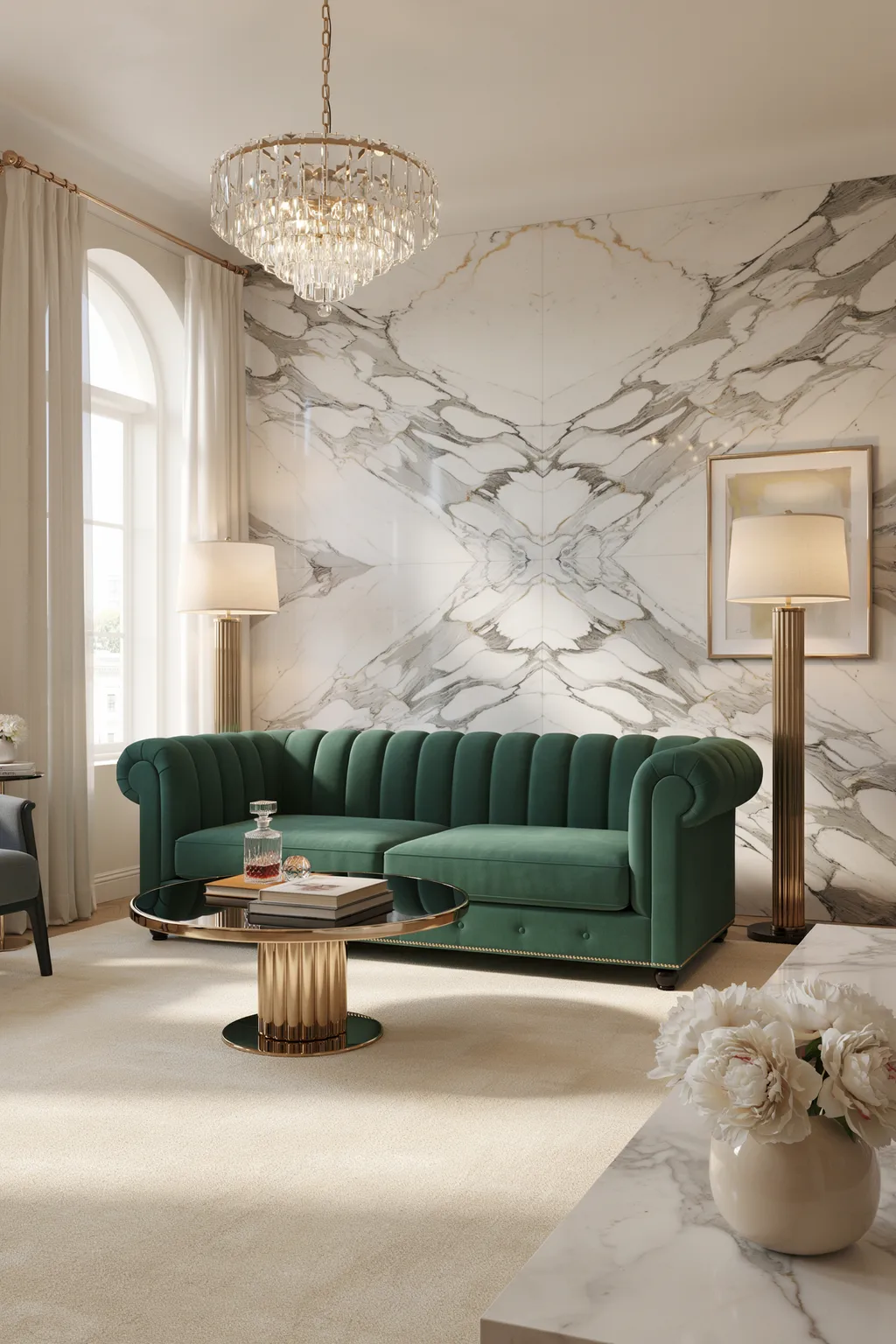
Glamour and small spaces get along better than you would guess. An emerald channel-tufted sofa, a gold round coffee table, a marble accent wall, and a crystal chandelier make this room feel rich, while reflective metal and stone bounce light everywhere. Shiny surfaces double the light in a room, and doubled light reads as more space. A gold table and mirror-bright accents work like tiny windows.
Reflection is the engine here. Choosing furniture with metallic legs or glass tops keeps the floor visible and throws light back into the room, so it never feels heavy despite the drama. Picture a dim corner: add one gold-framed mirror across from a lamp and the whole nook brightens as the light bounces.
As living room ideas go, this suits people who want a little drama without a big room. Keep the jewel tones to one or two pieces, since too many saturated colors in a small space can feel like they are pressing inward.
10. Bring Nature In With Light Rattan and Jute
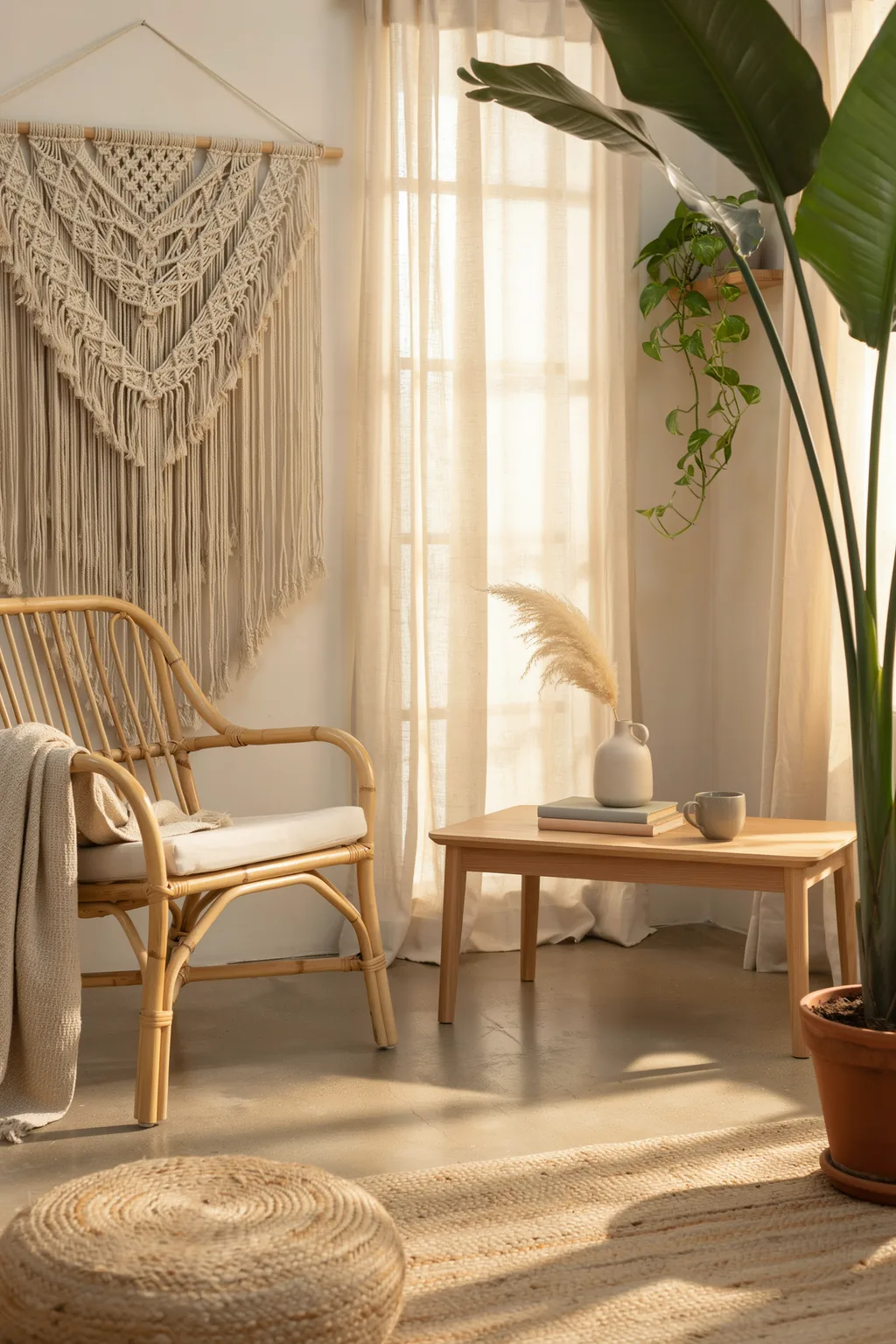
Natural materials keep a room feeling light on its feet. This nature-inspired space uses pale rattan and wood furniture, macrame wall hangings, big bird-of-paradise plants, and a jute rug in a warm, earthy neutral scheme. Light woods and open-weave furniture feel less bulky than solid upholstery, so the room stays visually quiet. You can see through and around the pieces, which keeps sightlines long.
Openness in the furniture itself is the point. A rattan chair with a see-through frame takes up the same floor as a solid armchair but blocks far less of your view, so the room feels roomier. As an example, swap a chunky ottoman for a light woven pouf and the floor suddenly looks bigger.
Ideal for plant lovers and warm-minimalists. Just avoid crowding the floor with too many potted plants, since a jungle at ankle height can trip up the flow and eat the open space you are trying to protect.
11. Paint Bold Arches to Trick the Depth
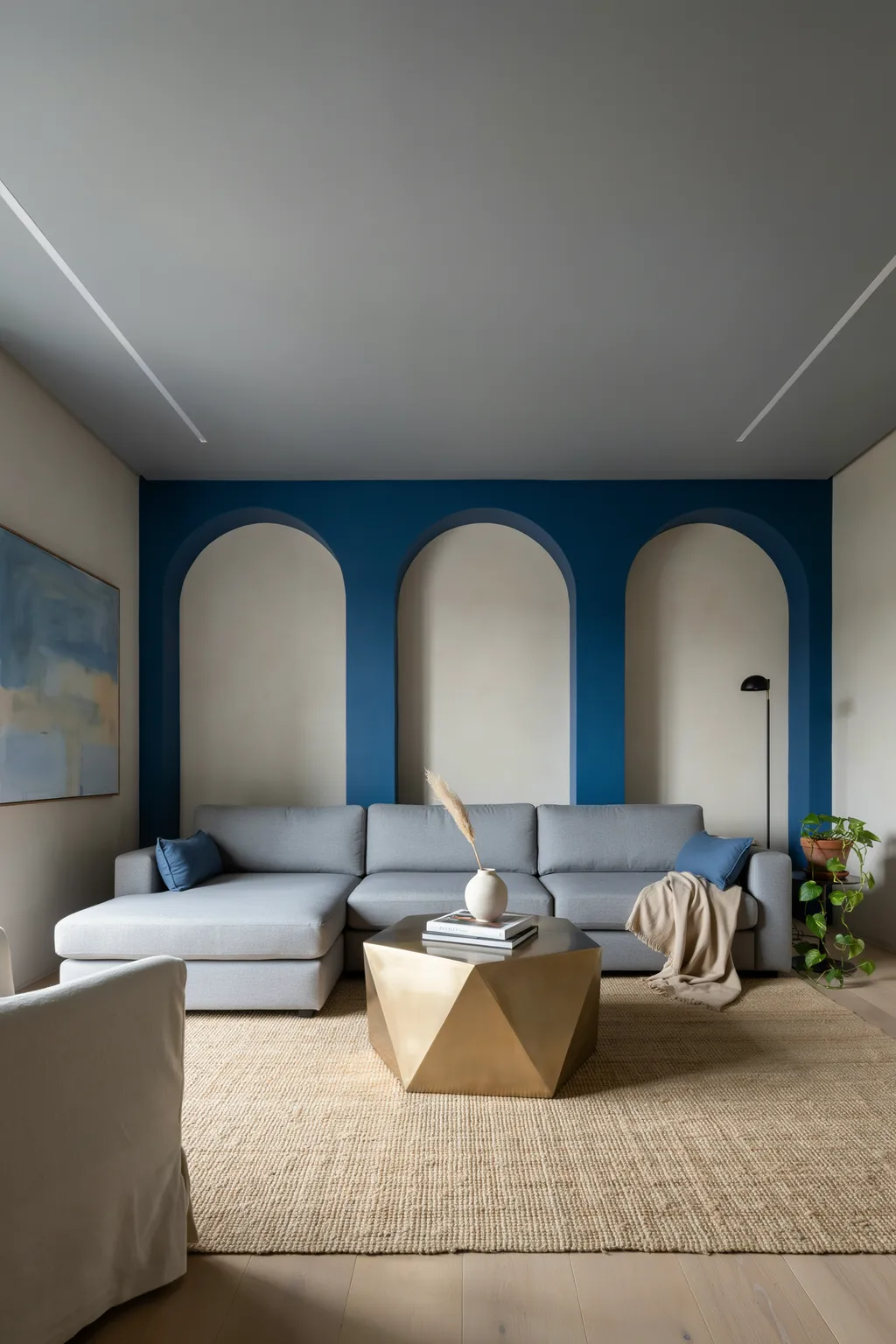
Paint can carve out depth where there is none. This contemporary room uses blue painted arches on the walls behind a gray modular sofa, with a geometric metal coffee table and slim LED linear lights. The arches act like painted doorways, hinting at rooms beyond and pulling the eye past the flat wall. Color blocking with curves adds a sense of layers to a shallow space.
Illusion is the whole idea. Painting an arch shape a few shades deeper than the wall makes that spot feel recessed, like a niche, which adds fake depth for the cost of a quart of paint. One example: a painted arch behind the sofa reads as an alcove, so the wall no longer feels like a flat box.
This is for the bold and the renters who can repaint. If you cannot paint, a large arched mirror or an arch-shaped decal gives a similar depth cue without the commitment.
12. Brighten a Farmhouse With Shiplap and White
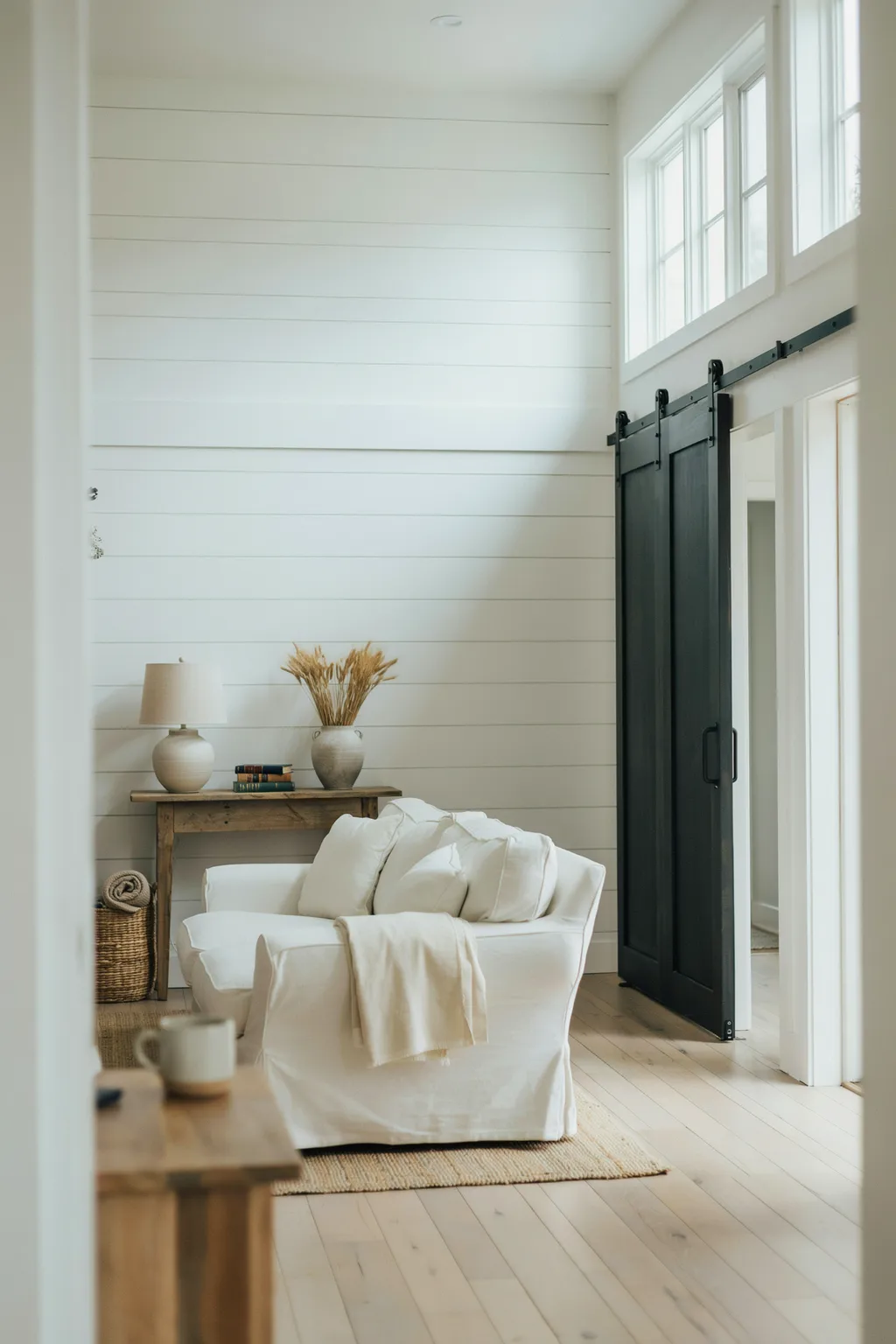
Farmhouse style can feel bulky, but a white version reads clean and open. White shiplap walls, sliding barn doors, white slipcovered sofas, a rustic wood console, and high transom windows keep this room bright and country-fresh. All that white reflects light and smooths the walls into one bright plane, so the room feels larger than its footprint. Barn doors also save the swing space a hinged door steals.
Space-saving hardware is the clever part. A sliding barn door needs zero clearance to open, unlike a standard door that carves a useless arc out of your floor. Picture a small room where a swinging door blocked the sofa: put it on a sliding track and you reclaim a whole corner.
Best for cottages, and among the brightest living room ideas for a home that already leans traditional. If you love farmhouse but have a dark room, keep the whites bright and skip the distressed dark-wood pieces that can make a small space feel cluttered.
13. Wrap One Wall in Mirror, Deco-Style
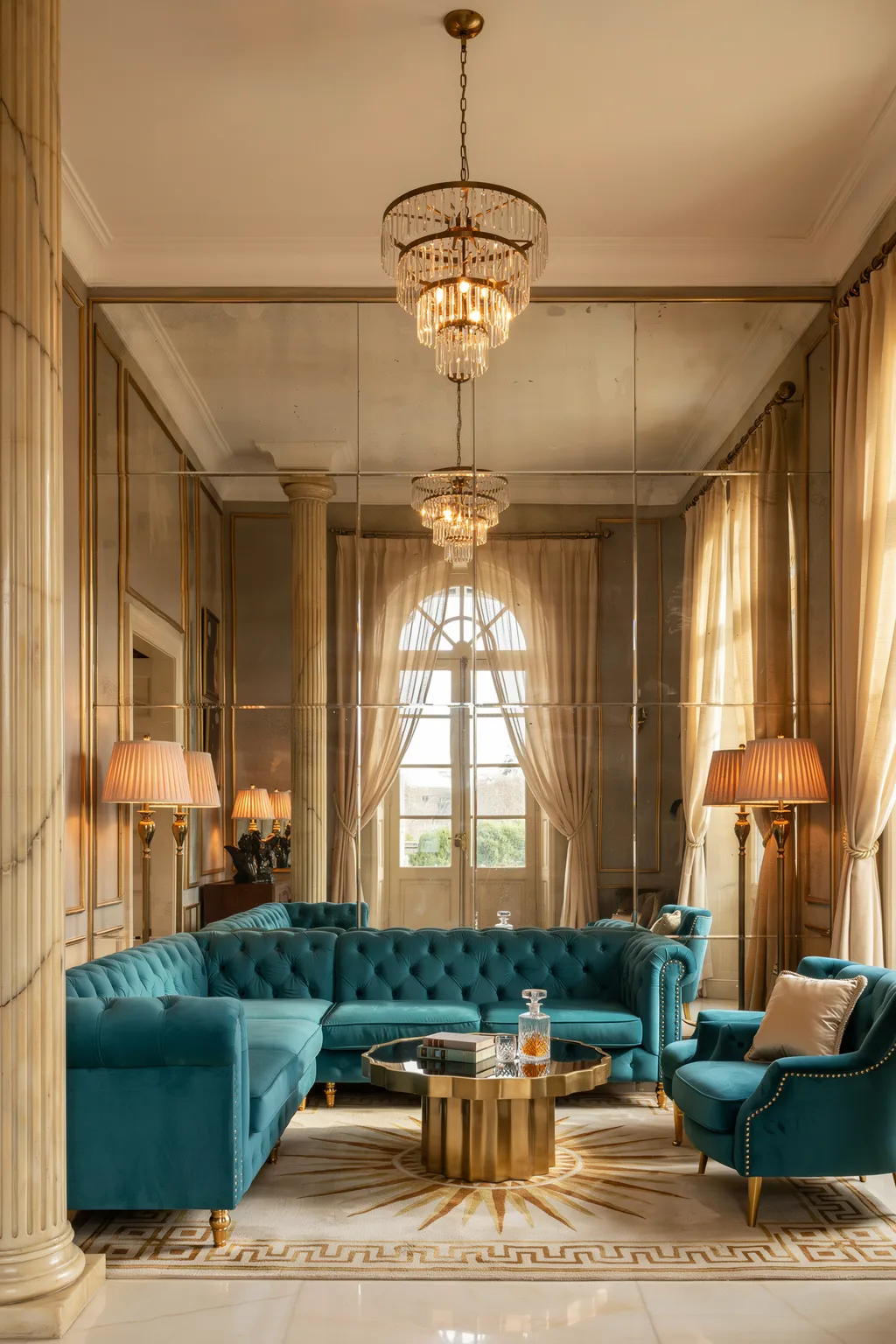
Nothing doubles a small room like a mirrored wall, and Art Deco does it with flair. Teal velvet tufted sofas, a gold geometric coffee table, and a brass chandelier sit in front of a wall of antiqued mirror panels. The mirror reflects the whole room back, so the space appears to stretch twice as far. This is the single most powerful small-space trick on the list.
Scale is what makes it work. A full wall of mirror, rather than one small framed piece, reflects the opposite window and pulls its light and view deep into the room. As an example, a mirrored wall across from a window makes a one-window room feel like it has two, and the extra light is real.
This suits glamorous, pattern-loving decorators. The honest catch: mirror walls show every fingerprint and need cleaning, and cheap mirror tiles can distort, so budget for quality panels or a single large framed mirror instead.
14. Raise Everything on Mid-Century Legs
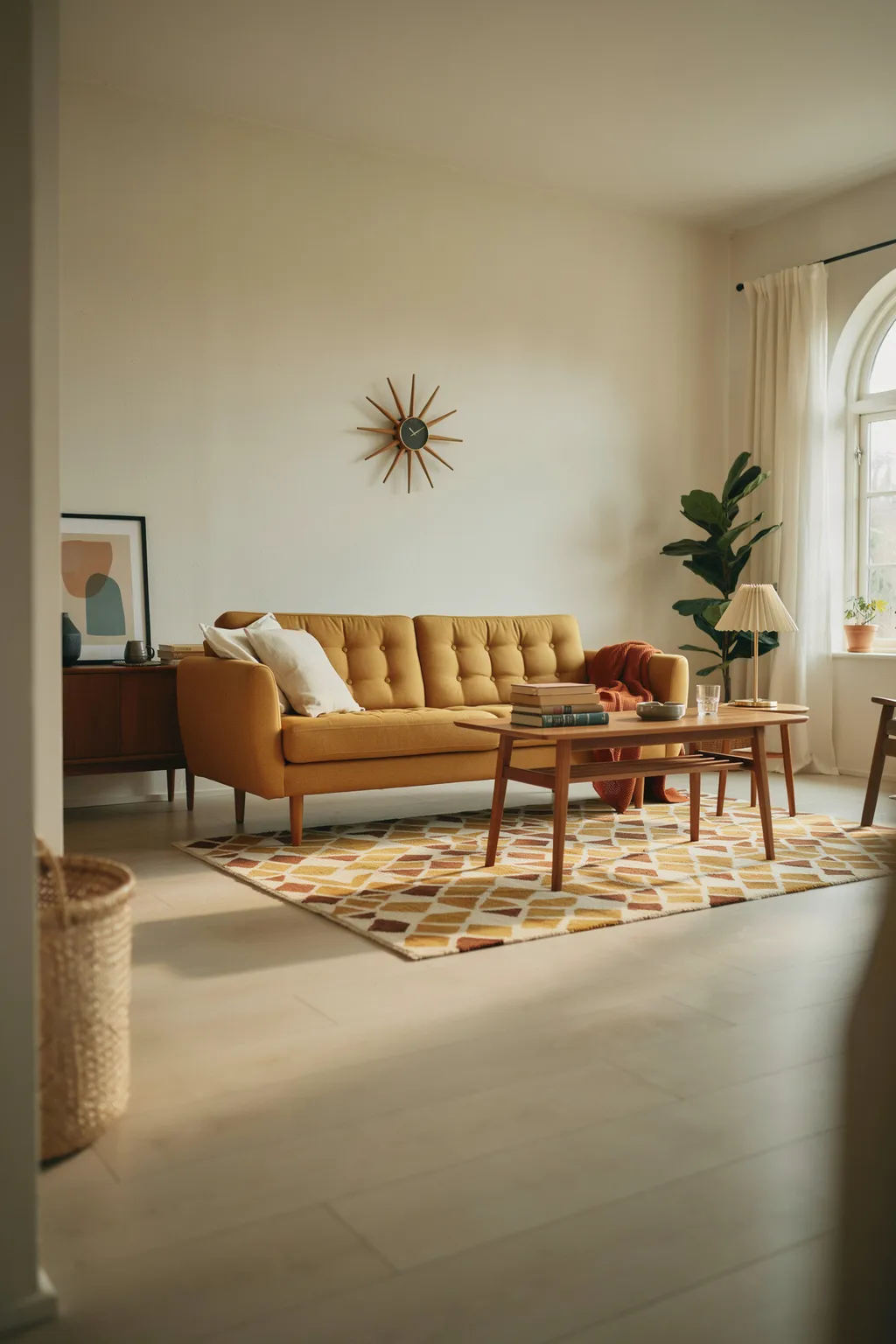
Furniture that stands on legs makes a room feel bigger, and mid-century modern nails this. A mustard tufted sofa on tapered wood legs, a teak coffee table, a starburst clock, and a geometric rug keep the whole setup light and lifted. Because you see the floor running under every piece, the room reads as more open. Visible floor equals perceived space, plain and simple.
Airflow beneath the furniture is the trick. Raising a sofa and table on slim legs lets light and floor flow under them, so the pieces seem to float rather than block. Compare a skirted sofa that sits flush to the ground with a leggy mid-century one: the leggy version shows a strip of floor that makes the room feel wider.
Perfect for fans of clean retro lines, and one of the lowest-risk living room ideas for a small room. It is forgiving for small rooms, though very low-slung pieces can feel cramped under a low ceiling, so balance one low sofa with a taller lamp or shelf.
15. Try a Dark Palette the Smart Way
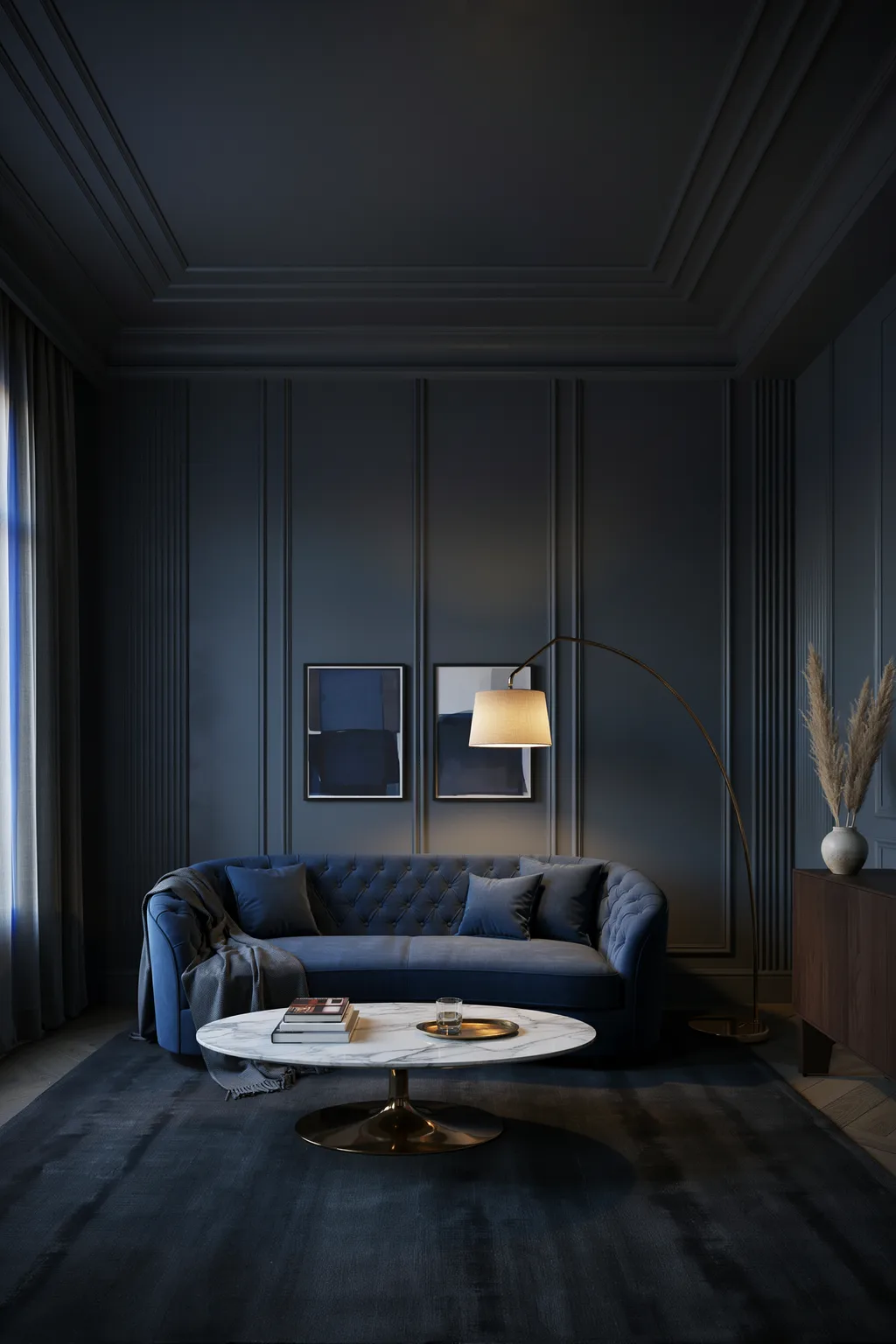
Dark rooms can feel bigger, not smaller, if you commit fully. This luxe lounge wraps charcoal paneled walls around a navy velvet curved sofa, a marble oval coffee table, and brass accents. When every wall is the same deep color, the corners vanish into shadow and the room loses its hard edges, so it can feel surprisingly expansive at night. The key is going all-in, not halfway.
Consistency is what saves it. Painting walls, trim, and ceiling the same dark shade erases the lines that tell your eye where the room ends, which blurs the boundaries. For example, a charcoal room with matching trim feels moody and boundless, while charcoal walls with white trim just feel small and chopped up.
This is for confident decorators and rooms you use mostly in the evening. The real caveat: a dark room with little natural light can feel like a cave by day, so reserve this for spaces you light warmly at night, and add a mirror or two to bounce what light you have.
16. Open It Up With Mediterranean Plaster
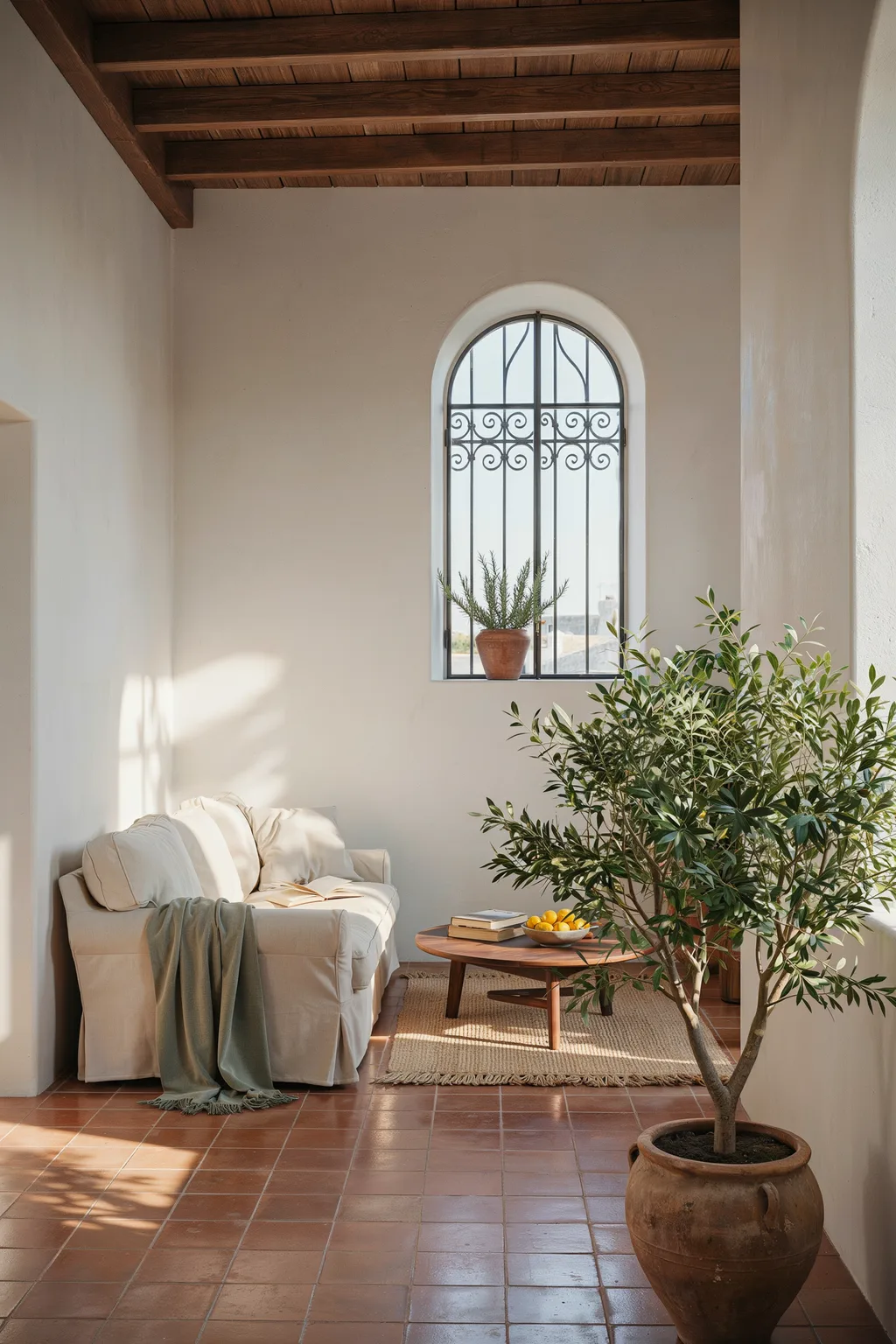
Soft plaster walls have a way of melting a room’s hard edges. This Mediterranean space pairs white lime-plaster walls with wood beams, an arched iron window, terracotta floors, a cream slipcovered sofa, and an olive tree in a clay urn. The rounded plaster corners and pale surfaces reflect light softly and remove the sharp lines that make a small room feel like a box. Curves read as calm and open.
Softness is the quiet trick. Rounded plaster edges and an arched window blur the boundary between wall and ceiling, so the room feels like it flows rather than stops. Picture a squared-off corner versus a gently curved plaster one: the curve feels roomier because your eye has nothing hard to snag on.
Great for warm climates and lovers of handmade texture. If true plaster is out of budget, a limewash paint gives a similar soft, light-catching finish for far less, and it still helps a small space breathe.
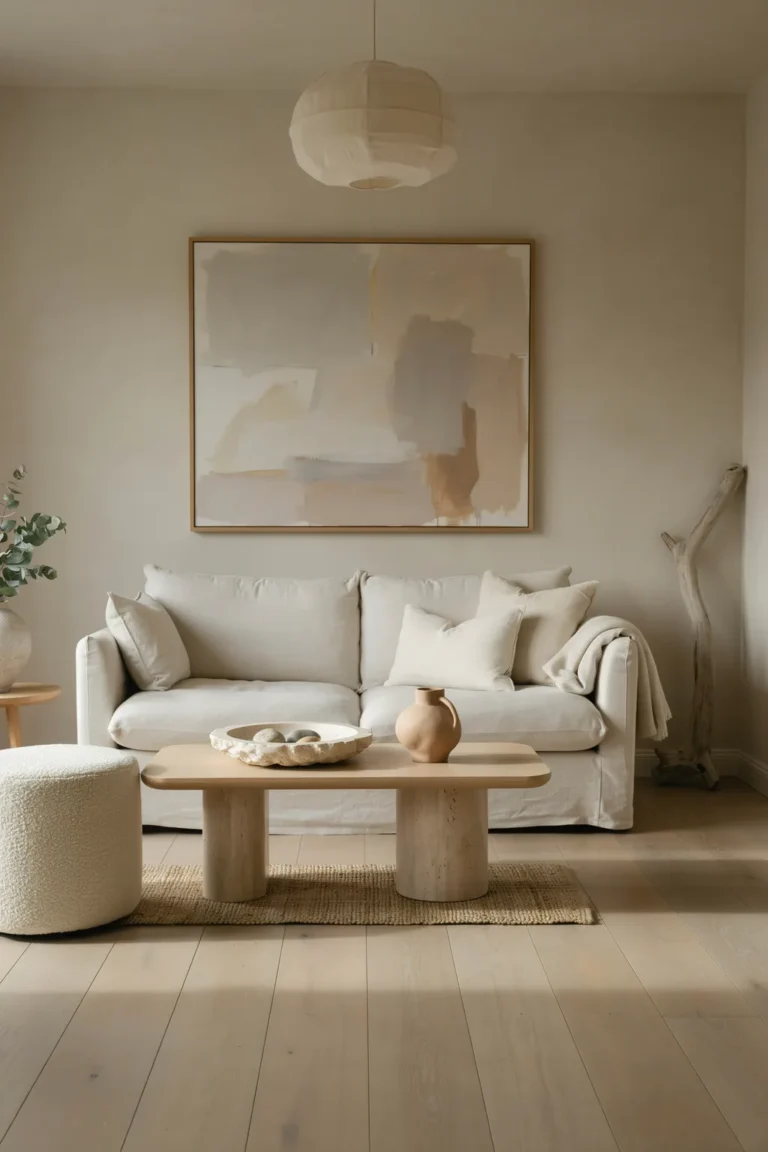
17. Strip It Back to Zen Essentials
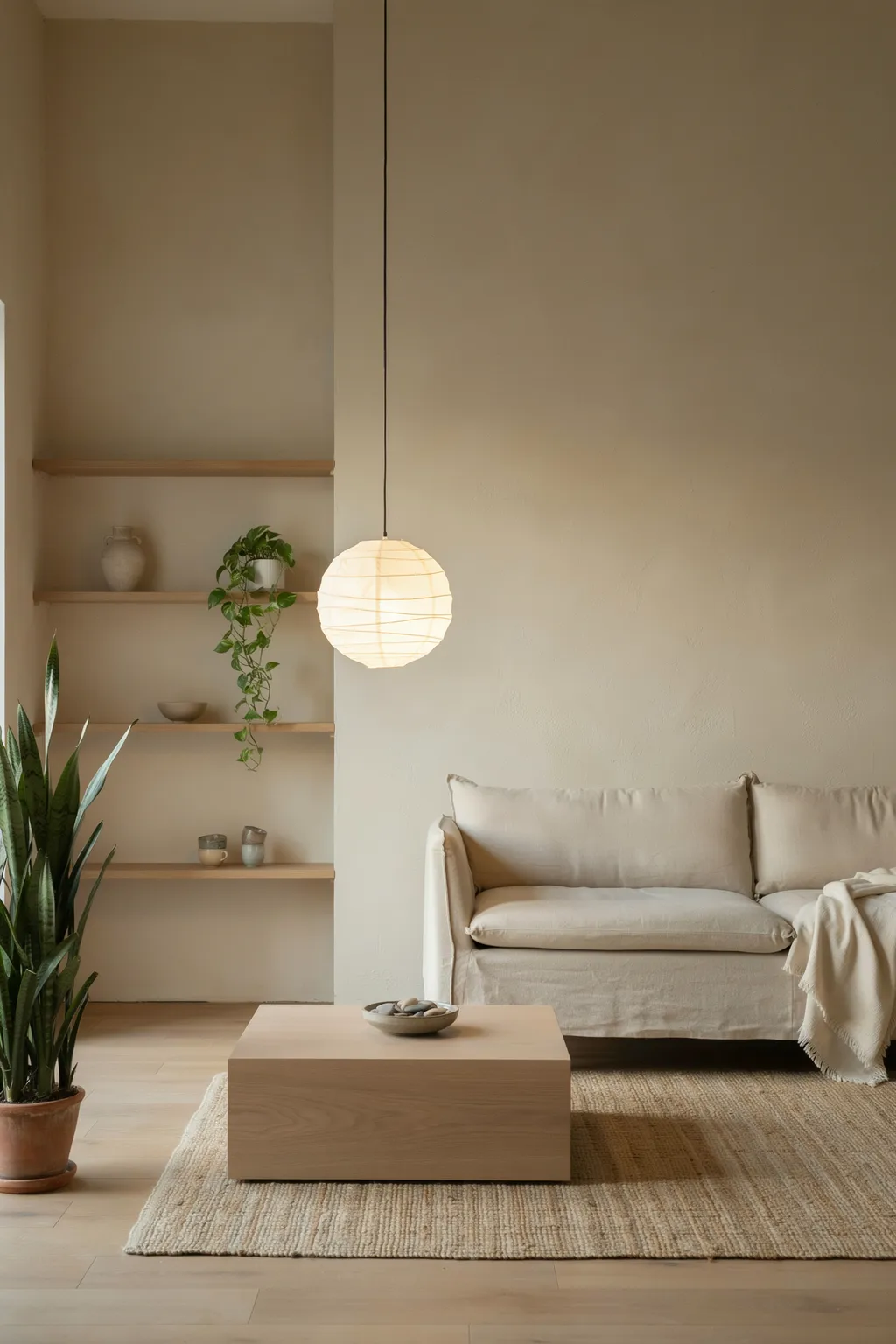
Zen style clears the room until it can breathe, which is exactly what a small space needs. Beige walls, a soft rice-paper pendant lamp, light wood shelving, a low platform coffee table, and a few snake plants keep everything calm and uncluttered. Empty space is treated as a feature, not a gap to fill, so the room feels open by design. Less stuff means more room to move and to look.
Negative space is the whole philosophy. Leaving areas of wall and floor deliberately bare gives the eye somewhere to rest, which makes even a small room feel larger and calmer. As an example, one low table and a single plant in a bare corner feel serene, while the same corner packed with furniture feels tight.
This is a strong choice for anyone craving calm in a busy home. The only caveat: minimal rooms need good storage elsewhere, or the clutter you removed just piles up out of sight and creeps back in.
18. Use Botanical Color as a Focal Wall
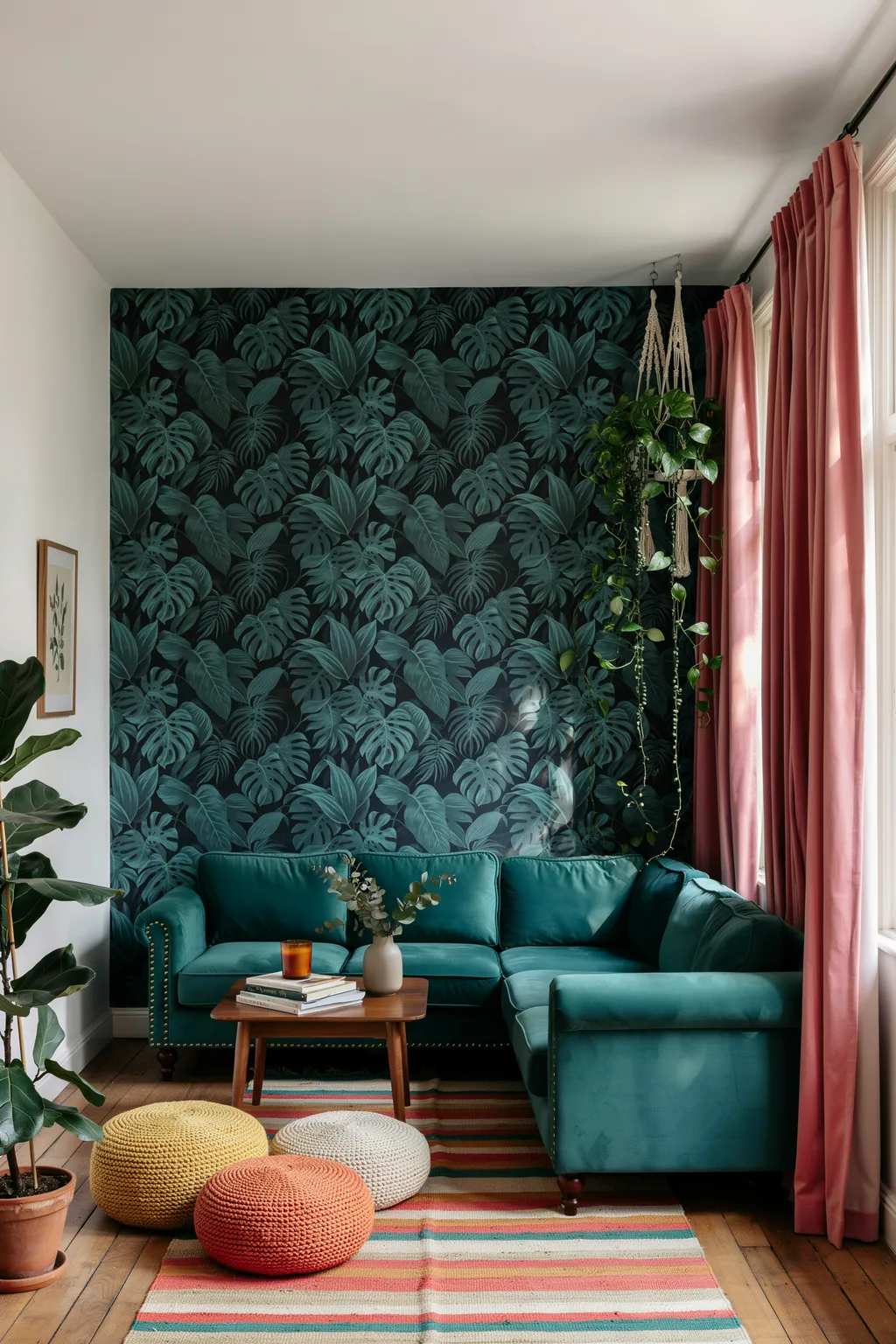
Bold color and small rooms can coexist if you keep the drama to one wall. This botanical room puts dark leafy wallpaper behind teal sofas, with hot-pink curtains, hanging plants, and a colorful striped rug. One patterned focal wall gives the eye a destination and adds depth, while the other walls stay simple to keep the room from shrinking. Contained color reads as a feature, not a cage.
Focus is what keeps it from backfiring. Papering just one wall behind the sofa, instead of all four, creates a deep, immersive backdrop without wrapping you in pattern from every side. Picture a small room papered floor-to-ceiling on every wall versus one bold wall with three calm ones: the single wall feels rich, the full room feels claustrophobic.
For maximalists who still want their room to feel open, this is the compromise. Skip it if you truly cannot leave the other walls plain, since all-over dark pattern will close a small space right in.
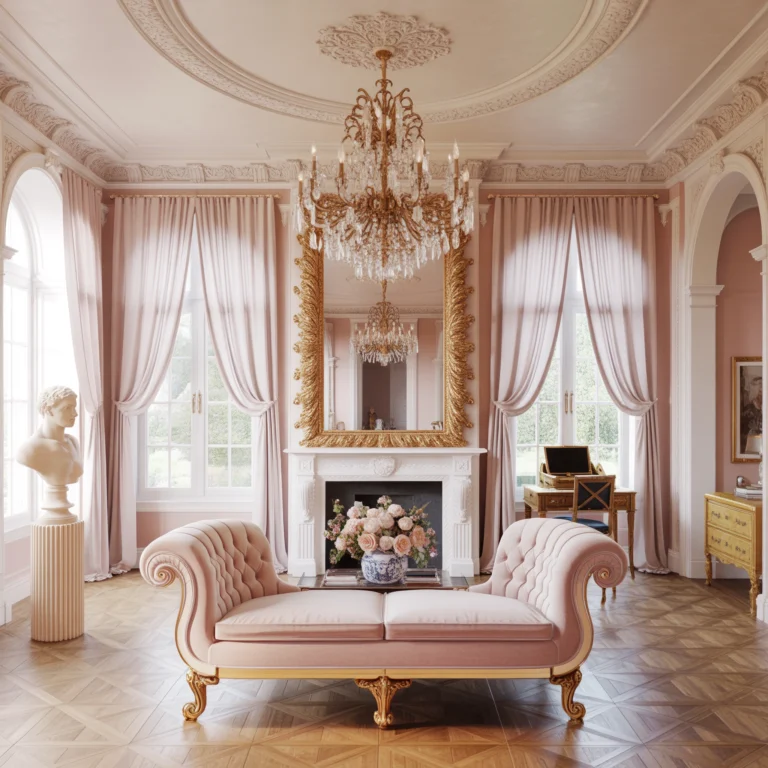
19. Charm It French Country With Light Pastels
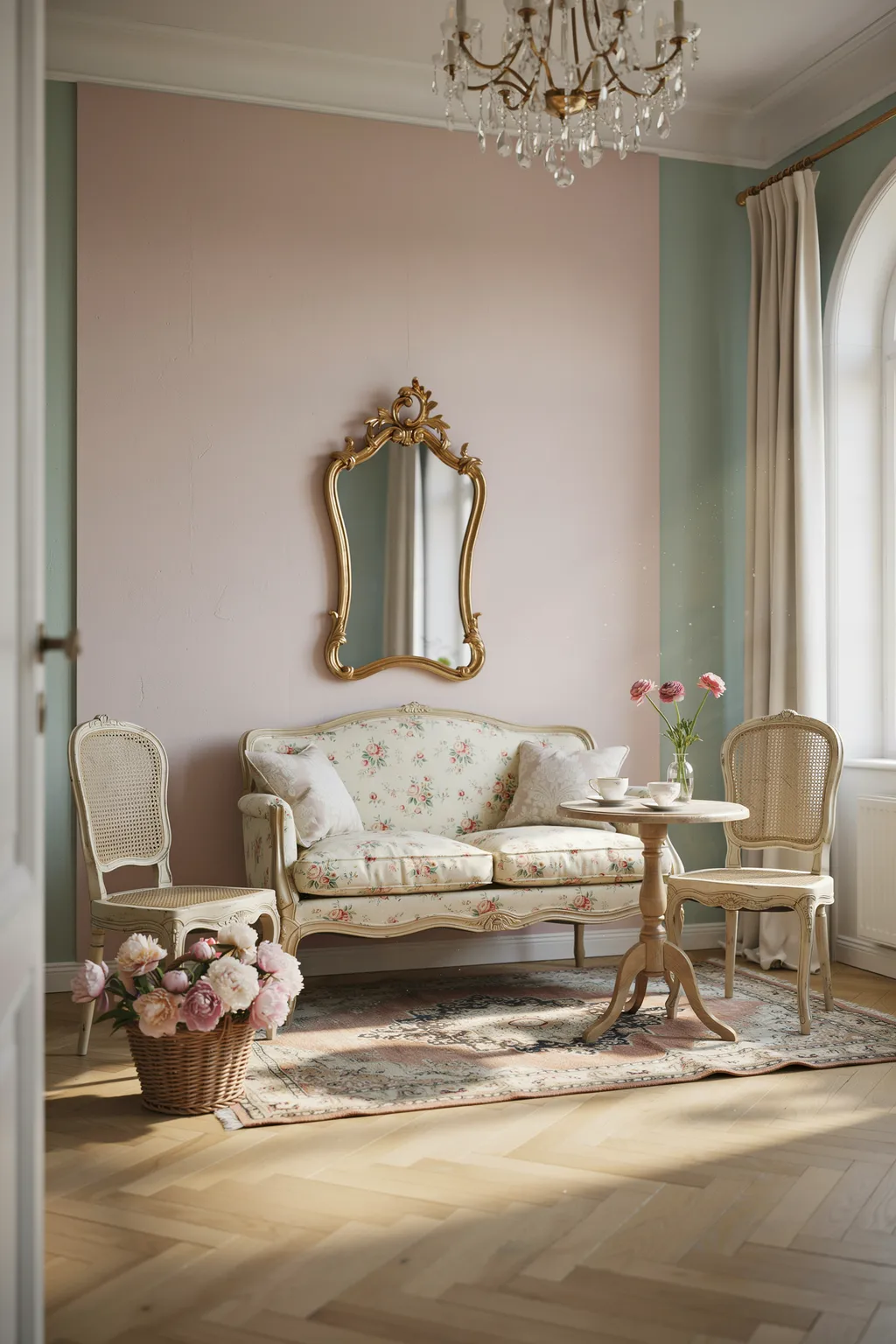
French country proves a small room can feel elegant and open at once. Pastel pink and mint walls, a crystal chandelier, a floral toile settee, antique cane chairs, and an ornate mirror fill this space with soft light and grace. The pale pastels keep the walls receding, and cane-backed chairs you can see through hold the sightlines open. An ornate mirror does double duty, adding charm and bouncing light.
See-through seating is the smart detail. Choosing chairs with open cane or spindle backs, rather than solid upholstered ones, lets your eye pass through them to the room beyond, so they take up space without blocking it. For example, two cane chairs feel far lighter than two wingbacks in the same spot.
This suits romantic, vintage-leaning decorators. If pastel walls feel too sweet, keep them on the walls only and ground the room with a natural wood floor and a simple rug so the look stays fresh, not fussy.
Common Mistakes to Avoid
Mistake 1: Pushing all the furniture against the walls
People think shoving everything to the edges opens the middle, but it often makes a room feel like a waiting area. Pull the sofa a few inches off the wall and float a chair on an angle. The breathing room reads as intentional and makes the space feel designed, not crammed.
Mistake 2: Choosing one oversized sofa
A giant sectional swallows a small room and blocks every path. Measure your space and leave at least 30 inches of walkway around seating. A slim two- or three-seat sofa with exposed legs almost always makes a small room feel bigger than a bulky sectional does.
Mistake 3: Hanging curtains at the window frame
Mounting the rod right at the window top makes ceilings look lower and windows smaller. Hang the rod close to the ceiling and let panels reach the floor. This one free change can add a visual foot of height to the whole room.
Mistake 4: Using lots of tiny decor
A dozen small trinkets create visual noise that makes a room feel cluttered and smaller. Swap ten little objects for two or three larger ones. Fewer, bigger pieces read as calm and give the eye space to move.
Mistake 5: Relying on one overhead light
A single ceiling light flattens a room and pushes the corners into gloom, which shrinks it. Add two or three lamps at different heights. Layered light creates depth and makes a small space feel warm and larger after dark.
Mistake 6: Skipping a rug or buying one too small
A tiny rug floating under the coffee table chops the floor into pieces and shrinks the room. Size the rug so the front legs of your seating sit on it. A properly sized rug ties the space together and makes the floor feel bigger.
Quick Start Checklist
- [ ] Measure the room and sketch a layout before buying anything
- [ ] Pick three or four living room ideas from this list that fit your light and style
- [ ] Choose one light, cool paint color for the walls and test it on the wall first
- [ ] Swap or shop for a slim sofa with exposed legs
- [ ] Add one large mirror across from your main window
- [ ] Hang curtain rods near the ceiling with floor-length panels
- [ ] Mount shelves on the wall to keep the floor clear
- [ ] Layer at least three light sources at different heights
- [ ] Size your rug so the front seating legs rest on it
- [ ] Clear the central path so you can walk through without weaving
- [ ] Edit decor down to a few larger pieces instead of many small ones
- [ ] Leave some wall and floor deliberately empty to let the room breathe
Frequently Asked Questions
What colors make a small living room look bigger?
Light, cool tones open a room the most. Soft whites, pale grays, greige, and gentle blues and greens reflect light and appear to recede, which pushes the walls back visually. Painting the walls, trim, and ceiling close to the same light shade removes hard lines and makes the room feel seamless. If you want depth instead, a single dark accent wall can work, as long as the rest stays light.
How do I arrange furniture in a small living room?
Start by keeping a clear path through the room, at least 30 inches wide. Float the sofa a few inches off the wall, angle a chair to soften the box, and choose pieces with legs so the floor shows underneath. Use one focal point, like a window or fireplace, and aim seating toward it. Avoid blocking doorways or windows, since open sightlines make the space feel larger.
Does a mirror really make a room look bigger?
Yes, when you place it well. A large mirror across from a window reflects the view and the daylight back into the room, so it reads as a second window and doubles the sense of light and depth. A full mirrored wall has the strongest effect. Avoid pointing a mirror at clutter or a blank wall, since it will just reflect that back at you.
What is the best sofa size for a small living room?
Measure your wall and doorways first, then pick a sofa that leaves walking room on every side you use. A two- or three-seat sofa around 70 to 80 inches wide fits most small rooms, and one with raised legs feels lighter than a floor-hugging design. Apartment-depth sofas, which are a few inches shallower, free up even more floor without giving up comfort.
How can I make my small living room feel cozy but still open?
Balance is the answer. Use warm textures like a chunky throw, a soft rug, and layered lamplight for coziness, but keep the big pieces light in color and raised on legs so the room stays open. These living room ideas prove you can have both: warmth comes from texture and lighting, while openness comes from pale colors, mirrors, and a clear floor.
Can I use dark colors in a small living room?
You can, if you go all in. A room where the walls, trim, and ceiling share one deep shade loses its hard corners and can feel moody and boundless, especially at night. The trick is committing fully rather than mixing dark walls with bright white trim. Add a mirror and warm layered lighting so the dark space still feels rich instead of cramped.
Conclusion
A small living room is not a limit, it is a design brief with clear answers. The living room ideas that work all pull from the same playbook: reflect light with mirrors and pale colors, lift furniture on legs so the floor shows, draw the eye upward with tall shelving and stacked art, and keep the center of the room clear so you can move.
Here is what to carry with you. First, light and reflection beat square footage every time, so start with paint and a big mirror before you buy furniture. Second, choose fewer, leggier, larger pieces instead of many small ones that chop up the space. Third, use height on purpose, with ceiling-hung curtains and vertical storage that free the floor. Fourth, when you want a dark or bold look, commit fully to one wall or one shade so it reads as a feature, not a squeeze. Fifth, always leave a clear path and a little empty space, because breathing room is what makes a room feel big.
Your one action today: stand in your living room and pick the single biggest wall, then plan a large mirror or one light paint color for it. That one change starts the whole transformation, and the rest of these looks build from there.
You Might Also Like
- ▸26 Small White Living Room Ideas That Feel Calm
- ▸15 Inspiring Small White Living Room Ideas for a Cozy Space
- ▸22 Cozy Small Living Room Ideas That Feel Airy
- ▸16 Luxury Living Room Ideas for a Beautifully Curated Home
- ▸22 Cottage Living Room Ideas That Feel Warm and Earthy
- ▸15 TV Table Ideas That Suit Any Living Room
- ▸20 Wall Paneling Ideas for Modern and Classic Homes