24 Japandi Bathroom Design Ideas for Calm Living
You want your bathroom to feel like a quiet exhale, not a cold, cluttered box you rush through. Maybe you have seen those calm, wood-and-stone spaces online and wondered how to get that look without it feeling stark or fussy. That gap between the serene room you picture and the busy one you actually have is exactly where Japandi bathroom design earns its keep. It blends Japanese calm with Scandinavian warmth, so a small or plain bathroom can feel like a spa you never want to leave.
The style rests on a few honest ideas: natural materials, warm neutral colors, clean lines, and only what you need. Light oak, pale stone, matte black taps, a single plant, and warm light do most of the work. You are not adding more. You are choosing better and clearing the rest away, which is why this look suits real homes and real budgets.
This guide walks through 24 setups, each grounded in a real bathroom scene, so you can see the look and copy the parts that fit your space. You get the idea, why it works, who it suits, and where it falls short, because a rice-paper screen is beautiful until you learn how it handles steam. Some ideas are full renovations. Plenty are a weekend swap of taps, a mirror, and a plant. Pick the ones that match your room, your light, and your budget, and leave the rest.
Quick Answer
Good Japandi bathroom design comes down to three moves: use warm natural materials like light wood and pale stone, keep the palette to soft neutrals with matte black accents, and strip clutter down to a few beautiful, functional pieces. Start with one warm wood element and a natural stone or ceramic basin. Add hidden or warm lighting, a single plant, and closed storage so surfaces stay clear. The goal is calm, not empty, so let texture and grain carry the interest.
1. Start With a Grounded Material Palette
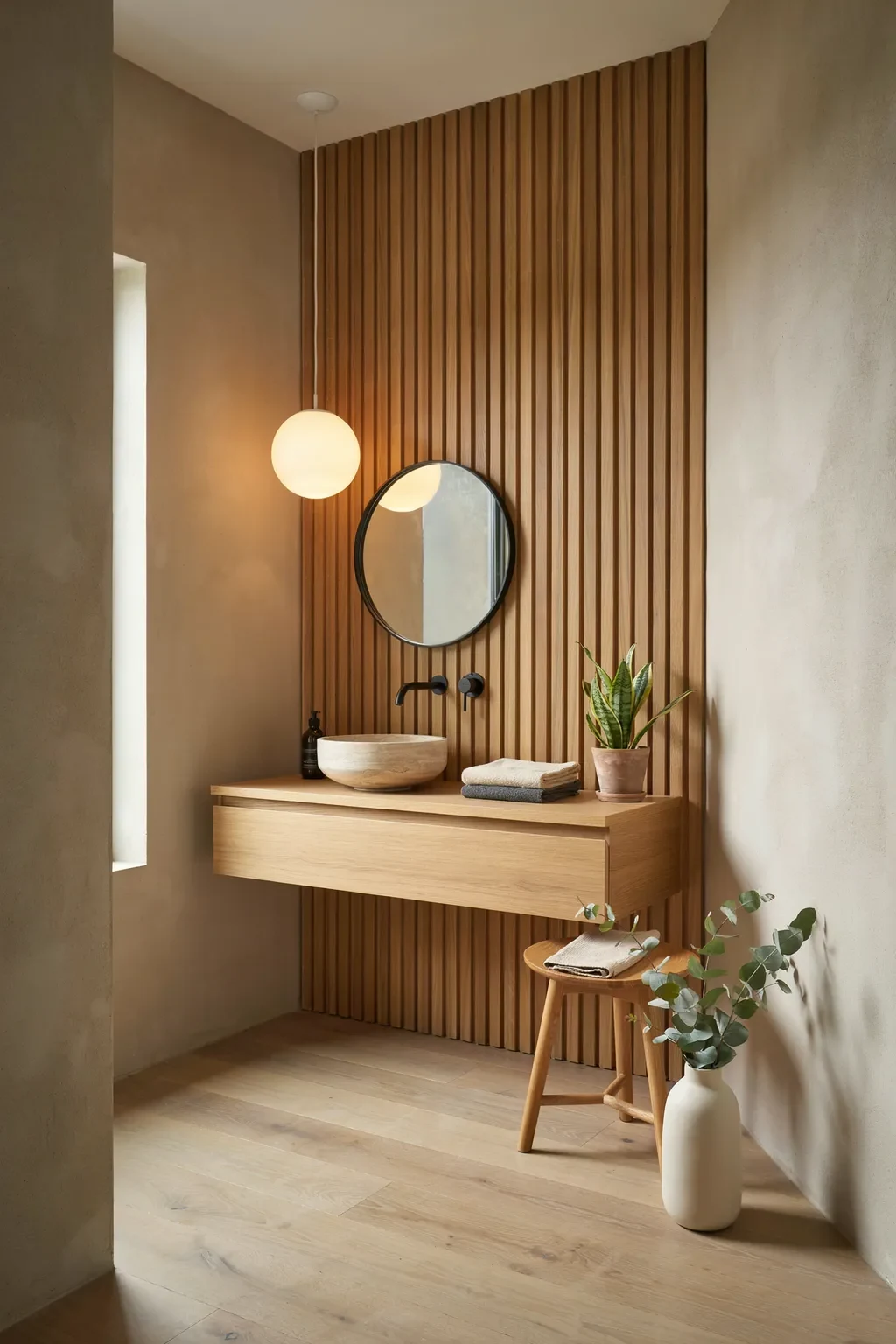
Before you buy a single fixture, pull your materials together like a designer would. Gather swatches of light oak, pale travertine, a sage-green tile, natural linen, and a bit of matte black, then lay them side by side. Seeing them together tells you in seconds whether the room will feel warm and calm or cold and flat. This one step saves you from expensive mismatches later.
A palette works because Japandi lives or dies on texture and tone, not color. When your wood, stone, and textile all sit in the same warm, muted family, the finished room feels intentional and restful. Add one grounding dark accent, like a charcoal ceramic bowl, so the softness has an anchor. You can build a full sample board for under 30 dollars in offcuts and tile chips.
Perfect for anyone planning a full renovation who wants to commit with confidence. Skip the guesswork of buying piecemeal, since a vanity and tile chosen months apart rarely land in the same tone.
2. Warm the Room With Wood and a Paper Lantern
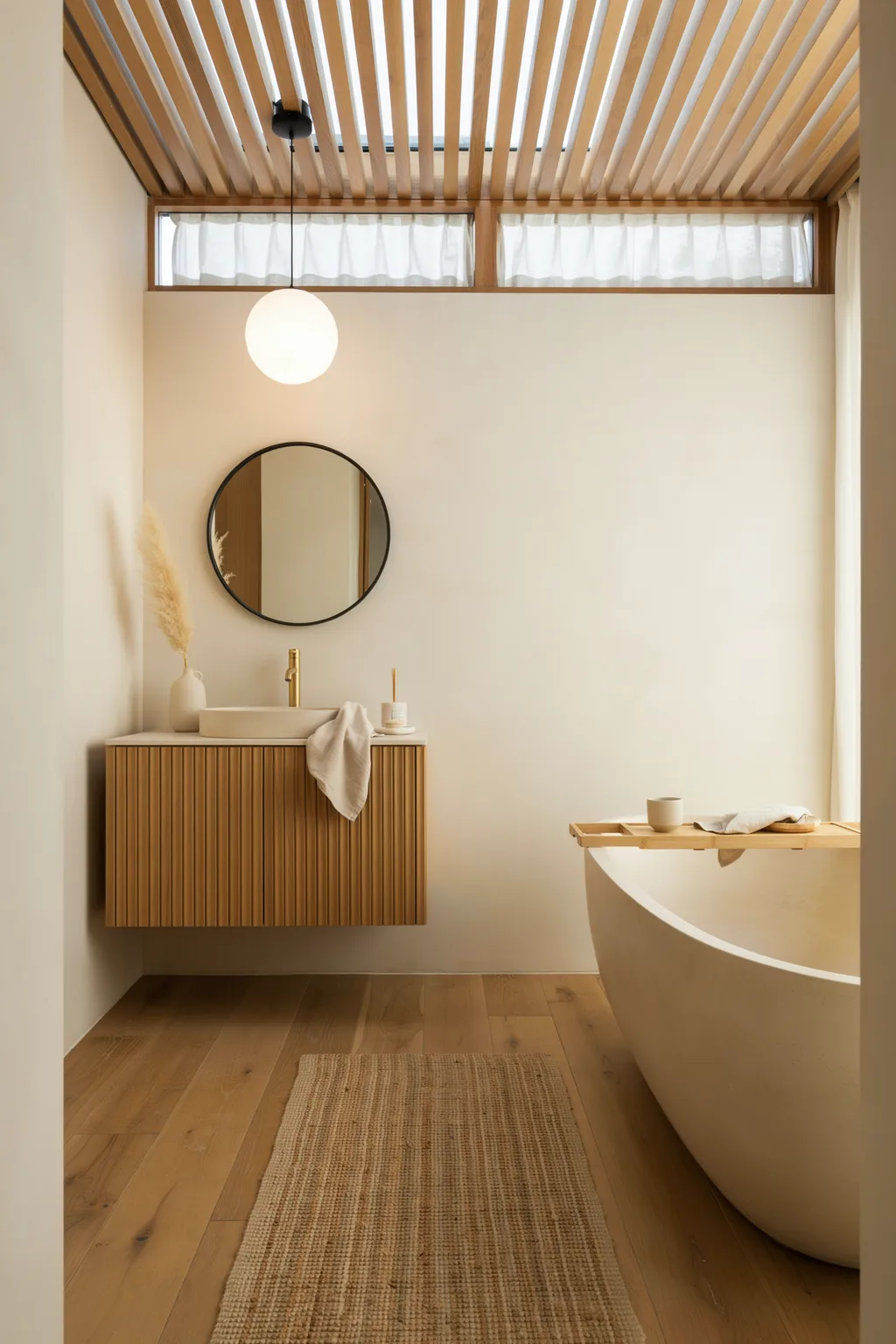
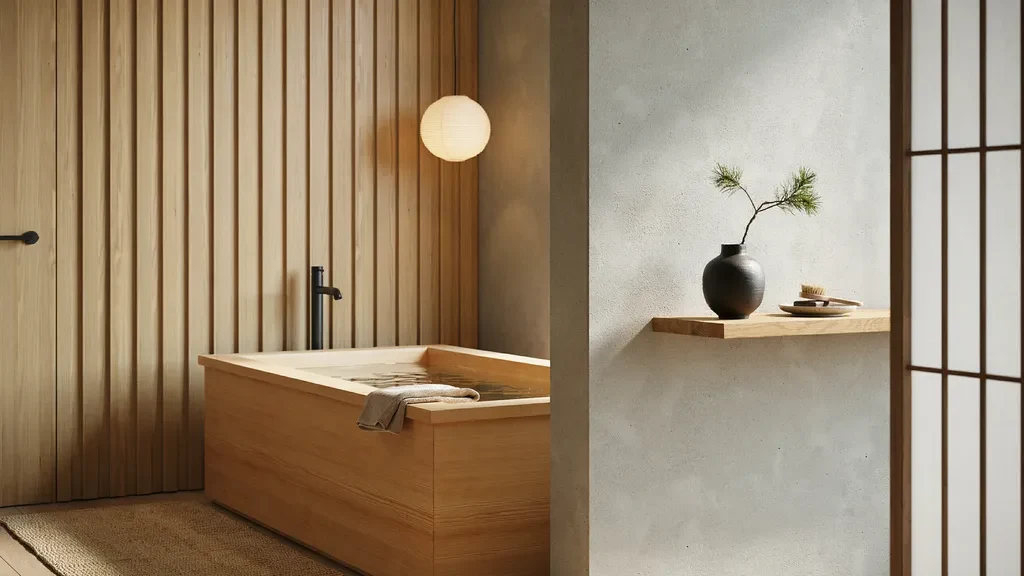
Nothing signals japandi bathroom design faster than warm wood overhead and a soft paper globe light. Picture a slatted wood ceiling, a floating oak vanity with vertical fluting, a round mirror, and a single rice-paper lantern glowing above. The wood wraps the room in warmth while the paper light casts a gentle, shadow-free glow. It feels calm the moment you walk in, day or night.
The paper lantern is the quiet hero. Its diffused light softens every surface and echoes traditional Japanese interiors, while the wood grain brings the Scandinavian warmth that keeps the room from feeling austere. A pendant paper shade costs as little as 25 to 60 dollars, so it is the cheapest way to shift a whole room’s mood. Pair it with a jute mat to ground the floor.
Great for anyone wanting maximum impact on a modest budget. Skip a cheap paper shade right over a shower or tub, since real paper warps in constant steam and needs a dry, ventilated spot.
3. Float a Marble Sink Slab Over Wood Shelves
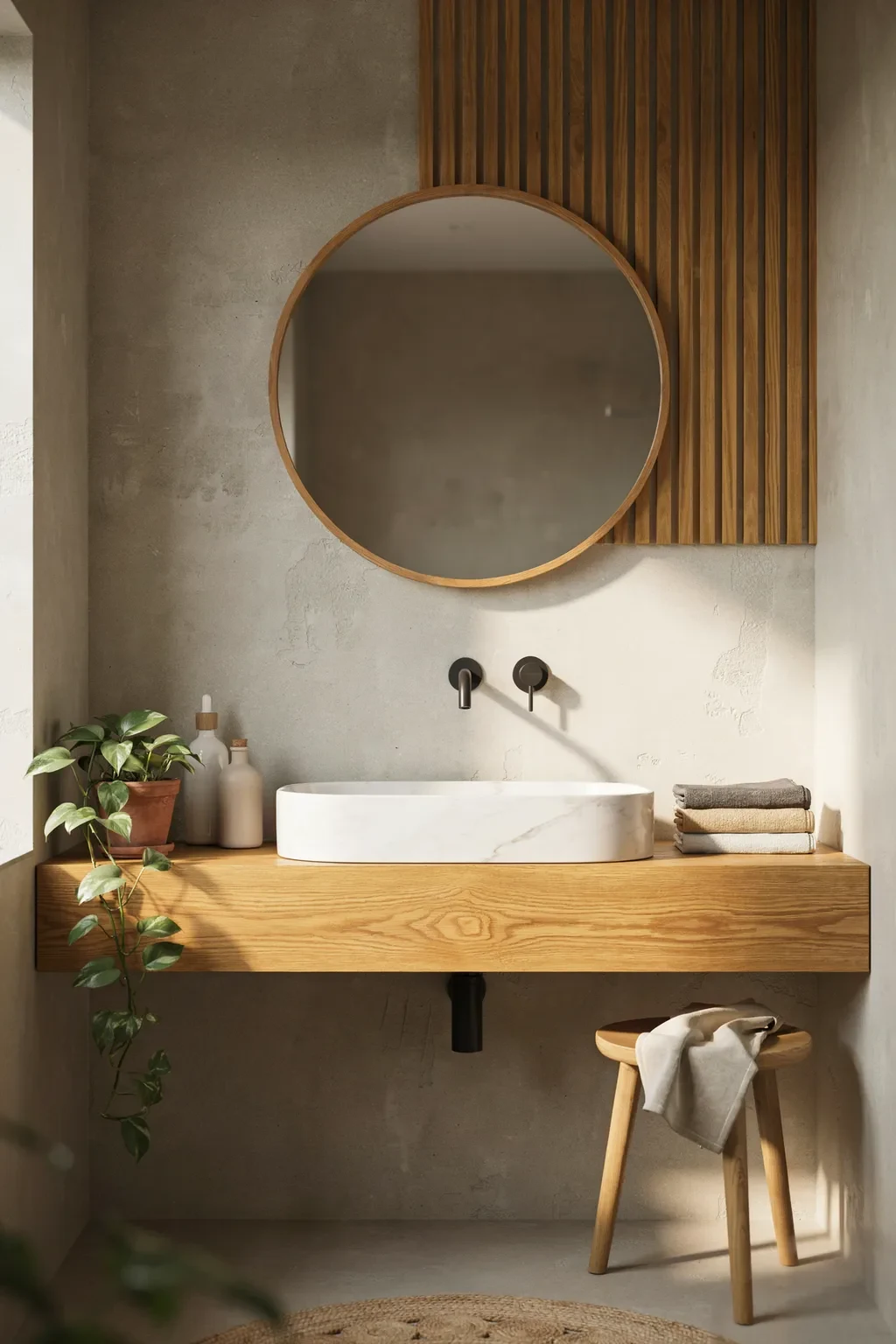
For a crisp, gallery-like feel, mount a slim marble sink slab on the wall and float a raw wood shelf just beneath it. The white stone reads clean and modern, while the warm wood underneath softens it and gives you a spot for folded towels. A large frameless mirror and a matte black wall faucet keep the lines sharp and the clutter at zero.
Pairing cool marble with warm wood is the balance Japandi does best. The stone brings a quiet luxury and the timber keeps it human and warm, so the room feels refined without turning icy. Floating both pieces off the floor makes a small bathroom feel open and airy. A prefab marble sink slab runs 300 to 700 dollars, with a solid wood shelf adding 40 to 100.
Ideal for modern minimalists who want a clean, high-end look. Not the pick if you are hard on surfaces, since natural marble stains from oils and toothpaste and needs sealing once or twice a year.
4. Bring Character In With a Reclaimed Wood Vanity
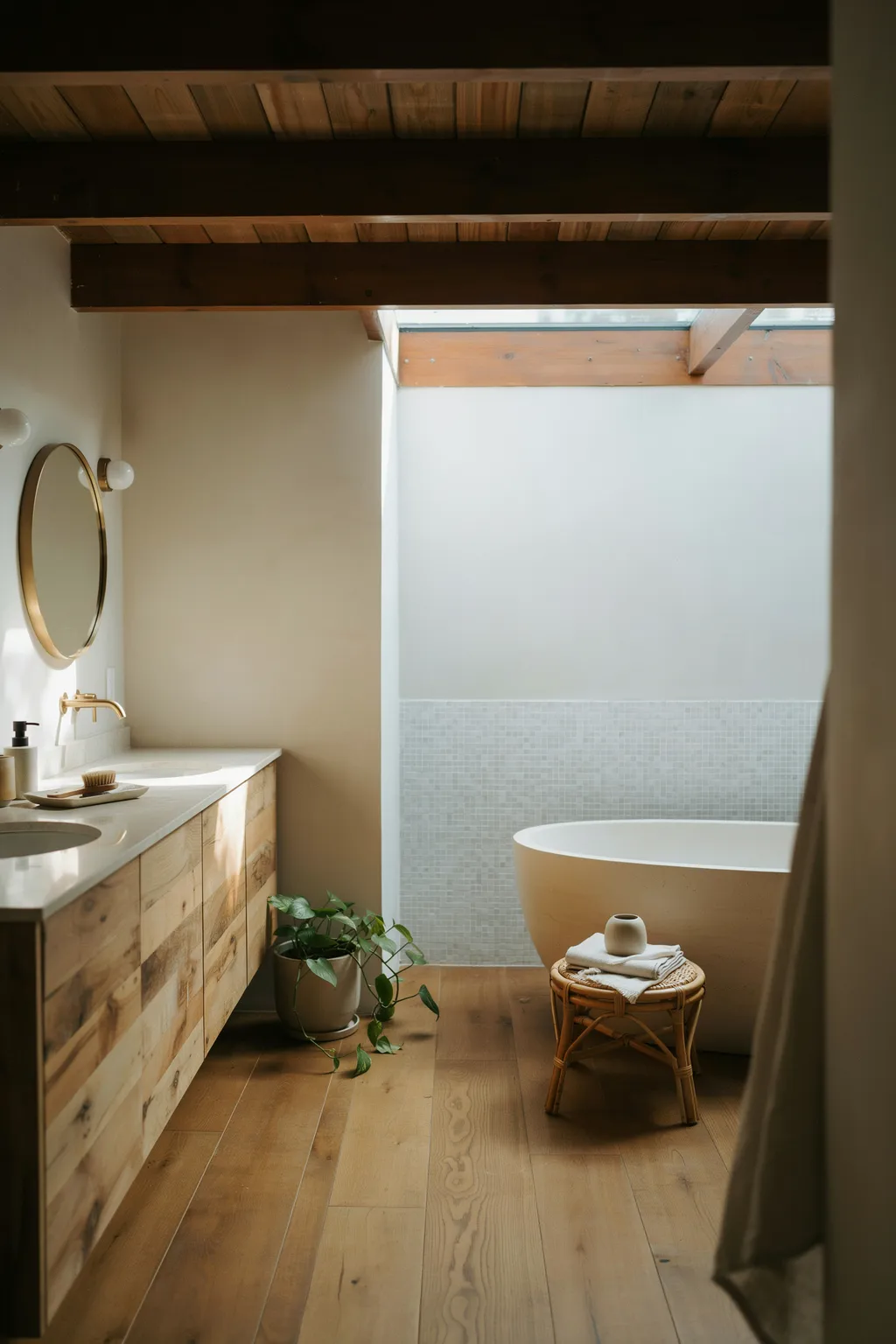
A vanity built from reclaimed timber gives a Japandi bathroom instant soul. The mix of grain, knots, and color variation reads as honest and lived-in, which sits at the heart of the wabi-sabi spirit behind the style. Top it with a pale quartz counter, hang a round brass mirror, and let a skylight or window pour daylight over the wood so the texture glows.
Recycled wood carries a story that new flatpack never will. Each mark and seam adds warmth and keeps the minimal room from feeling sterile, and reusing timber is kinder to the planet too. A skylight above amplifies the effect by washing the grain in changing light through the day. Reclaimed vanities run 400 to 1,200 dollars, or far less if you build from salvaged boards.
Great for character-lovers and anyone drawn to natural imperfection. Skip untreated salvage in a wet zone unless it is properly sealed, since raw old wood swells and stains where water splashes.
5. Go Luxe With a Double Marble Vanity
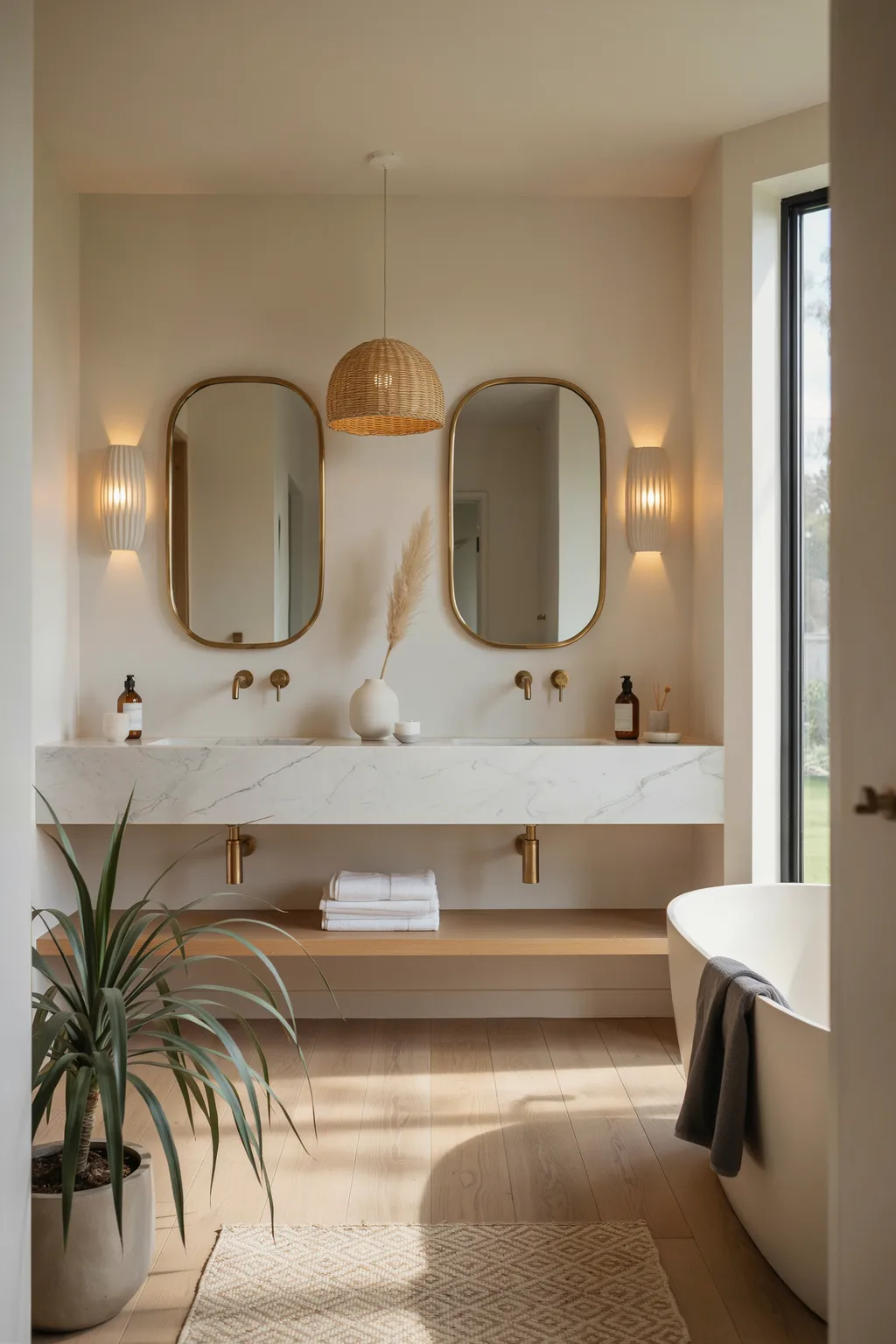
When you have the space, a long double marble vanity turns a Japandi bathroom into a true retreat. Run a thick marble counter with twin basins, hang two slim oval mirrors, and flank them with ribbed ceramic sconces. Add a freestanding tub and a single sculptural plant, and the room feels like a boutique hotel that still breathes calm rather than showing off.
Restraint is what keeps luxury from tipping into flashy. Two of everything in matching marble reads generous and serene, while the muted palette and one plant stop it feeling like a showroom. The ribbed sconces add a soft, tactile detail that catches the light. A custom marble double vanity is a real investment, often 2,000 dollars and up installed, so plan it as a centerpiece.
Best for primary bathrooms with room to spread out and a budget to match. Too much for a compact space, where a double vanity would crowd the floor and kill the airy feel.
6. Fit a Fluted Oak Vanity Into a Small Bathroom
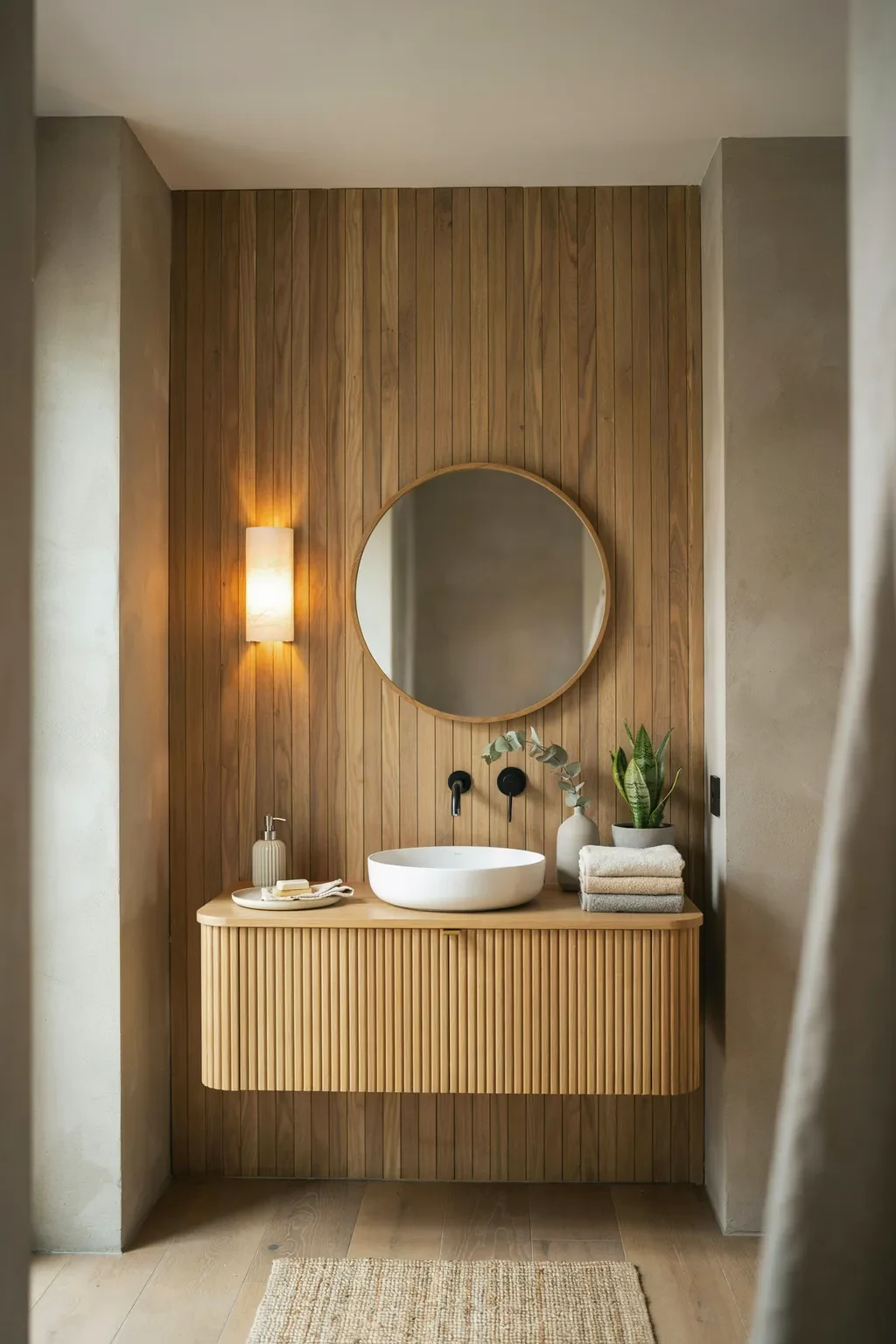
Small bathrooms suit japandi bathroom design better than almost any other style, because paring back is the whole point. Hang a light-oak vanity with vertical fluting, top it with a simple white vessel sink, and add a round black-framed mirror. Slip a tall bamboo plant into the corner and leave open cube shelves for a couple of neatly folded towels. The room feels tidy, warm, and bigger than it is.
Fluting is the detail that lifts a plain box vanity. Those vertical grooves catch light and add gentle texture without any color or clutter, which keeps a tight room calm. A floating vanity also shows more floor, tricking the eye into reading extra space. A fluted oak floating vanity runs 350 to 800 dollars depending on size and finish.
Perfect for apartments, ensuites, and powder rooms under 40 square feet. Skip a big statement plant if the room gets little light, and choose a hardy pothos over fussy bamboo that yellows in the dark.
7. Perch a Vessel Sink on a Live-Edge Shelf
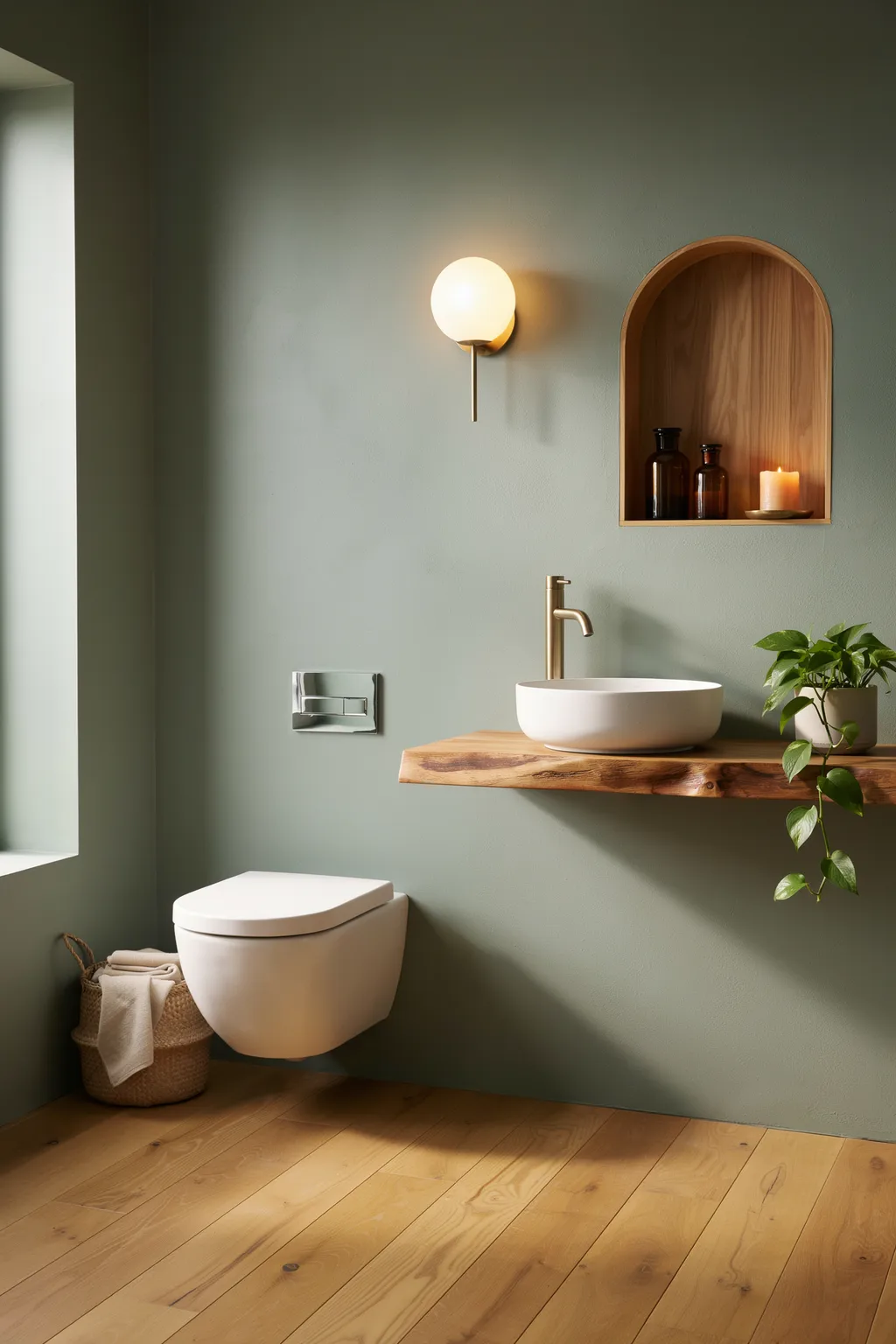
For a powder room with quiet drama, mount a live-edge wood shelf and set a round white vessel sink on top. The natural wavy edge of the timber contrasts beautifully with the smooth ceramic bowl, and an arched wood niche nearby holds a few amber bottles. A tall brass faucet and a wall-hung toilet keep the floor clear and the mood serene.
The live edge is the point of difference. Leaving the timber’s natural profile intact brings organic softness that a straight-cut shelf cannot, and it turns a basic sink into a sculptural moment. An arched niche adds a Japanese sense of calm and a home for daily bits. A live-edge slab runs 80 to 250 dollars, and a vessel sink adds 80 to 200.
Great for a guest powder room or small ensuite that needs a wow without a full remodel. Not for a busy family bath, since a raised vessel sink splashes more and the exposed shelf collects drips.
8. Blur Indoors and Out With a Stone Basin Garden
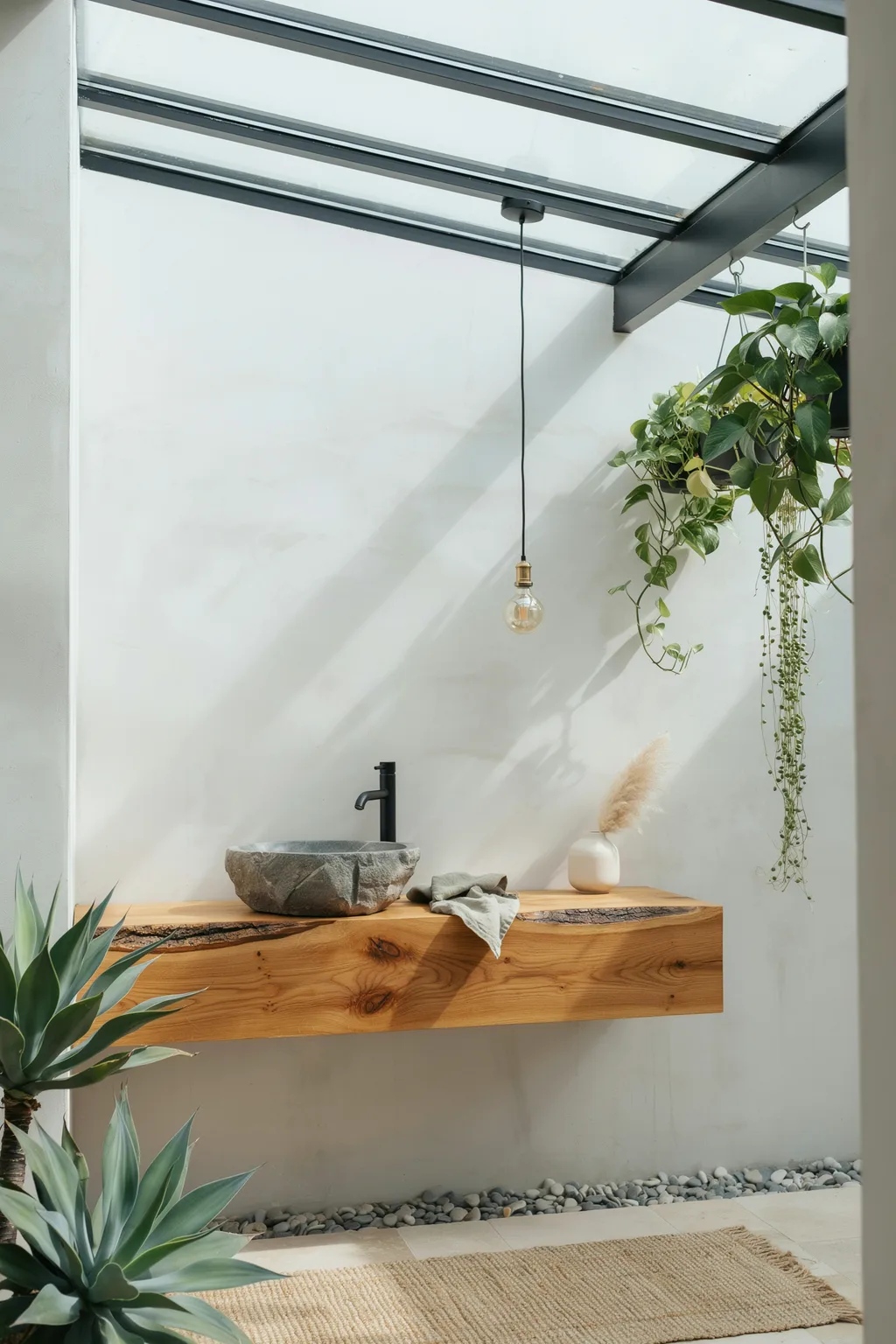
Bring nature all the way in by pairing a rough stone basin with living plants and a skylight. Set a chiseled grey stone bowl on a live-edge wood counter, surround the base with pebble beds and agave, and let vines trail from above under a glass roof. The result feels like a bathing spot in a courtyard, which is Japandi at its most restful.
Raw stone and greenery pull the outdoors inside, and that connection to nature is central to the style. A rugged stone basin adds weight and permanence, while the plants and skylight keep the air and light feeling alive. Pebble beds soften the floor edges and hide drainage. A natural stone vessel basin runs 150 to 500 dollars, plus the cost of hardy plants.
Best for a bright, well-ventilated bathroom with a skylight or big window. Skip heavy planting in a dark, damp room, since most of these plants need real light and good airflow to avoid rot.
9. Divide the Space With Shoji Sliding Screens
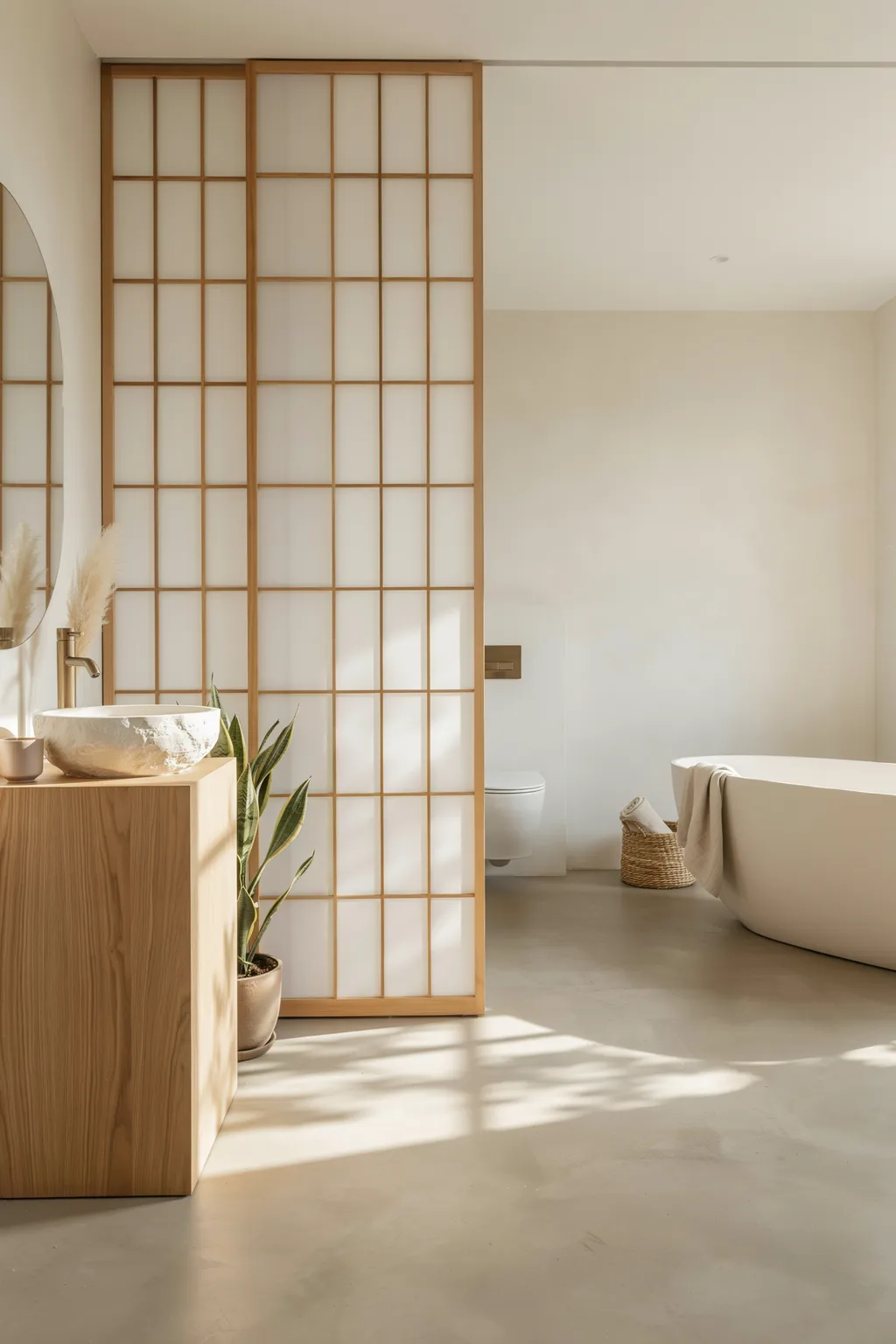
Shoji screens are the most recognizably Japanese element you can add, and they earn their place. Fit sliding wood-framed panels of rice-paper grid to separate a toilet or tub zone, and they filter sunlight into a soft, even glow while saving the swing space a hinged door needs. The grid pattern throws gentle shadows that shift through the day.
Sliding screens solve two problems at once: privacy and space. Because they slide instead of swing, they suit tight bathrooms where a door would block the room, and the translucent panels keep the space feeling open and full of light. They read calm and architectural without any color. Custom shoji-style sliders run 200 to 600 dollars per panel, more for solid hardwood frames.
Ideal for a bathroom where you want to zone areas or soften harsh light. This one has a real caveat: traditional rice paper hates steam, so use a modern laminated or acrylic panel in a wet, humid bathroom.
10. Pair a Round Mirror With a Black-Glass Shower
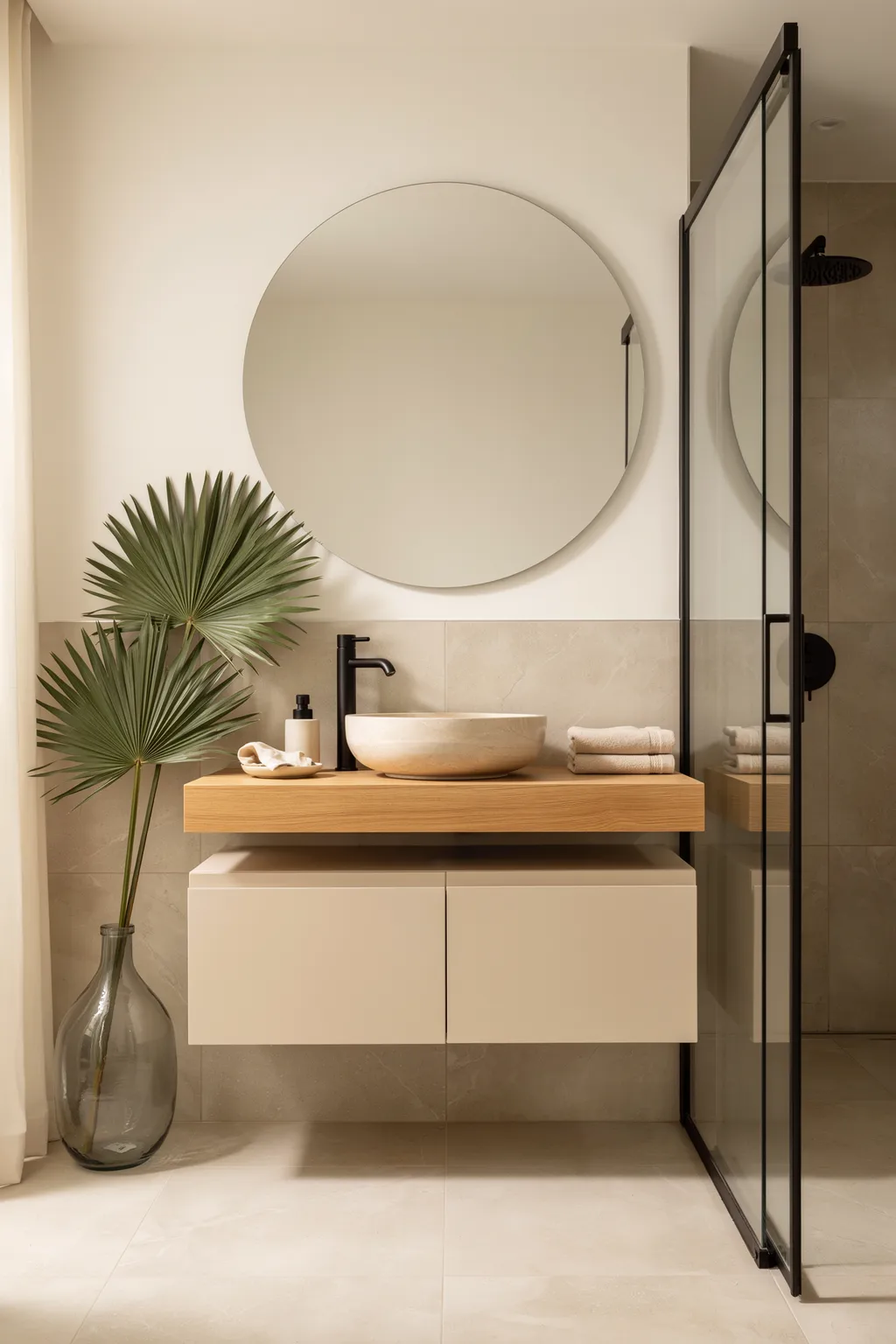
A large round mirror softens the straight lines every bathroom has, and it pairs perfectly with a crisp black-framed glass shower. Set a stone vessel sink on a floating counter with a warm wood cabinet below, hang the round mirror above, and let the black shower frame add a graphic edge. A fan palm in a smoky glass vase keeps the corner alive.
Curves and grids balance each other here. The round mirror and organic stone basin bring softness, while the black-framed shower and clean counter add structure, so the room feels both calm and current. Warm beige tile ties it together without any loud color. A round mirror runs 60 to 200 dollars, and a black-framed shower screen 400 to 900.
Great for a modern bathroom that wants warmth and edge in one look. Skip the black frame if your room is dim, since heavy dark lines can shrink a low-light space and make it feel closed in.
11. Let a Stone Vessel Basin Be the Whole Statement
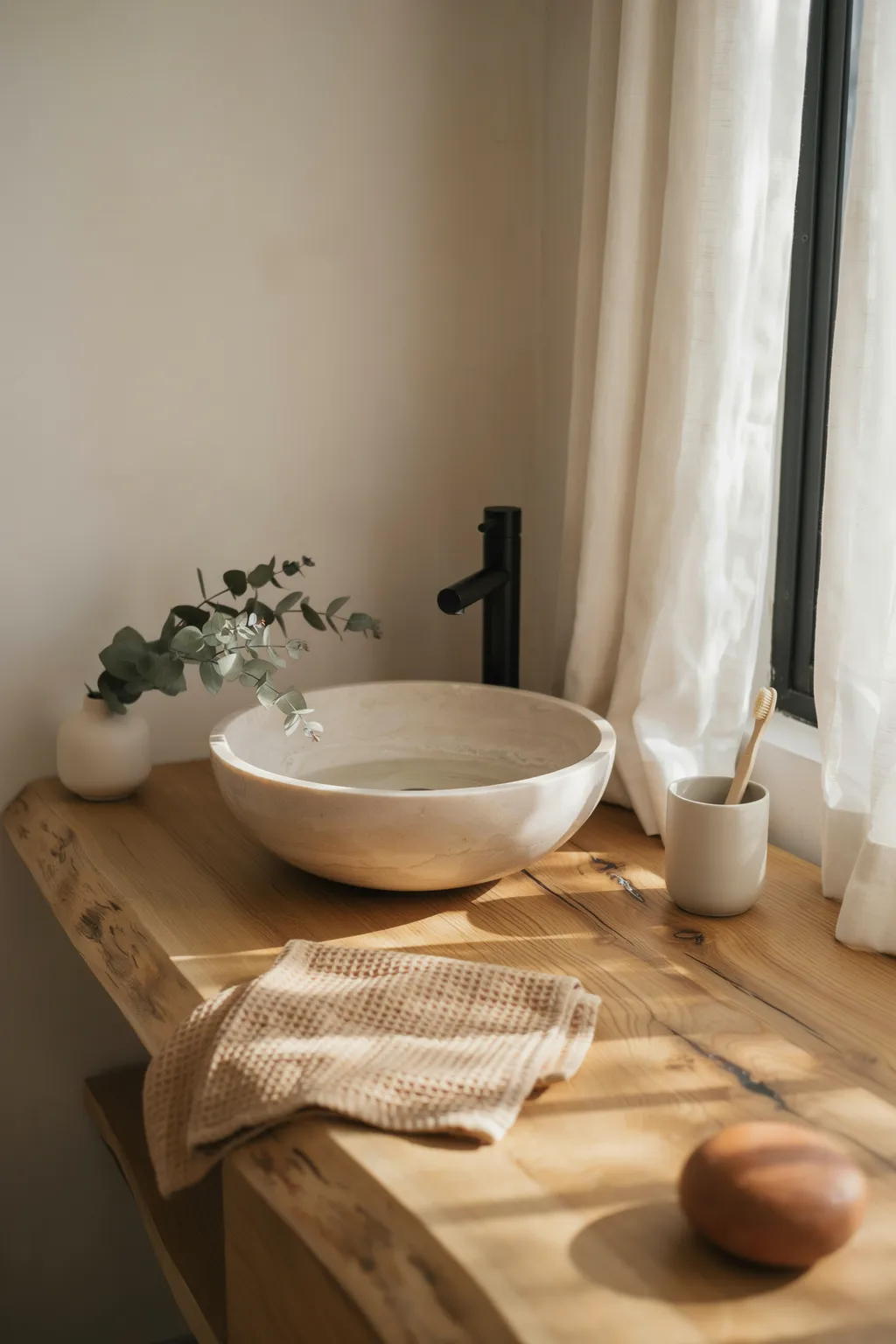
Sometimes one honest object is enough. A rounded stone or concrete vessel basin on a raw wood counter, lit by a nearby window, needs almost nothing else. The weight and matte texture of the stone against the grain of the timber says calm and craft in a single glance. A matte black wall spout and a linen curtain finish it without fuss.
Focusing on one tactile piece is very Japandi. When the basin itself carries the interest, you can keep everything around it plain, which is restful and easy to keep clean. Natural stone also feels cool and grounding under your hands each morning. A concrete or stone vessel basin runs 100 to 350 dollars, an easy upgrade even on a small budget.
Perfect for renters and quick refreshes, since a vessel basin can sit on an existing counter. Just confirm your tap height and drain first, because a tall vessel needs a taller spout to clear the rim.
12. Wrap a Wall in Vertical Wood Slats
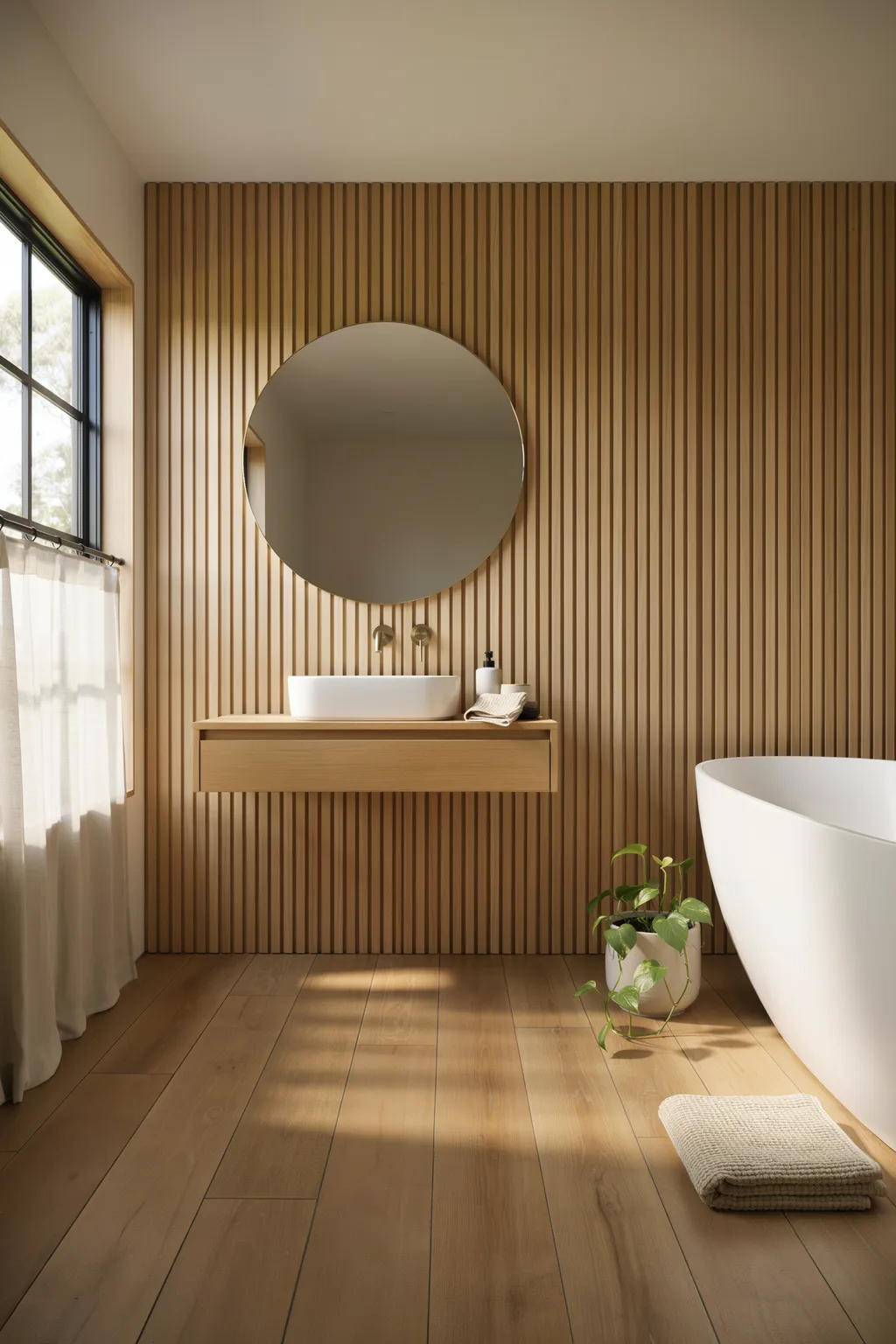
A vertical wood-slat feature wall is the japandi bathroom design move that makes a room look designed. Run warm timber battens floor to ceiling behind the vanity, mount a round mirror on top, and hang a floating oak vanity with a simple white vessel sink below. The vertical lines draw the eye up and add rhythm and warmth without a scrap of color.
Slats add texture and a sense of height at once. The repeating grooves catch light and shadow through the day, giving a plain wall depth, and they nod to traditional Japanese joinery. Behind a vanity they frame the mirror like art. A slat wall panel system runs 15 to 40 dollars a square foot, or less with DIY battens and glue.
Best for a feature wall away from direct spray, above a vanity or tub surround. Skip solid wood slats inside a wet shower, since trapped water rots timber, and use a sealed or faux-wood alternative there instead.
13. Layer a Lattice Screen With Warm Hidden Light
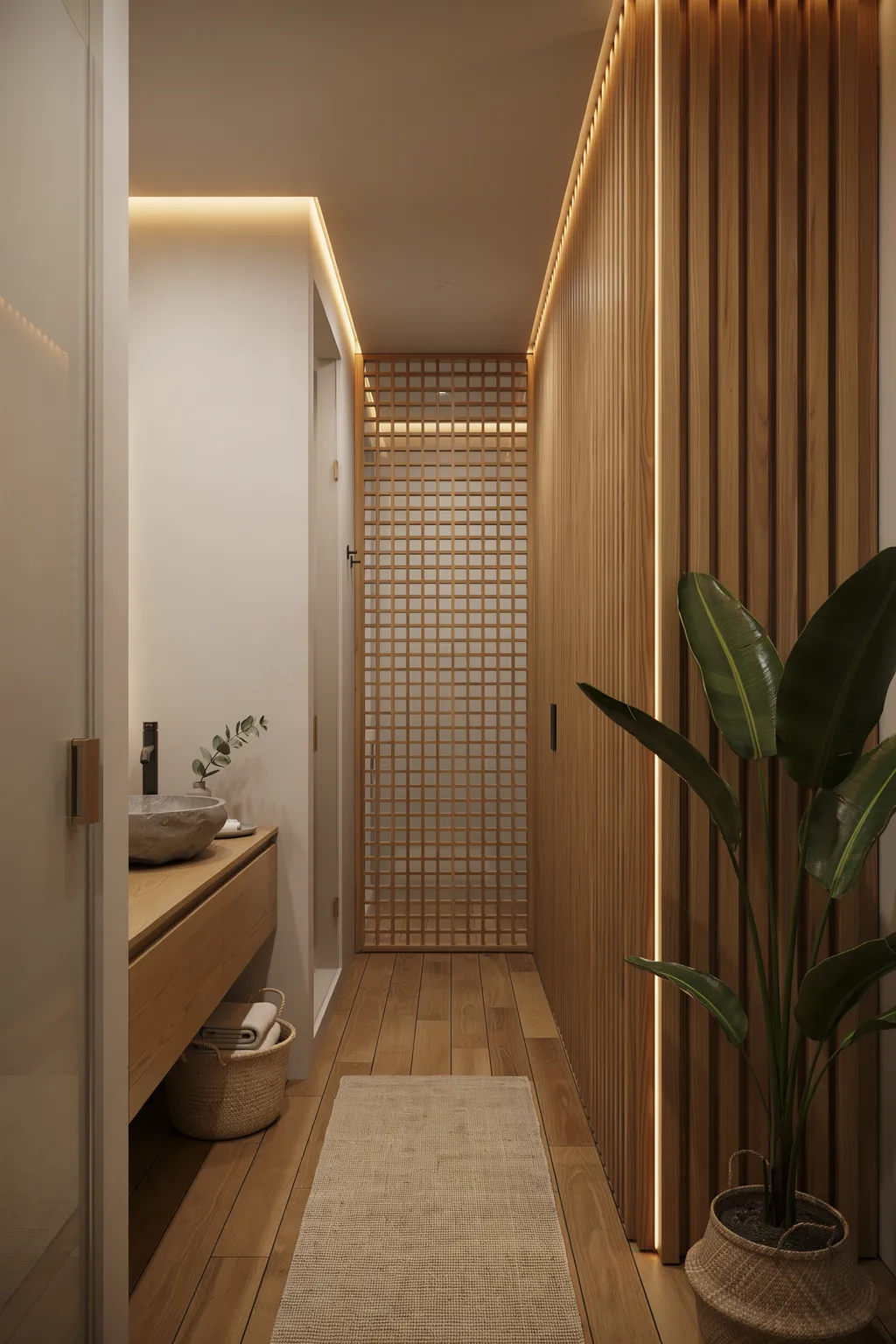
For a bathroom that glows at night, combine a wooden lattice screen with hidden LED strips behind the slat walls. Warm light spilling from the ceiling edges and behind the timber turns the whole room amber and soft after dark. Add a stone vessel on a wood vanity, a banana plant, and seagrass baskets, and the space feels like a private onsen.
Concealed lighting is the trick that reads as high-end. By hiding the source and letting only the glow show, you avoid harsh glare and create the layered, restful light Japandi loves. The lattice screen filters that light into a gentle grid pattern and screens a toilet or shower zone. LED strip and a simple lattice panel run 60 to 200 dollars together.
Great for anyone who bathes in the evening and wants a warm, low-lit mood. Skip cool white LEDs entirely, since a blue-toned strip kills the calm and makes the wood look grey and cheap.
14. Keep It Tonal With Fluted Tile Walls
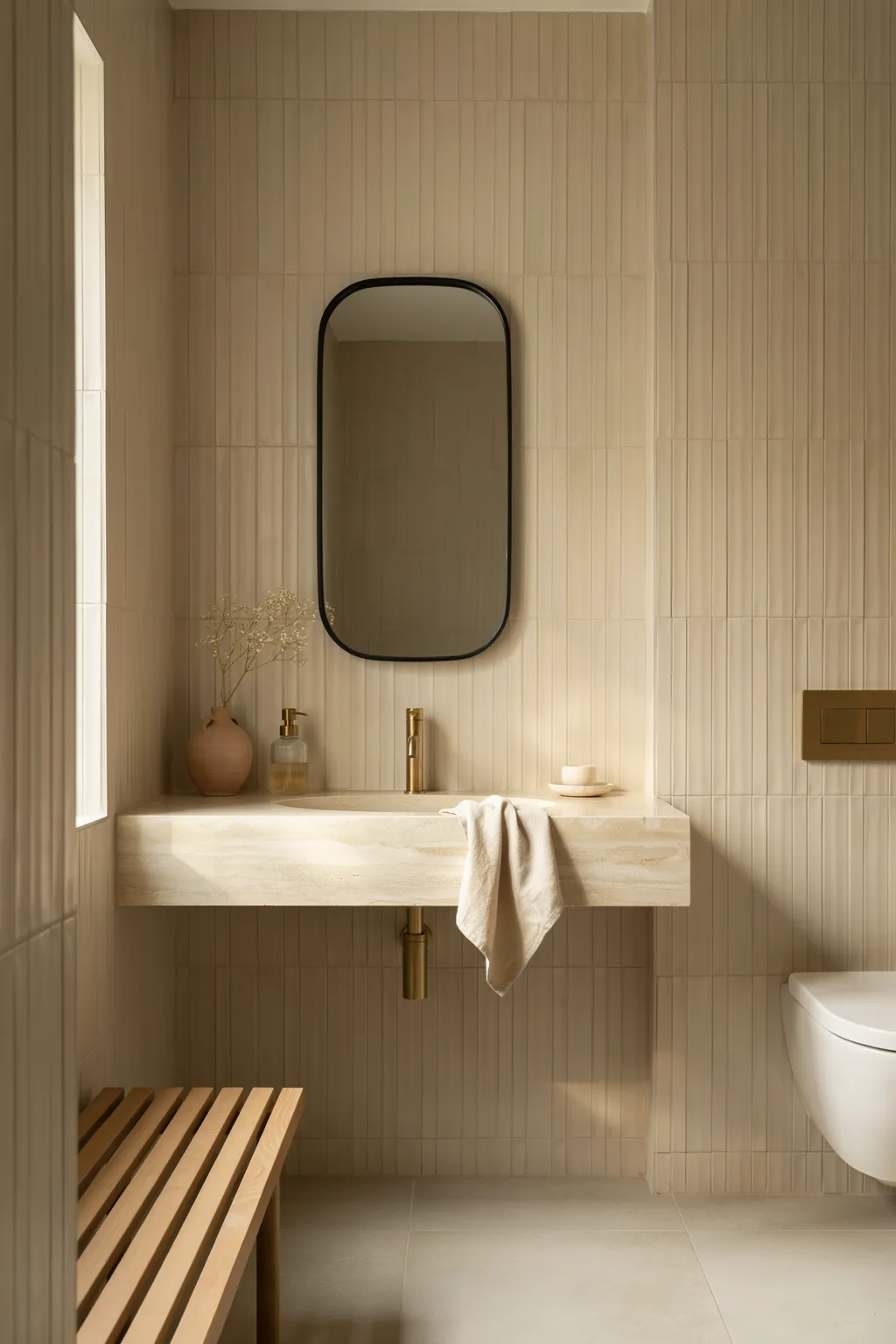
For a serene, monochrome look, wrap the walls in soft beige fluted tile. The vertical ribbing runs across the whole room, so light and shadow do all the decorating and you need almost no accessories. Add a black rounded-rectangle mirror, an integrated stone counter, and a stem of dried gypsophila, and the room feels like a calm, sunlit sculpture.
Tonal design is deeply restful because there is nothing jarring for the eye to catch on. Keeping wall, counter, and floor in the same warm sand tone makes the room feel seamless and larger, while the fluting adds just enough texture to stop it feeling flat. One dark mirror grounds the softness. Fluted or ribbed tile runs 8 to 20 dollars a square foot.
Perfect for lovers of quiet, gallery-like minimalism. Not for you if you crave contrast and color, since an all-beige room can feel too subtle without a few natural textures layered in.
15. Soften a Family Bath With Wood and White Tile
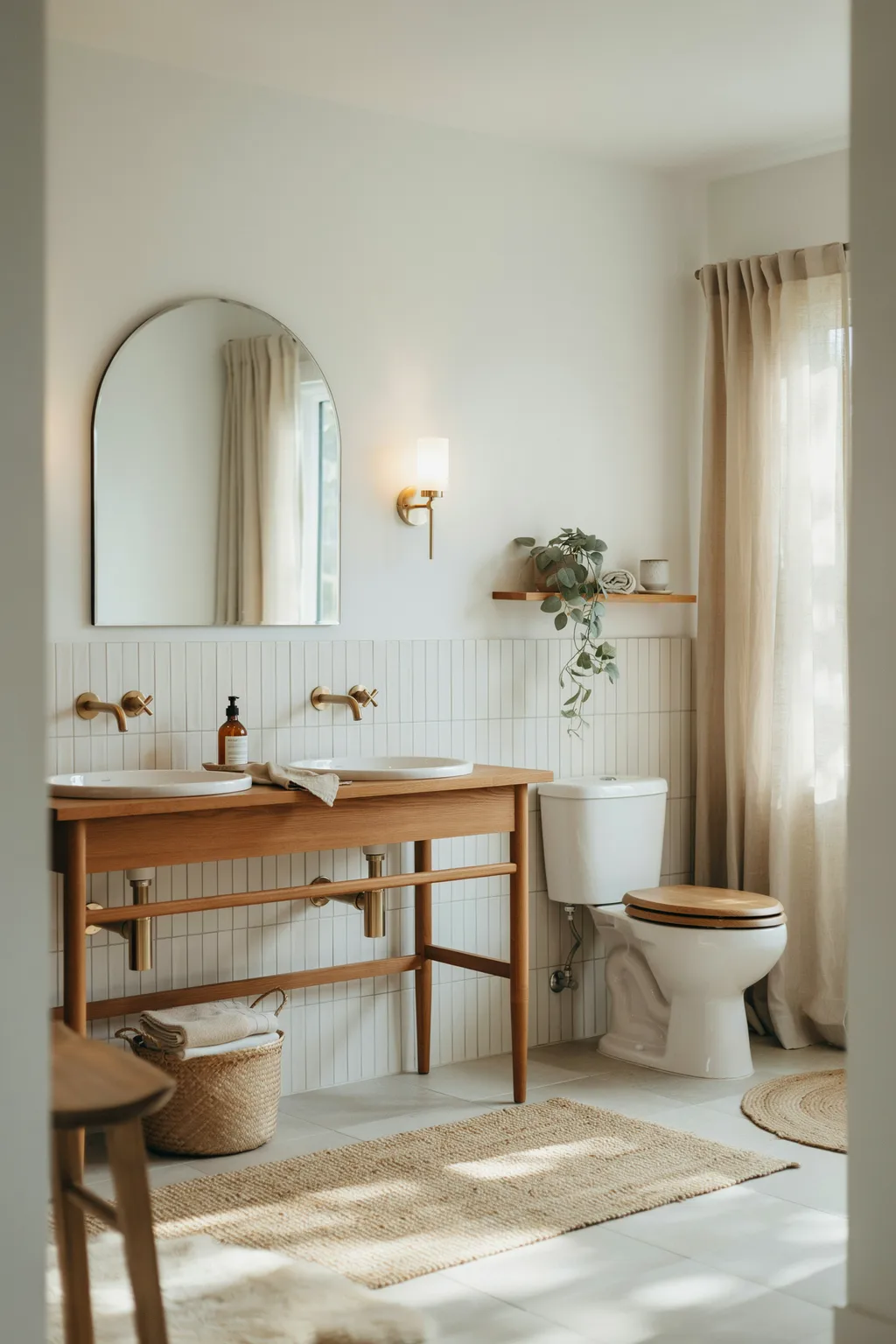
Japandi does not have to mean brand new. Pair a warm mid-century wood double vanity with a simple square white tile backsplash, hang an arched frameless mirror, and add a sconce, a curtained window, and a trailing plant on a small shelf. It gives a hardworking family bathroom a calm, collected feel while still handling daily life.
Combining wood warmth with plain white tile is a practical, forgiving mix. The tile wipes clean and reflects light, while the wood vanity and arched mirror bring the softness that keeps a busy room from feeling clinical. A trailing plant adds life at eye level. A mid-century style wood double vanity runs 500 to 1,300 dollars, and square tile is among the cheapest you can buy.
Great for shared and family bathrooms that need to work hard and still feel calm. Skip delicate finishes here, and choose sealed wood and wipeable surfaces that survive splashes and small hands.
16. Add Texture With Hexagon Tile and a Backlit Mirror
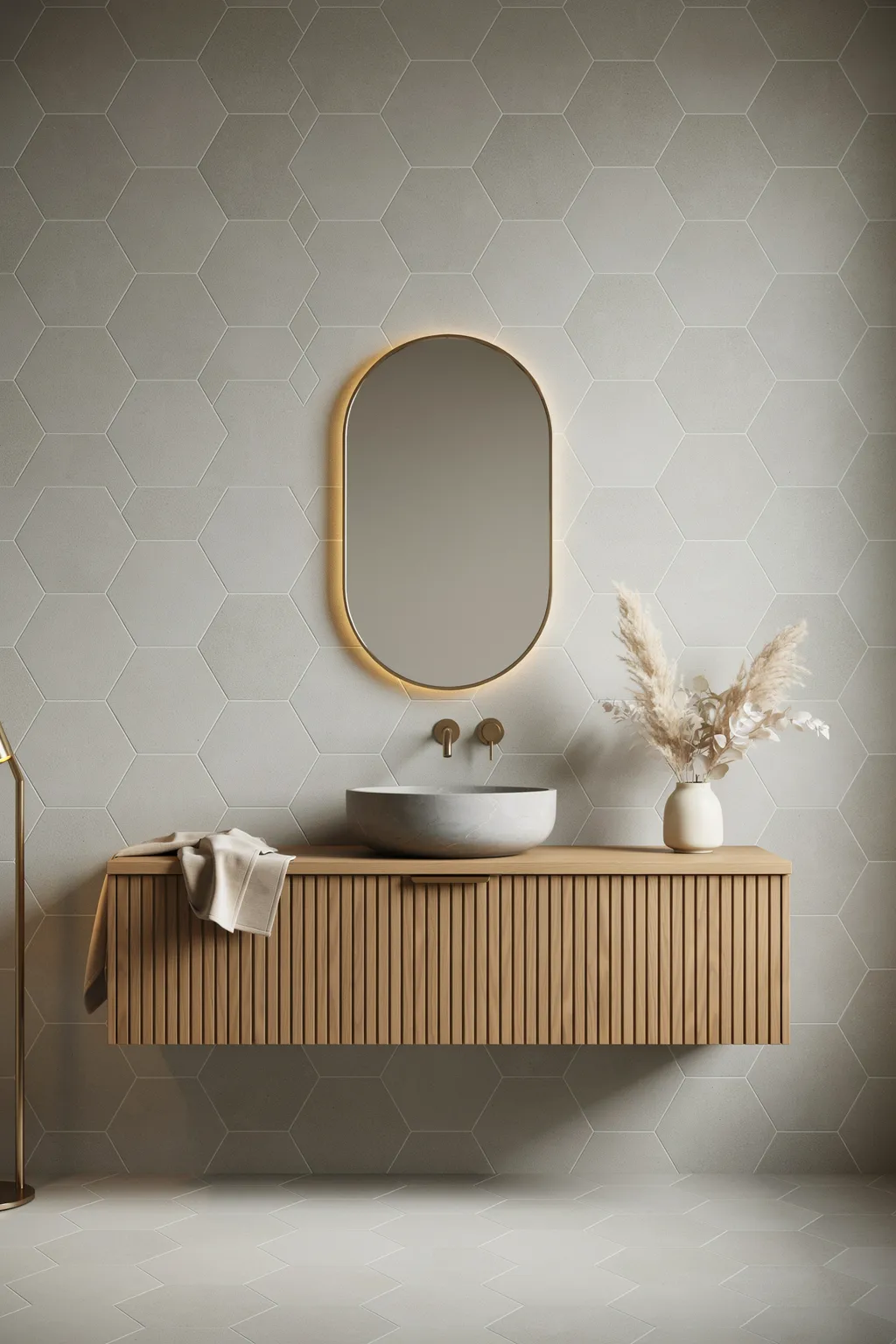
A textured hexagon tile wall gives a Japandi bathroom quiet interest without any color, and a backlit oval mirror makes it glow. Run matte stone-look hex tiles up the feature wall, float a fluted wood vanity with a grey stone vessel, and let the halo of light behind the mirror wash the tile softly. The mix of geometry and warm light feels both calm and modern.
Texture is how you keep a neutral room from reading boring. The faceted hex tiles catch light at different angles, adding depth that flat paint never could, while the backlit mirror provides gentle, even light for the face without a harsh overhead. A fluted vanity ties in the warmth. Hex tile runs 10 to 25 dollars a square foot, and a backlit LED mirror 150 to 400.
Best for a powder room or ensuite where you want a subtle wow. Skip a backlit mirror if you never wire in power there, since retrofitting a hidden circuit means opening the wall.
17. Keep It Effortless With an Oval Mirror and Light Wood
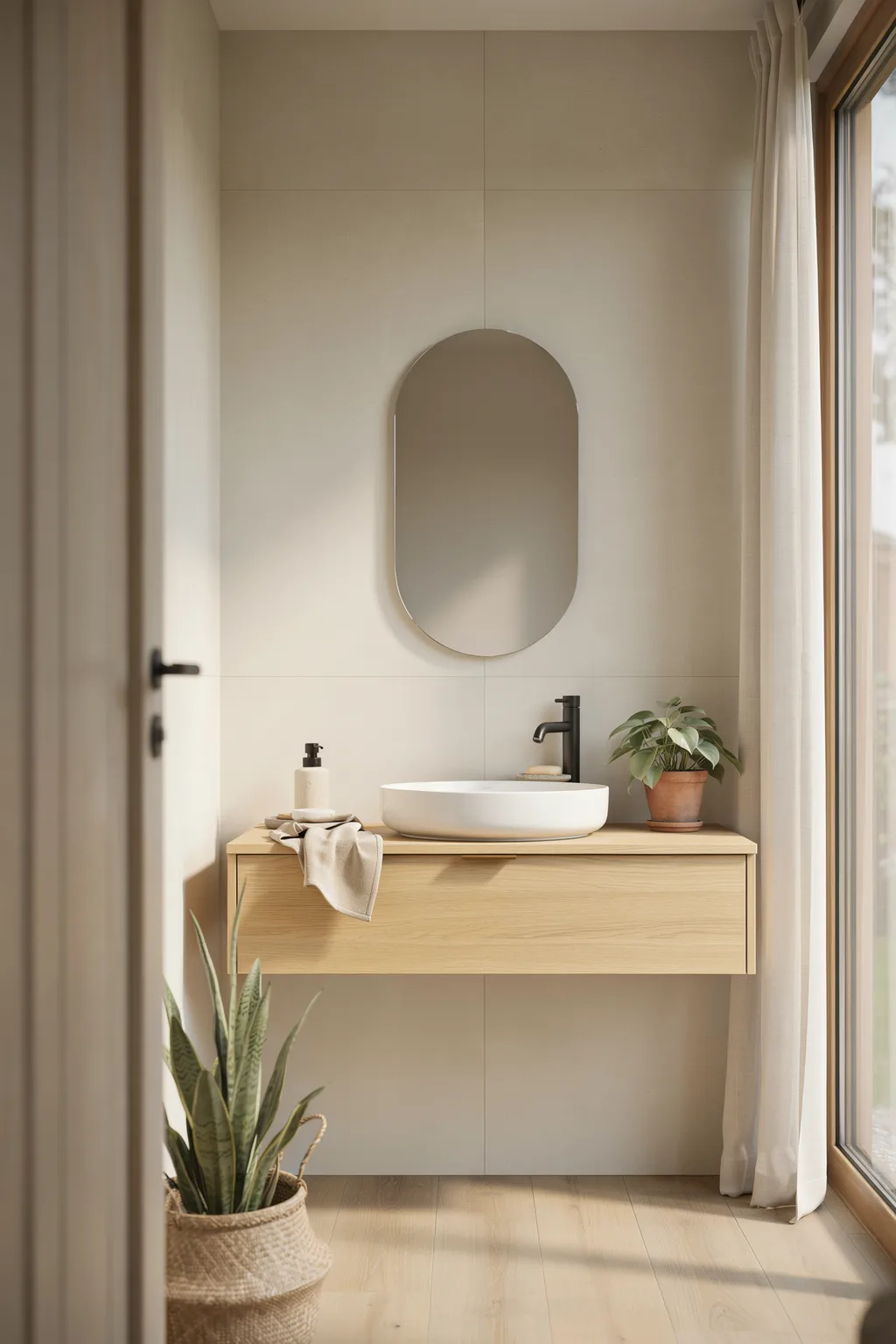
The easiest Japandi look is also one of the best: a simple oval frameless mirror over a light wood floating vanity with a clean white vessel sink. Add a matte black wall tap, a couple of potted plants, and daylight from a window, and you have a calm, uncluttered bathroom that never dates. This is the low-effort, high-reward version of the style.
Simplicity is a feature, not a shortcut. An oval mirror softens the room’s edges, light wood keeps it warm, and a single white basin keeps the eye at rest, so nothing competes for attention. Two green plants add just enough life. A light wood floating vanity runs 300 to 700 dollars, and an oval mirror 50 to 150.
Perfect for beginners and anyone who wants results without a full renovation. Just resist over-accessorizing, since even one busy shelf of products can undo the calm this look depends on.
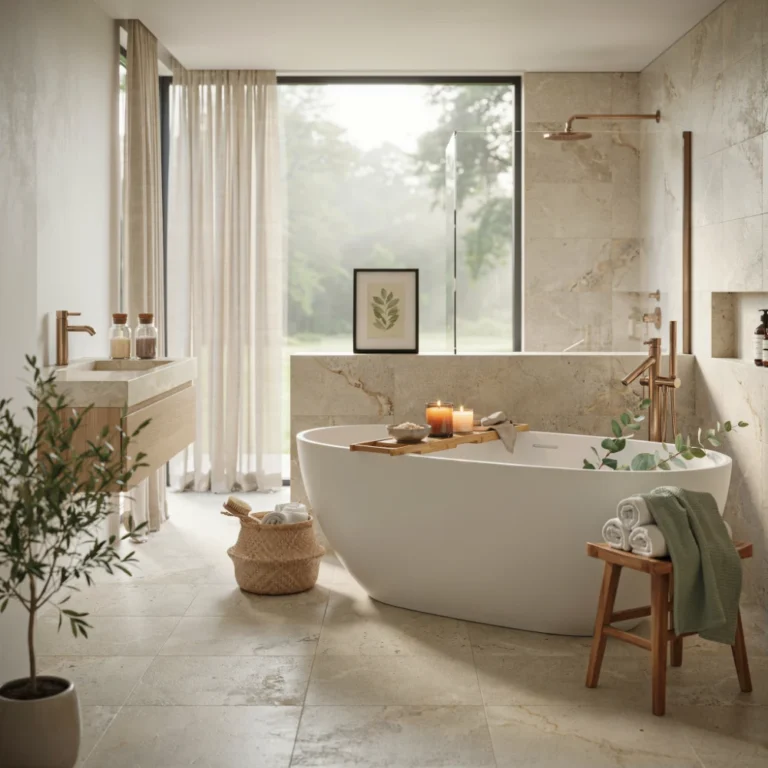
18. Center a Freestanding Tub Against a Wood Wall
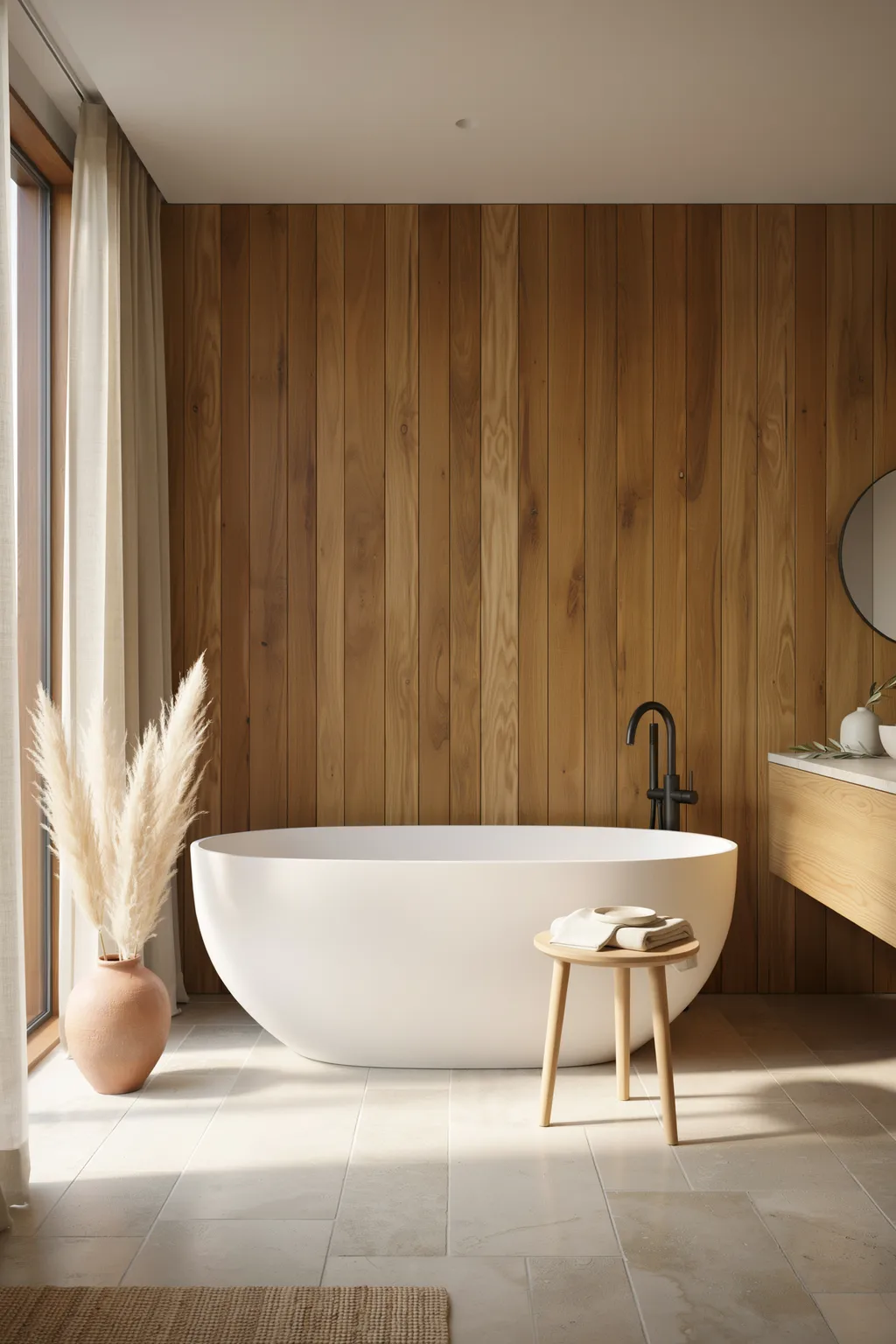
In japandi bathroom design, a freestanding tub is the ultimate calm anchor, and against a rich wood plank wall it becomes the heart of the room. Place an oval white tub in front of a warm timber feature wall and a big window, add a matte black floor-mounted filler, and set a low wood stool nearby. Pampas grass in a clay vase and a stone-tile floor complete a spa you will actually use.
A sculptural tub does a lot of quiet work. Its curves contrast the straight wood planks, and floating it away from the walls gives it presence and calm, while the big window frames a view and floods the room with light. The wood wall wraps it all in warmth. A freestanding tub runs 800 to 3,000 dollars, plus a floor-mounted filler at 300 to 800.
Best for primary bathrooms with the floor space and plumbing for a standalone tub. Skip it in a small room, where a freestanding tub eats space and a built-in alcove tub makes far more sense.
19. Ground a Tub With Terrazzo and Plaster Walls
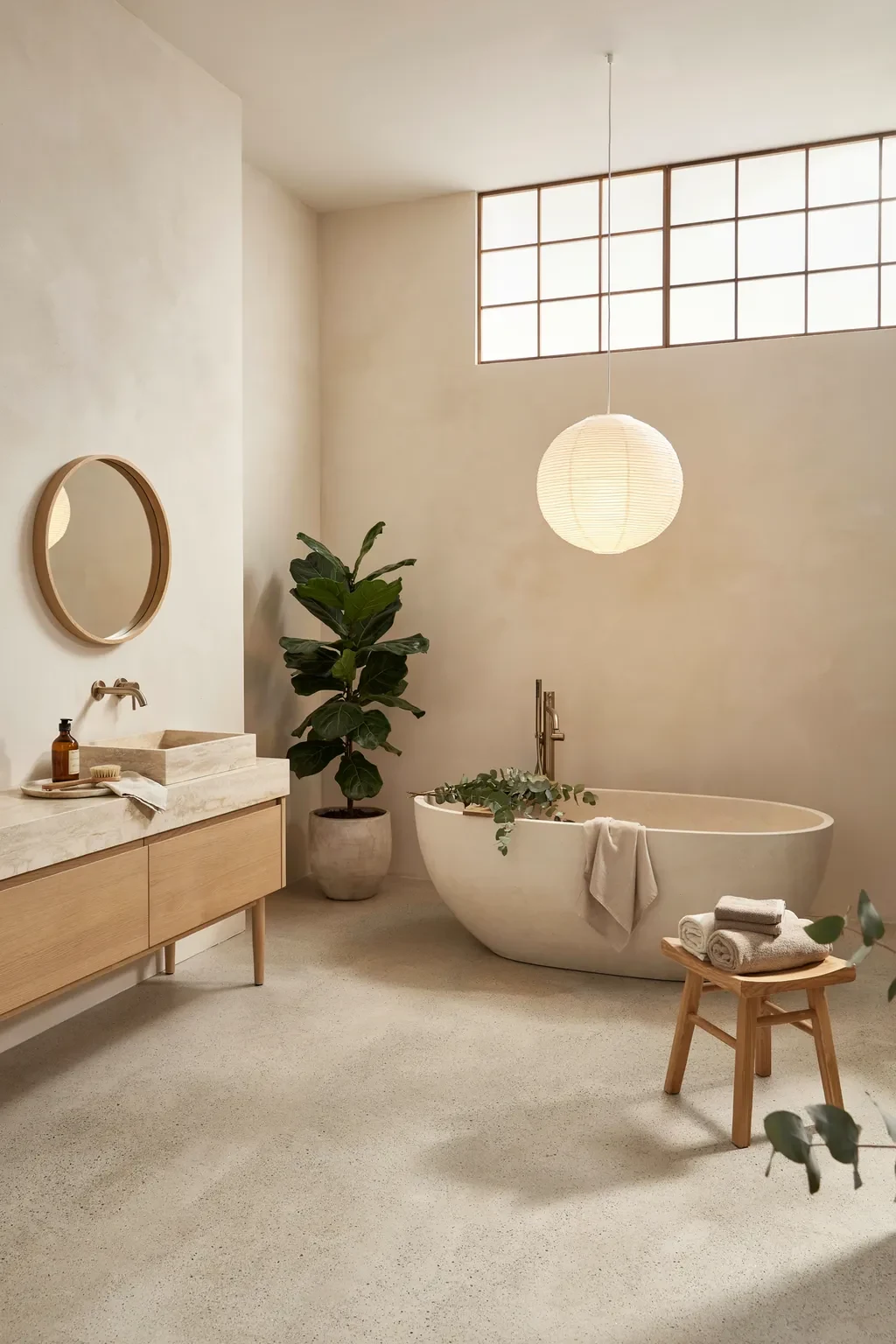
Soft plaster walls and a speckled terrazzo floor give a Japandi bathroom a modern, tactile calm. Set a white freestanding tub against a warm microcement wall, hang a simple dome pendant, and lay a cream terrazzo floor flecked with black. A wood stool with folded dark towels and a leafy plant keep it warm and human. The finish feels handmade and quietly upscale.
Textured surfaces are what give this look depth. Microcement or limewash walls have a soft, cloudy finish that flat paint cannot match, and terrazzo brings gentle pattern underfoot without shouting. The black flecks tie to a matte black tap and pendant for a subtle thread. Microcement runs 5 to 15 dollars a square foot applied, and terrazzo tile 10 to 30.
Great for anyone who loves tactile, artisan finishes over glossy ones. Skip microcement as a weekend DIY, since it needs skilled application and proper sealing or it cracks and stains in a wet room.
20. Choose a Fluted Walnut Vanity With Subway Tile
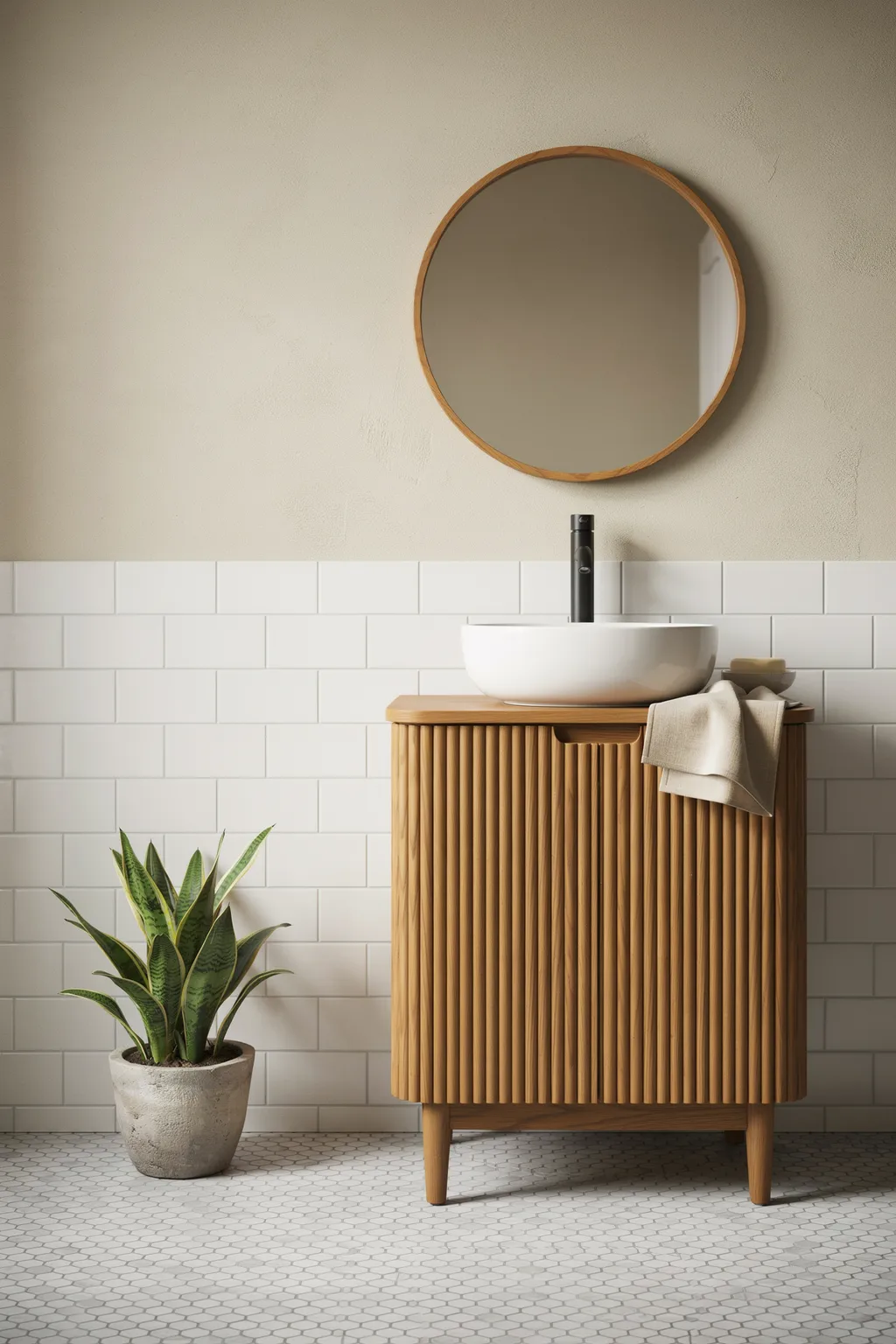
A freestanding fluted walnut vanity brings rich warmth that lighter woods cannot. Set it on legs against a white subway-tile wainscot, hang a round wood-framed mirror, and top it with a clean white vessel sink and a matte black tap. A snake plant in the corner adds an easy vertical accent. The dark wood against crisp white tile feels classic and grounded.
Deeper wood tones add contrast while staying natural. Walnut fluting reads warm and refined against plain white tile, giving the room a grounded, timeless base that suits older and newer homes alike. The legs keep it feeling like furniture, not a fitted box, which softens the whole space. A fluted walnut vanity runs 500 to 1,400 dollars.
Best for those who find pale oak too cool and want more depth. Skip very dark wood in a tiny, dim bathroom, since it can weigh the room down, and lighter timber keeps a small space airy.
21. Corner Two Floating Shelves With Speckle Wallpaper
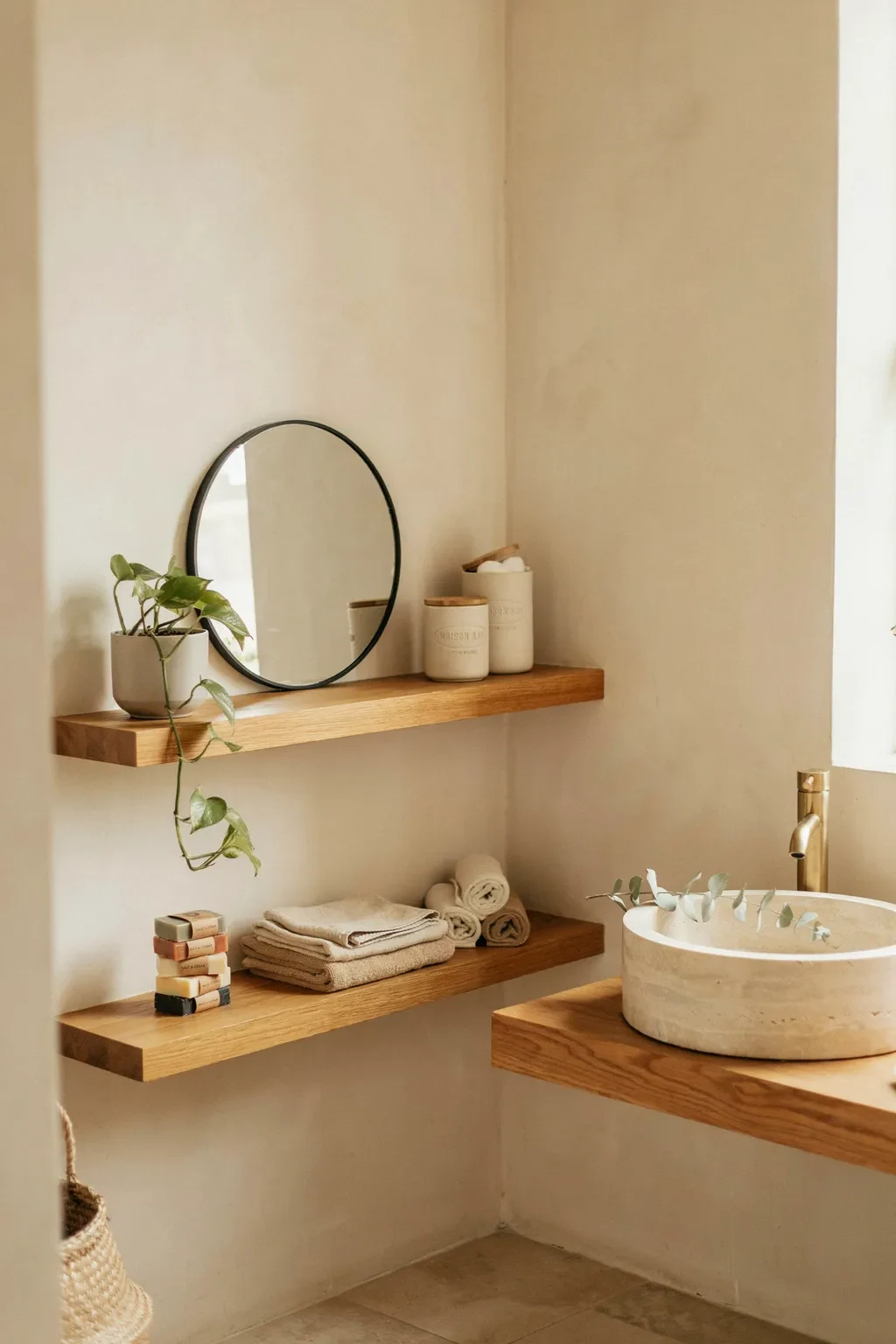
Turn an awkward corner into a feature with two stacked live-edge wood shelves and soft speckled wallpaper. Mount the shelves in the corner, set a round white vessel on the top one, and let the lower shelf hold folded towels and a bowl. A black-framed mirror and a dried palm in a pale vase finish a look that squeezes style from a tight spot.
Corner shelving is a clever space saver. Using the corner for the whole vanity frees the rest of the room, and stacking two live-edge shelves adds warmth and storage in a small footprint. Subtle speckled wallpaper brings gentle texture behind it all without loud pattern. Peel-and-stick speckle wallpaper runs 30 to 80 dollars, and live-edge shelves 80 to 200.
Great for tiny bathrooms, powder rooms, and renters, since much of it can be removable. Just anchor the shelves into studs or solid fixings, because a stone vessel is heavy and a weak wall mount will sag or pull out.
22. Fit a Compact Walk-In Shower With a Fluted Vanity
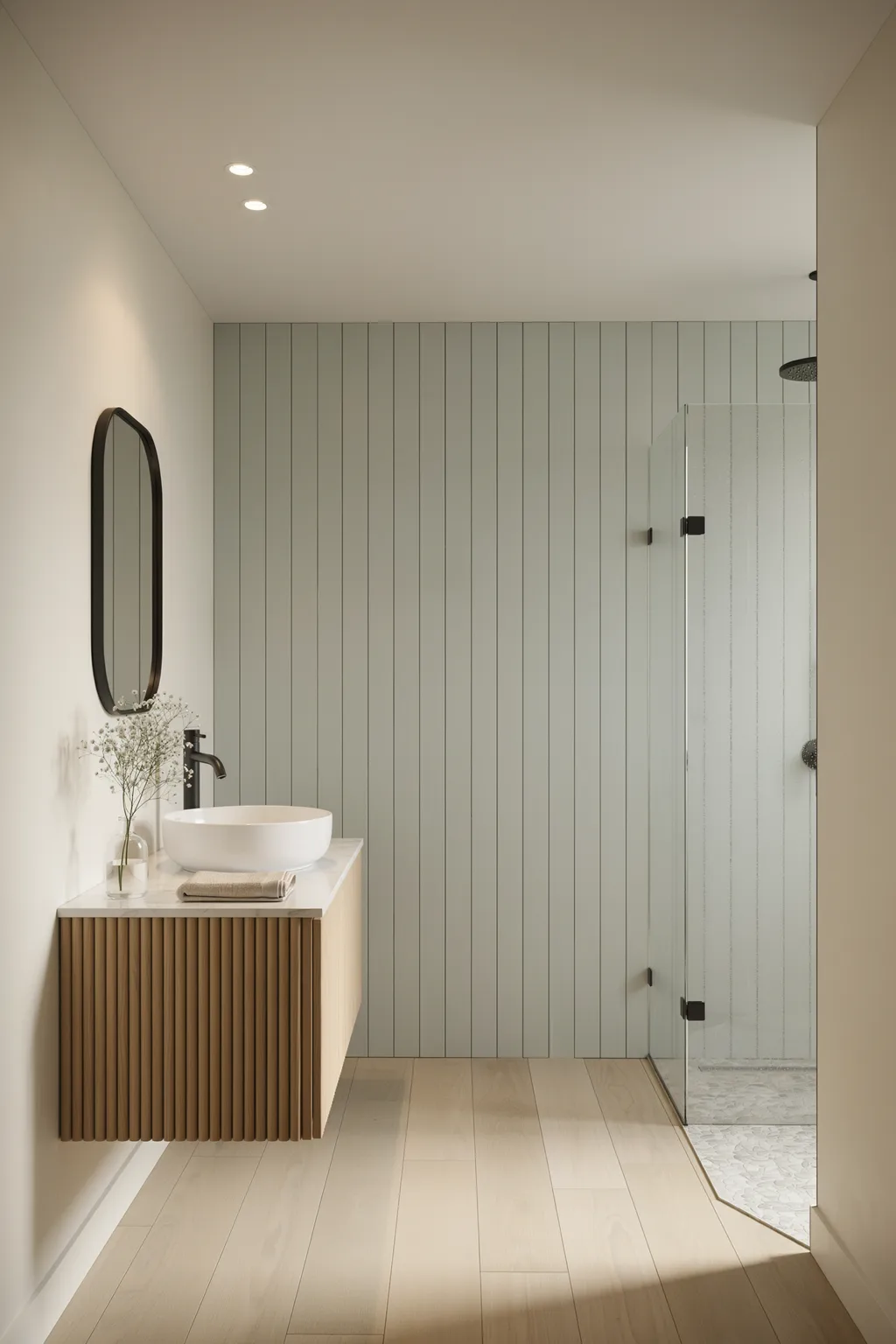
Small bathrooms still get the spa treatment with a frameless walk-in shower and a fluted wood vanity. Use a single glass panel and a black rain head against light vertical wood-panel walls, then pair it with a fluted vanity, a marble top, and a round white vessel. A black rounded mirror and recessed lights keep the compact room feeling calm and complete.
A walk-in shower makes a small room feel bigger. A single frameless glass panel keeps sight lines open so the whole floor reads as one space, and the black rain head adds a quiet focal point. The fluted vanity and marble top bring warmth and a touch of luxury without crowding. A walk-in glass panel runs 250 to 700 dollars installed.
Perfect for compact ensuites and city apartments that want a hotel feel. Skip a full shower enclosure here, since a boxed-in cubicle would chop up the room and make it feel smaller.
23. Style a Console Vanity With Blossom Branches
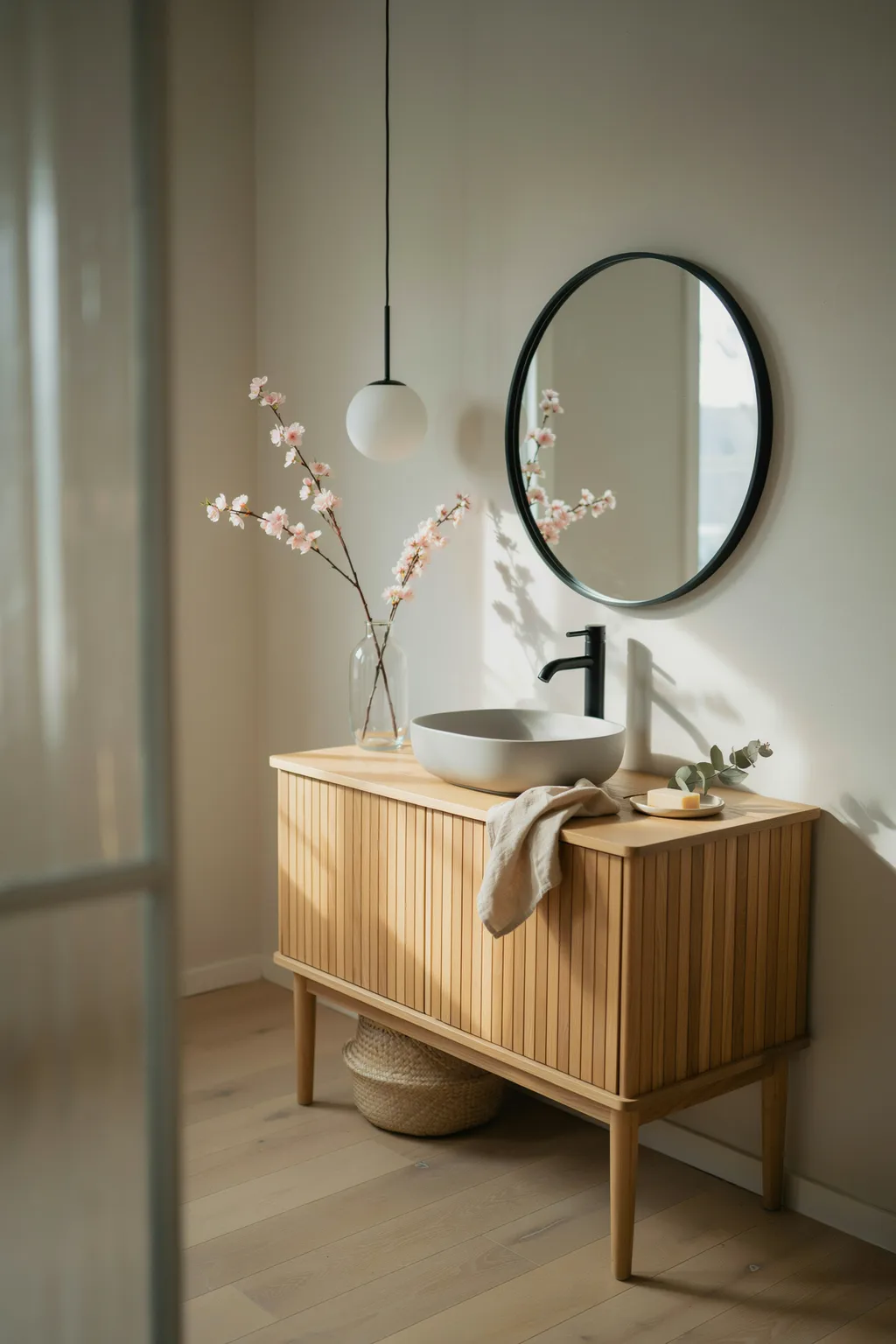
A mid-century console vanity with legs and a slatted side reads more like fine furniture than a bathroom fitting, and that is the point. Set it against a warm wall, hang a round black mirror and a globe pendant, and top it with a soft grey oval vessel. A few cherry blossom branches in a glass vase throw delicate shadows and bring a seasonal, poetic touch.
Treating the vanity as furniture keeps the room from feeling like a builder’s showroom. Legs and a slatted end let light pass under and around it, so the piece feels lighter and more crafted, and it echoes the warm mid-century strand of Japandi. Blossom branches add the natural, seasonal note the style loves. A console-style vanity runs 400 to 1,000 dollars.
Great for a powder room or bedroom ensuite where you want warmth and personality. Real blossom is fleeting, so use good faux stems if you want the look to last past a week.
24. Set a Backlit Mirror in a Slatted Zen Niche
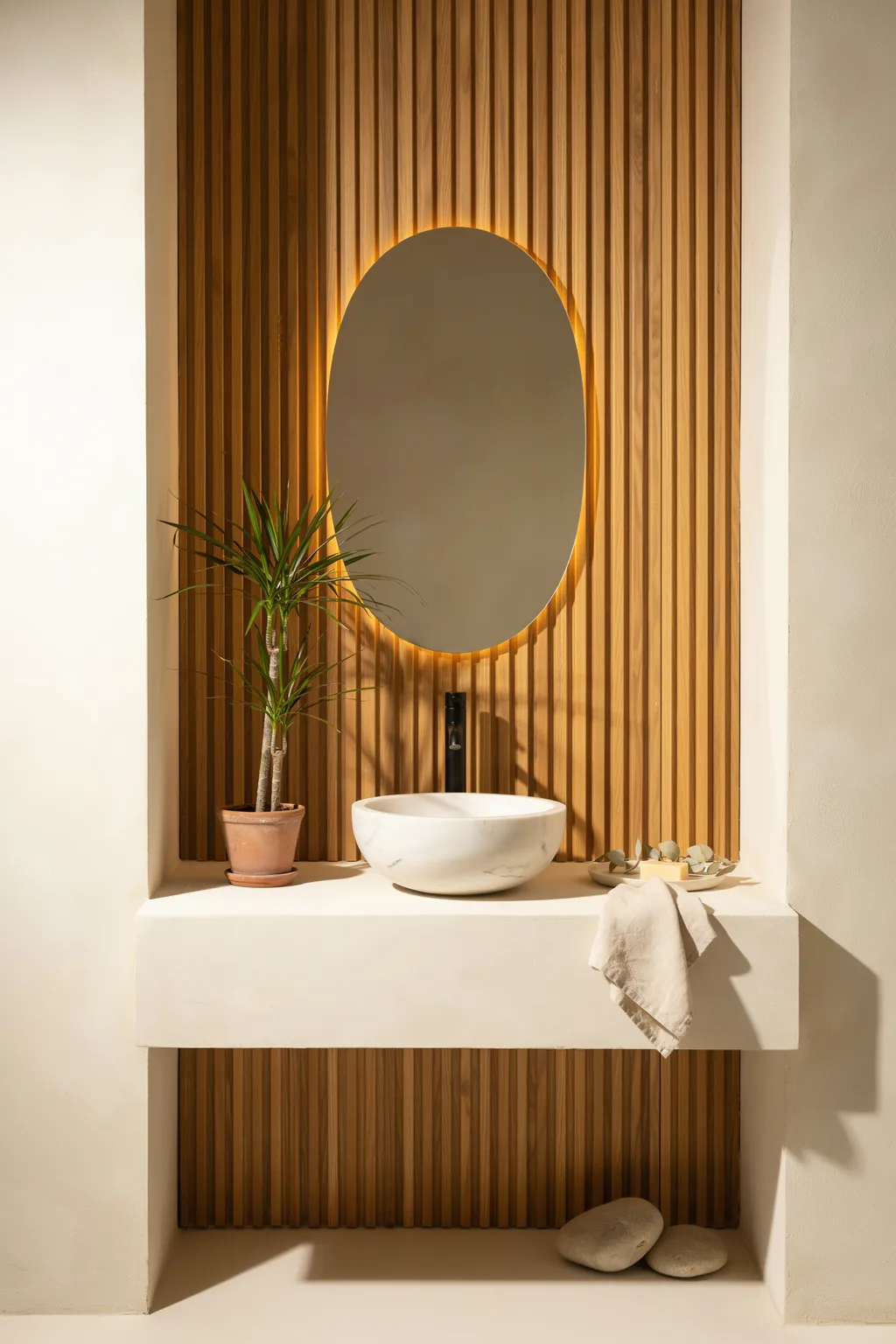
End on pure serenity with a backlit oval mirror recessed into a warm wood-slat alcove. Frame the mirror with vertical battens and a soft light glow behind it, top a plaster counter with a smooth white stone basin, and place a dracaena to one side. A couple of natural rocks below the floating counter turn the whole vanity into a small zen shrine.
A recessed, lit niche creates a focal point that feels sacred and calm. Backlighting the mirror inside a wood-slat frame draws the eye and softens the whole corner, while the plaster counter and stone basin keep it earthy. The rocks and single plant add the spare, intentional touch of a Japanese garden. A slat niche with LED backlight is a custom build, roughly 300 to 800 dollars.
Best as a statement vanity in a powder room or spa ensuite. Skip the floor-level rocks if the space is a busy walkway, since they look lovely but can be a trip hazard underfoot.
Common Mistakes to Avoid
Even a beautiful Japandi bathroom design can fall flat when a few basics get missed. Each of these is easy to fix once you spot it.
Mistake 1: Going all cold or all beige
Leaning too far into grey minimalism makes the room feel like a clinic, while all beige with no contrast feels flat. Balance cool and warm: pair light stone with warm wood and one dark accent. The whole style rests on that mix, and losing it is the most common way the look goes wrong.
Mistake 2: Skipping proper ventilation
Wood, plaster, and rice paper all suffer in a room full of trapped steam, and mold ruins the calm fast. Fit a good extractor fan sized to your room and run it after every shower. The U.S. EPA’s guidance on controlling bathroom moisture and mold is worth a read before you finish the space.
Mistake 3: Cluttering the surfaces
Rows of bottles and gadgets undo the serenity instantly. Japandi needs closed storage and clear counters, so hide daily products in a drawer and leave out only one or two beautiful objects. A cluttered vanity is the fastest way to lose the calm you paid for.
Mistake 4: Using cheap, cool-white lighting
Bright blue-white bulbs flatten wood tones and kill the warmth this style depends on. Choose warm bulbs around 2700K and layer in hidden or soft light. Harsh overhead light is a small, cheap mistake that quietly wrecks an otherwise lovely room.
Mistake 5: Buying fake-looking materials
Plastic “wood” panels and printed stone laminate read false and cheapen the whole look. Japandi celebrates real, honest materials, so spend where it shows, on the vanity, basin, and taps. One genuine wood or stone piece beats a room full of convincing fakes.
Mistake 6: Forcing too many styles together
Adding boho, industrial, or glam touches muddies the calm. Keep to the core palette of wood, stone, neutral textiles, and matte black. Mixing in loud extra styles is the surest way to lose the quiet cohesion that makes the room feel special.
Quick Start Checklist
- [ ] Build a material palette of wood, stone, and linen before buying anything
- [ ] Choose one warm wood element and one natural stone or ceramic basin
- [ ] Keep the color scheme to soft neutrals plus one matte black accent
- [ ] Pick closed storage so counters stay clear
- [ ] Add warm lighting around 2700K, hidden or diffused where you can
- [ ] Confirm a properly sized extractor fan and good ventilation
- [ ] Add a single plant suited to your light and humidity
- [ ] Seal any natural wood or stone in wet zones
- [ ] Limit surface décor to one or two beautiful, useful objects
- [ ] Measure vessel-sink and tap heights so the spout clears the rim
Frequently Asked Questions
What is Japandi style in a bathroom?
Japandi blends Japanese minimalism with Scandinavian warmth. In a bathroom that means natural materials like wood and stone, a soft neutral palette, clean lines, and only what you need on show. Good japandi bathroom design feels calm and spa-like, warm rather than stark, and leans on texture and craft instead of color or clutter.
What colors work best for a Japandi bathroom?
Stick to warm, muted neutrals: soft white, oatmeal, sand, warm greige, and pale wood tones. Ground them with one darker accent, usually matte black on taps and mirror frames, or a charcoal ceramic piece. Sage green and soft clay work as gentle secondary tones. Avoid bright, saturated colors, which break the calm.
What materials should I use for a Japandi bathroom?
Choose honest natural materials: light oak or walnut, natural or engineered stone, ceramic, concrete or microcement, linen, bamboo, and rattan. Matte black metal suits taps and frames. Real texture matters most, so pick genuine wood and stone where you can and avoid printed or plastic imitations that cheapen the look.
How do I get a Japandi bathroom on a budget?
Start small. Swap the tap for matte black, add a light wood vessel-sink shelf, hang a round or oval mirror, and switch to warm bulbs. A paper lantern, a jute mat, and one plant cost little and shift the whole mood. You do not need a full renovation to get most of the calm.
Do Japandi bathrooms work in small spaces?
Yes, and they often work best there. The style’s love of clear surfaces and only-what-you-need suits a small room perfectly. Use a floating vanity, a light palette, and a walk-in shower to keep the floor open. A tight bathroom is one of the easiest places to make japandi bathroom design shine.
How do I keep wood from getting damaged in a bathroom?
Use sealed or engineered wood in wet zones and keep raw timber away from direct spray. Seal natural wood counters and shelves once or twice a year, wipe up standing water, and run your fan to control humidity. Placed and sealed well, wood holds up fine and only grows warmer with age.
Conclusion
A calm bathroom is not about spending the most. It is about choosing honest materials, keeping the palette quiet, and clearing away what you do not need. Get those right and the room does the rest.
Start with the mix that defines the style: warm wood against cool stone, softened by neutral textiles and grounded with one matte black accent. Then keep the surfaces clear, since clutter is the enemy of calm and the cheapest thing to fix. Light it warm and low so the wood glows morning and night. Add a single plant and real ventilation so the space stays fresh and alive. And spend where it shows, on the basin, the vanity, and the taps, rather than on many small fakes.
You do not need all 24 of these Japandi bathroom design ideas or a full renovation to begin. Pick the one setup that fits your room, your light, and your budget, whether that is a paper lantern this weekend or a fluted vanity next month. The best japandi bathroom design is the one that makes you exhale the moment you walk in.
So pull your material samples together tonight, choose your first change, and start with the wood. That single decision does more than any other to turn a plain bathroom into the calm retreat you pictured.